


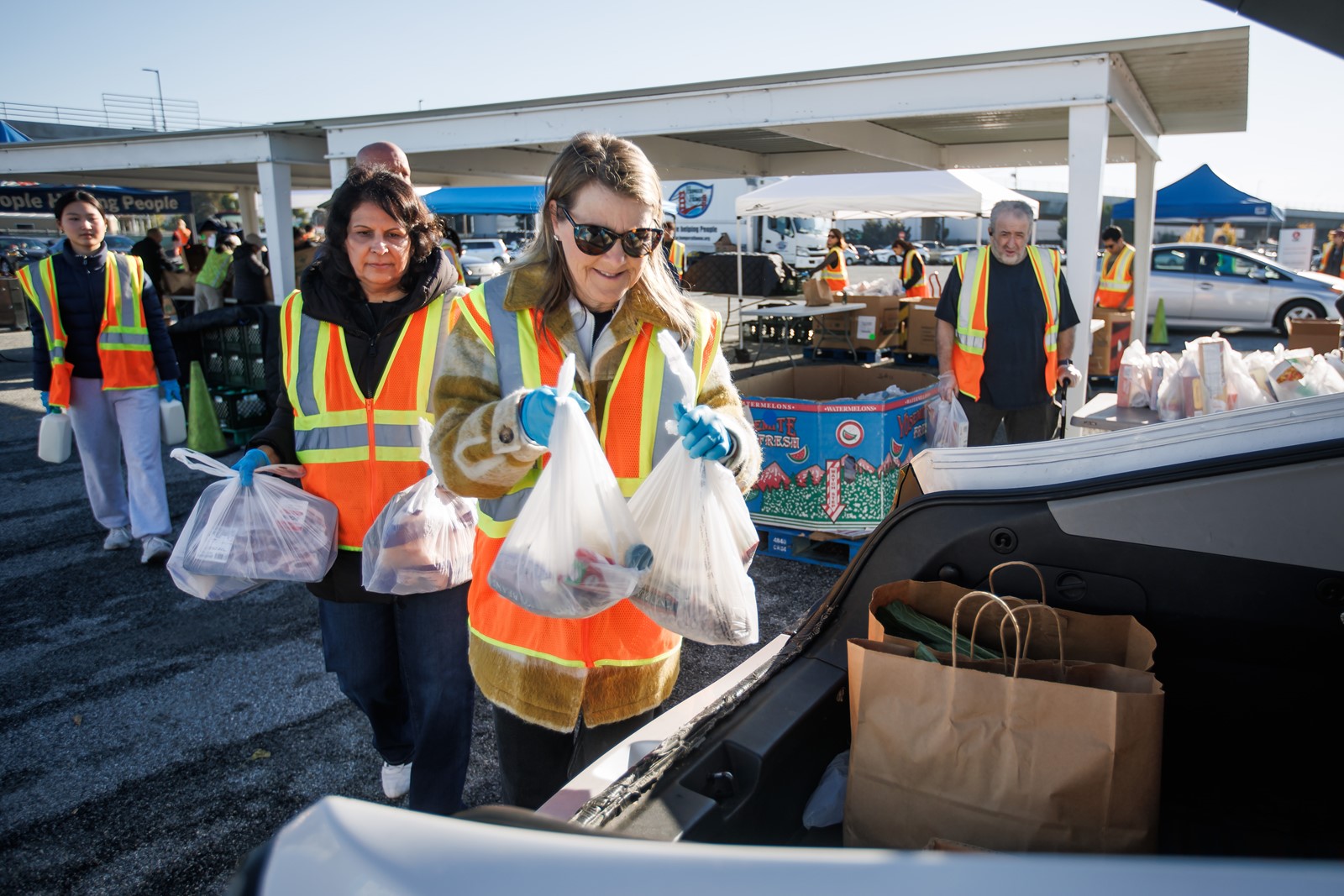
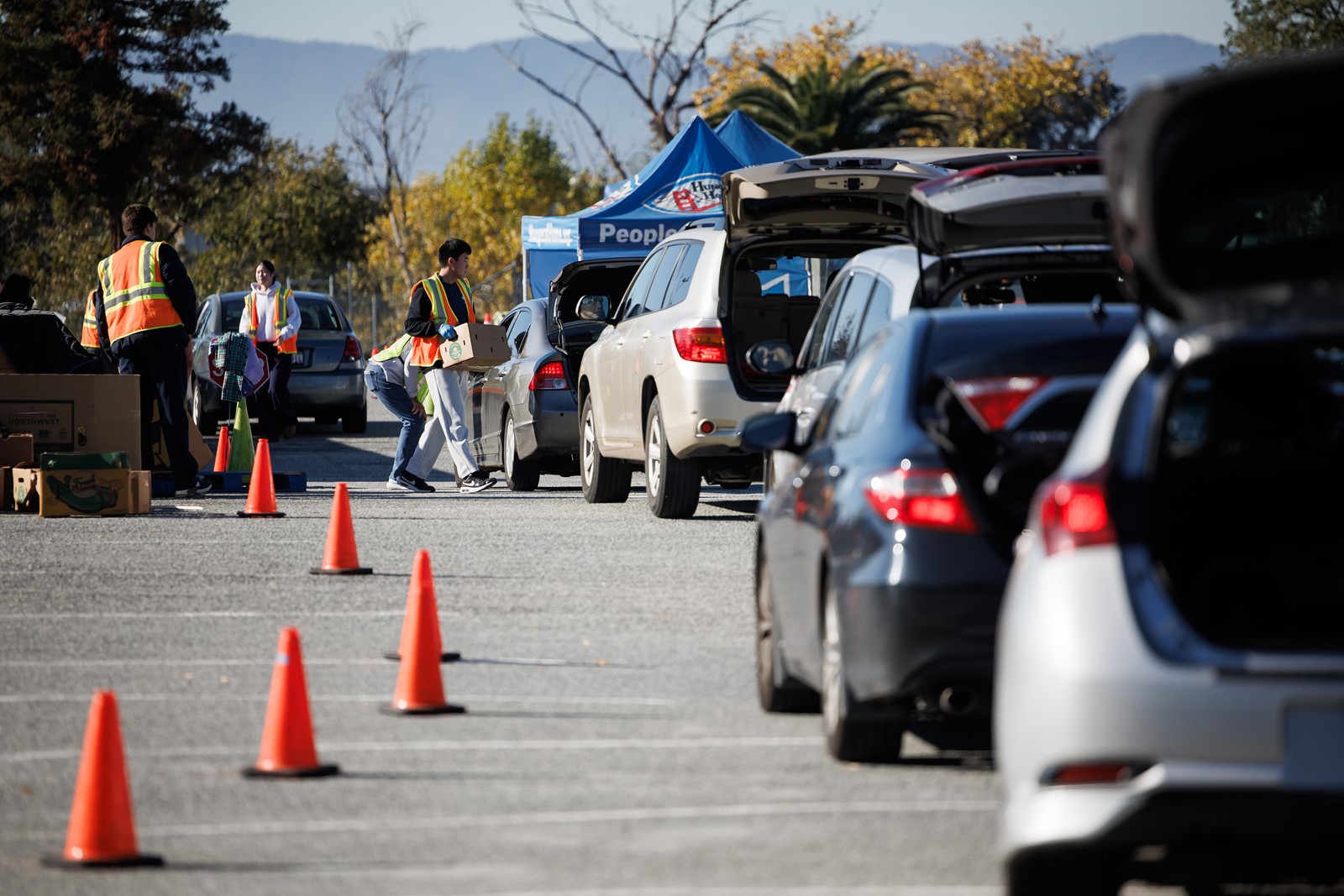
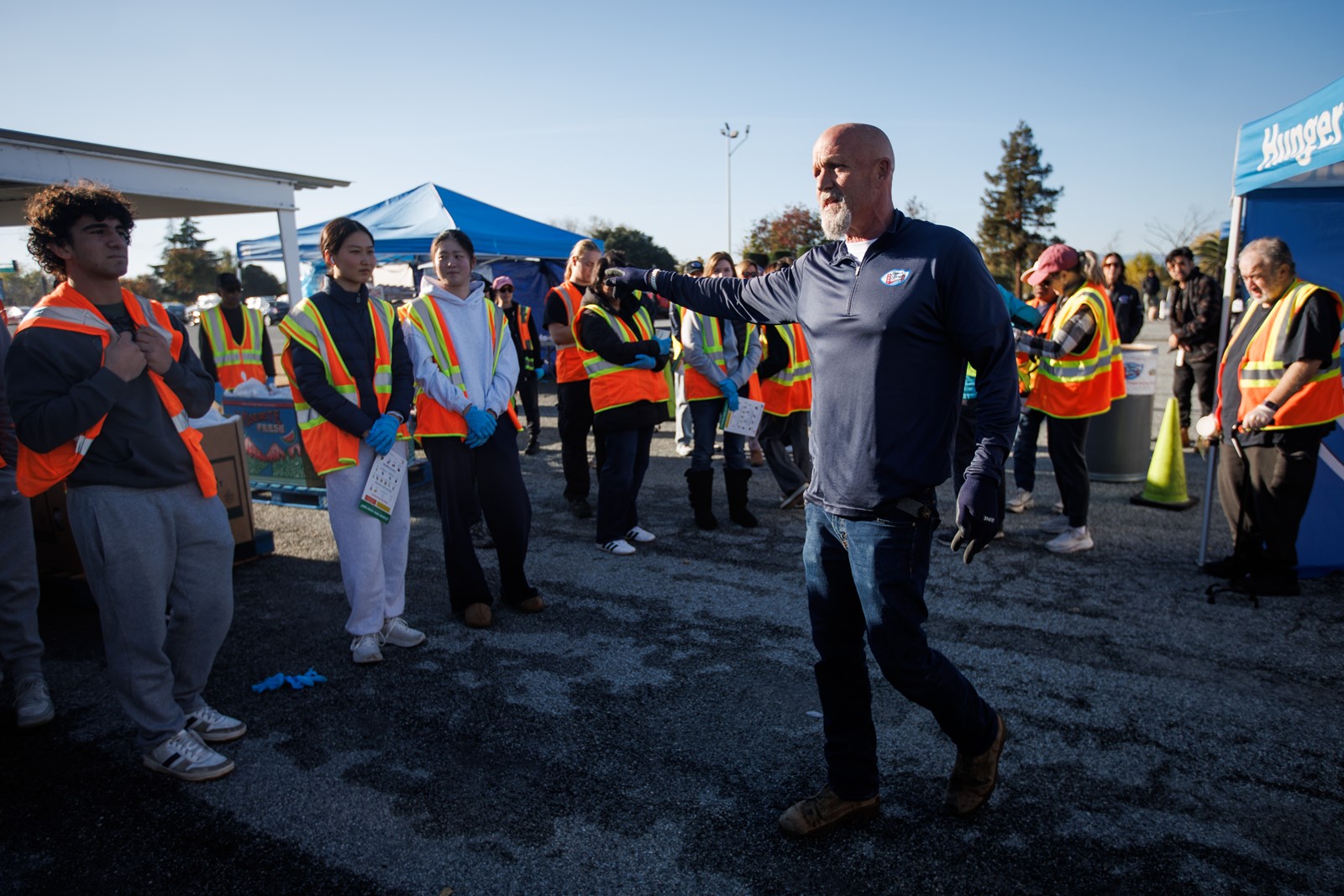


As federal government food assistance and funding shrink, lines have grown longer at Hunger at Home’s weekly food distribution in San Jose.
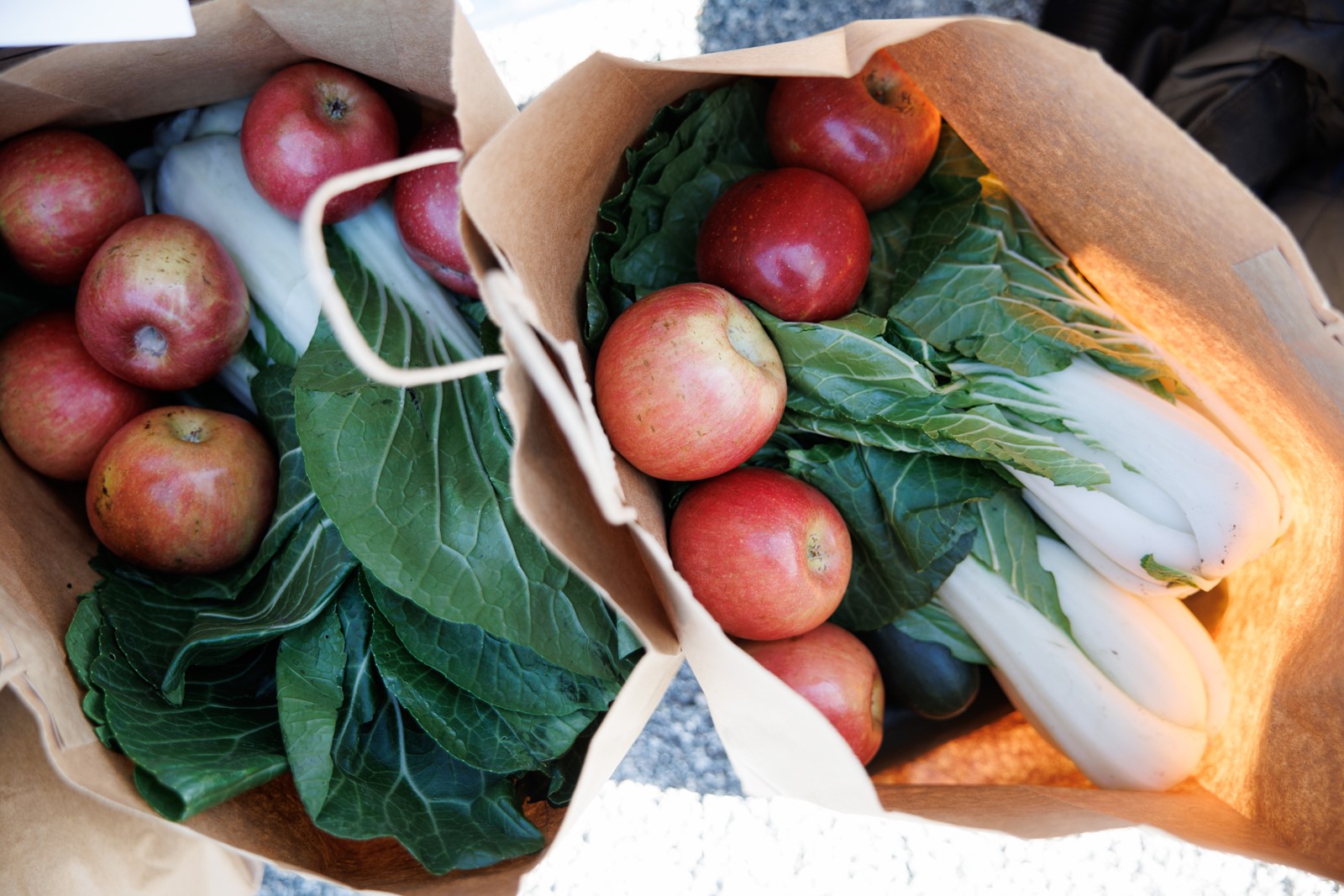
Every Monday, the group hands out groceries at the Berryessa Flea Market parking lot, but for the Thanksgiving holiday, the nonprofit makes it extra special. This year, it provided whole turkeys, $25 gift cards for groceries and roughly seven days of food to more than 440 vehicles alongside dozens of pedestrians, benefiting more than 1,800 local residents. It was among the biggest giveaways in the nonprofit’s history.
“During times of crisis, you tend to have more support from our civic leaders, from county, state, federal. Those funds have all but gone, and we’re busier now than we were a year ago,” CEO Ewell Sterner said. “We’ve increased our need by over 30%, yet the funding has all been depleted from the county, the state and federal.”
He said the increase in people coming out for help is largely caused by rising costs for food, gas and housing — compounded by recent public food assistance cuts affecting more than 55,000 local residents, many for the first time, the organization said in a news release.
Patricia Ribeiro was among those volunteering to hand out food Monday morning. As cars wrapped around the parking lot site, Ribeiro helped at the walk-in table, serving those without cars, many of whom are experiencing homelessness.
While chatting with this news organization, she simultaneously packed food bags, and then served two first-time walk-in clients in Spanish, who explained they didn’t have an address to list on the walk-in client forms. When they hesitated, worried they might be turned away, she told them to write down the nearest landmark or main road, assured them their information would be kept private and handed them groceries.
Ribeiro, a lifelong San Jose resident who used to work at Intel and a local school district, now volunteers weekly. She got teary-eyed when asked why she volunteers, explaining she knows firsthand the challenge of living in one of the most unaffordable cities in the country.
Unable to work while helping her daughter care for four grandchildren — including a grandson with autism who requires constant supervision — Ribeiro saw her finances strain after the children’s father stopped providing financial support for nearly a year. Covering gas and groceries for the household took up most of her budget, and her bills began falling behind. The family had never relied on welfare or food stamps, she said, leaving Ribeiro unsure where to turn until she searched online and called Hunger at Home.
Expecting there to be “a catch,” she was surprised when they simply told her, “Yeah, come on down.”
“I’m the type of person that if you’re gonna give to me, I’m gonna give back,” she said. “I don’t like to just stay in line and just take and go.”
Founded in 2015, Hunger at Home recovers surplus food from major grocers — including Safeway, Trader Joe’s and FoodMaxx — as well as restaurants, hotels, convention centers and sports stadiums. Rather than letting items that are still safe to eat go to waste once they can no longer be sold, the nonprofit distributes them at its weekly drive-thru on Mondays in San Jose, or through partnerships with other local organizations.
No refrigerator
For walk-in clients like Allen Read, Hunger at Home’s presence in the community is a lifesaver — though storing the food without a refrigerator remains a hurdle.
An artist and former teacher, Read lost his home in Brentwood and said that when he is not staying with a friend, he sleeps in a tent in a field, which he said is better than “under a rock.”
Read said he frequents the Berryessa Flea Market location, and while the groceries provide enough to sustain him — along with occasional bags of dog food — keeping fresh items from spoiling is a constant challenge for those living outside.
“Keeping it good for three or four days is a thing,” Read said, noting that without coolers, many unhoused residents end up throwing fresh produce away.
According to a 2025 survey by Second Harvest of Silicon Valley, food insecurity in Santa Clara and San Mateo counties is higher than the national average, with 1 in 6 residents turning to the food bank for support. More than 63% of respondents reported that at least one person in their household was employed, while 28% reported everyone was either retired or had a disability.
Costly area
In a region as unaffordable as Silicon Valley, financial struggle is not always obvious on the surface — what Los Gatos volunteer Michelle Abene described as a “very quiet, subtle need that you don’t hear about in your daily life.”
That is why whether someone pulls up in a “jalopy of a car” or a brand-new one, volunteers operate in good faith and don’t ask personal questions, she said.
“They tell us how large their families are, if they’re just getting food for one family, two families, three families, and we give them that amount that’s appropriate for them,” Abene said. “And there’s no questions asked.”
She pointed out that many drivers deliver those extra boxes to neighbors or relatives who cannot make the trip themselves. A board member with the Auxiliary Mothers Extended Network — a group of mothers of Bellarmine College Preparatory graduates in San Jose — she helped mobilize volunteers through newsletters and social media for the special Thanksgiving distribution.
‘enormous need’
In the South Bay, while there is “enormous wealth,” there is also “enormous need,” said Michael Miller, board treasurer and a volunteer who has been helping the organization for nearly nine years. Beyond giving out food, he makes a point to greet drivers and have a short conversation so they feel seen. For Miller, this is about providing a little dignity and recognizing that they are human beings, not just hungry people.
“Somehow we need to close the gap,” he said. “I think of all the issues that are out in our community, this is something that’s solvable.”
For details on how to help or receive assistance from Hunger at Home’s programs, go to hungerathome.org.
 PREVIOUS ARTICLE

