



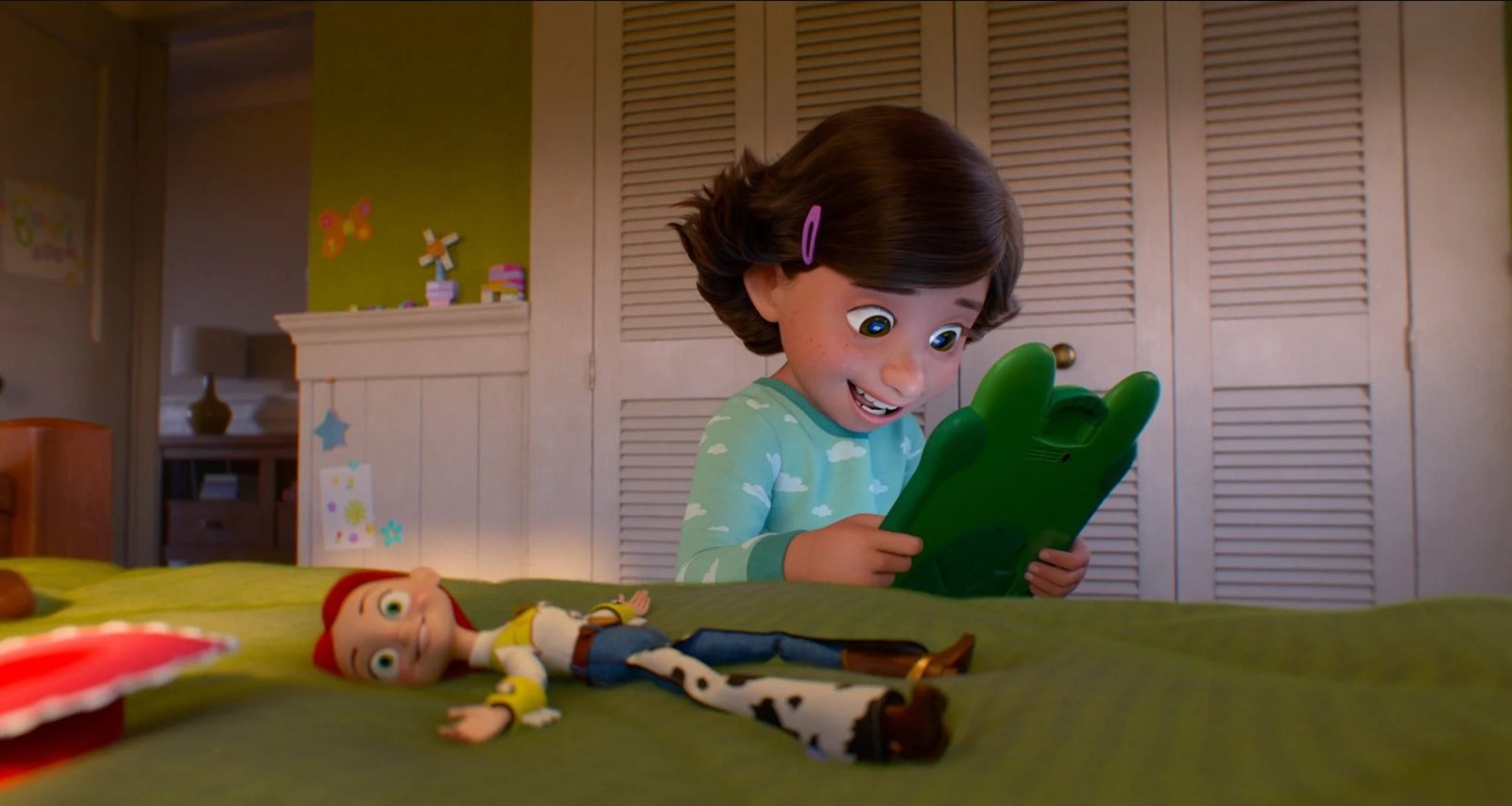


“Toy Story 5,” in which 8-year-old Bonnie becomes consumed with her cute, kid-friendly electronic tablet named Lilypad and her other heroic toys led by Jessie, Woody and Buzz take on a mission to intervene, provides a lesson for parents.
Dr. Doug Henry, a clinical psychologist and medical director for Enterprise Behavioral Health at Highmark Health, believes the movie is timely, relevant and helpful to parents and children, given the psycho-social issues associated with too much screen time for kids.
In the movie, which arrived in theaters about two weeks ago, Woody, Buzz Lightyear, Jessie and the rest of the gang’s jobs are challenged when they come face-to-face with Lilypad, a brand-new tablet device that arrives with her own disruptive ideas about what is best for their kid, Bonnie, according to Pixar Animation Studios.
Studies have found that children between 3 and 5 years old are seeing more than two hours a day on electronic devices, and the time increases with age, Henry said.
“For kids over 5, you’re seeing more than three hours a day, and then for teenagers, you’re getting up into really incredible numbers that are approaching 30 and 40 hours a week, which seems almost impossible. But, those are the numbers,” Henry said.
The resulting issues can be physical, emotional and/or psychological.
“What is being sacrificed and what is narrowing is often kids’ sleep time. So, teenagers are not getting the eight to 10 hours that they need, younger kids are not getting the nine to 12 hours that they need, and that also is contributing to a whole situation where a good number of kids are running on adrenaline as opposed to natural energy,” Henry said.
“That adrenaline has a tendency to make kids anxious, too. So, an anxious kid and a not-well-rested kid look very, very similar,” he said.
LESS SOCIALIZATION, HELICOPTER PARENTS
Another issue is the effects of reductions in in-person socialization, life experiences and opportunities for the use of imagination and creativity.
“What is happening to children more and more is that instead of being out having experiences and engaging the world, they’re having more time alone with screens. And therefore, they’re not acquiring skills that they need to navigate, whether it’s interpersonal relationships or it’s basic things like cutting the grass or cooking dinner or using an ATM machine, or any of these things that kids or adolescents will need to be able to do in the future,” Henry said.
An increase in “helicopter parenting” compounds the issue, he said.
“As parents, we’re hardwired to think that the highest value is to keep our kids safe. And so, we hover and we overprotect, when really the highest value is to prepare our children to navigate the world, including dealing with situations that are unsafe,” Henry said. “Those experiences are not occurring because of the combination of screen time and overprotective parenting.”
Often, parents believe that spending time watching TV, streaming videos or chatting on social media is safer for their children than facing the threats of gangs, drugs and alcohol or even kidnapping that exist in “the real world.”
But, increased screen time and overprotection also can negatively impact the mental health of children and young adults.
PEDIATRIC ANXIETY
“I’ve seen an incredible increase in anxiety disorders in our youth, and that really began accelerating in 2020 with the pandemic. The pandemic kind of laid bare a dynamic that was already occurring, but it became more pronounced,” Henry said. “Pediatric anxiety disorders are among the fastest growing diagnostic categories of any mental health challenge that we have in the United States.”
Henry said one can draw a direct comparison between the amount of time kids spend on social media to the likelihood that they will develop a clinical anxiety or depressive order that is more pronounced in girls, but that affects both genders dramatically.
“I think what drives anxiety, especially pediatric anxiety, is the feeling that the world is not a safe place, and that if children try to make it a better place, that they will fail and that they will be hurt doing so. That’s the kind of general zeitgeist that you see among kids, an existential kind of anxiety that really is characterized by their own helplessness and hopelessness,” Henry said.
“It’s the idea of ineffectiveness, that there’s nothing that you or I or any child could do that would change that negative state that we all exist in,” he said. “So, that, I think, is driving an increase in anxiety — the lack of independence.”
“To some extent, parents contribute to pediatric anxiety by helicopter parenting, really overprotecting children to the extent that the kids are not able to acquire some of the skills that they need to navigate daily life and will need later in their lives as they grow into teens and young adults,” Henry said.
A DOPAMINE FIX
Although social media companies are supposed to restrict accounts to children 13 and older, two-thirds of 11- and 12-year-olds in the U.S. say they have at least one social media account. And, tech company algorithms are designed to keep young eyes on screens as long as possible to increase ad revenue. Meanwhile, both children and adults get quick dopamine releases when scrolling through social media, Henry said.
He compared fast, constant releases of dopamine by the brain while scrolling through Tik-Tok or Instagram to watching an action/thriller movie with constant fight scenes, car chases and other action. The result is twofold.
“One is that your eyeballs stay on the screen because you’re being continuously reinforced, and these tech companies know how frequently kids must be reinforced in order to keep their eyes on the screen, and they tailor their products to that very precisely, as opposed to what I would call slow dopamine,” Henry said.
“Slow dopamine might be gotten through reading a book or watching a movie with others where the story is rich with character development in a really, really good story,” Henry said. So, there are healthy ways to incorporate screens.”
PROFESSIONAL ADVICE
Parents need to set realistic boundaries on screen time for their children and encourage more balanced routines, Henry said, while making sure their children don’t feel that they’re being treated unfairly or being punished.
“I like to treat kids with a lot of respect and not try to convince them or anything like that, but, just tell them the facts. Like, after an hour of social media use, your performance on an intelligence test is worse than your performance before consuming social media because your attention span gets assaulted a little bit each time,” Henry said.
Parents can find tasks for their children to perform that help increase their responsibility, independence and real-world experience — something as simple as walking into a fast food restaurant by themselves, picking up and paying for an order and bringing it back to the car.
They can also point to the obesity epidemic in America and reinforce the need for physical activity to remain healthy, he said.
“You can say, you just see that people do things that are not good for them on a very regular basis, and so, just because someone else is doing this doesn’t necessarily mean that it’s good for you,” Henry said.
“Just say that these things are not good for your brain, not healthy for your brain, and if you moderate your social media and your screen time, you’re going to be way ahead, you’re more likely to succeed because you’re going to be able to think and pay attention in ways that are deeper and longer than other kids,” Henry said.
 PREVIOUS ARTICLE
