


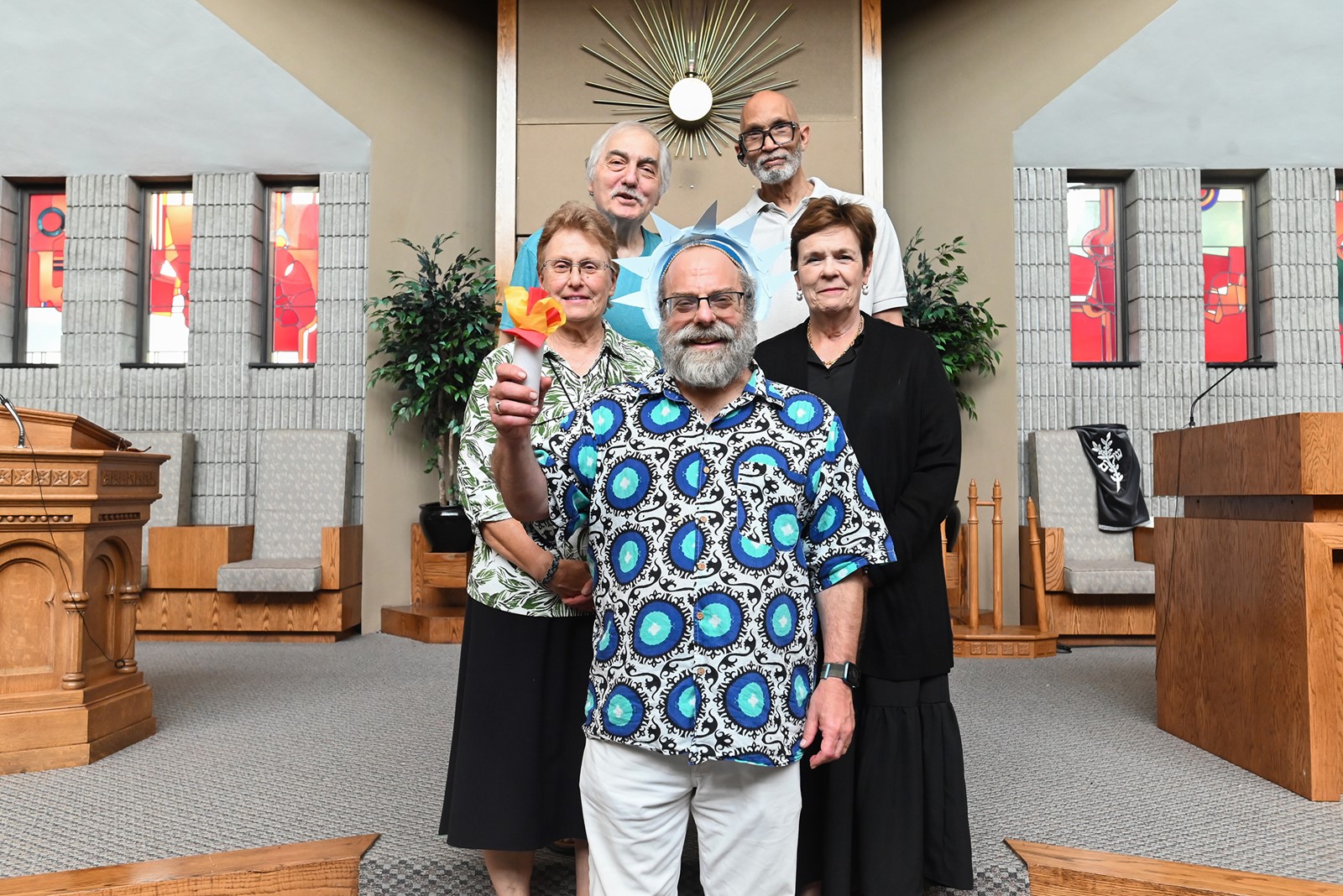


People and religious leaders in Northeast Pennsylvania of different backgrounds and traditions will come together to discuss some of the country’s monumental documents.
The first gathering of Faith 250 will take place July 13 at 7 p.m. at Temple Hesed in Scranton’s East Mountain section, with future gatherings planned for the summer and fall. It is part of a national initiative that encourages faith leaders and communities to come together to listen to each other and discuss shared civic values.
The discussions will focus on four texts: the Declaration of Independence; “The New Colossus,” a sonnet written by Emma Lazarus; “America the Beautiful,” written by Katharine Lee Bates; and Frederick Douglass’ 1852 speech, “What to the Slave is the Fourth of July?”
Rabbi Daniel Swartz, spiritual leader of Temple Hesed, was inspired to begin a Faith 250 dialogue locally after reading about a gathering in northern Virginia in The Washington Post in early May. He reached out to other faith groups and received an overwhelmingly positive response.
“There really was a sense of, ‘Oh, I was looking for something like this to happen around the 250th (anniversary of the signing of the Declaration of Independence), and here was the vehicle,’” Swartz said.
Congregations and religious organizations participating in the Faith 250 gatherings in Northeast Pennsylvania represent Christianity, Judaism, Islam and Buddhism. They include Bethel AME Church in Scranton, the Church of Jesus Christ of Latter-Day Saints Clarks Summit Stake, Covenant Presbyterian Church in Scranton, Elm Park United Methodist Church in Scranton, Islamic Center of Scranton, Jinyin Temple in East Stroudsburg, the Diocese of Scranton, Scranton Area Ministerium, the Sisters, Servants of the Immaculate Heart of Mary in Scranton, St. Luke’s Episcopal Church in Scranton, Temple Hesed, Bahá’ís of Scranton and United Baptist Church of Taylor.
Swartz said the different participants in the gatherings show how diverse the area is. Sister Donna Korba, I.H.M., director of the congregation’s Office of Justice, Peace, and Integrity of Creation, loves the opportunity for people of different backgrounds to come together.
“Scranton is a small enough city, it is filled with diversity and it’s just so healthy to try to come together,” she said.
Attendees will discuss “America the Beautiful” at the July 13 gathering, with food provided. Swartz said the other events will take place in August, September and October, where attendees will talk about “The New Colossus,” and excerpts from the Declaration of Independence and “What to the Slave is the Fourth of July?” The future events will take place in different locations, which he said not only allows participants to meet new people, but to be exposed to a different houses of worship.
“I figure part of the draw for some people at least is going to be, ‘Oh, I’ve never been inside a mosque or a Hindu temple or whatever,’ and here will be a chance to do it,” Swartz said.
Melinda Krokus, a board member for the Islamic Center of Scranton, said the program offers a safe place where participants can listen and share insights into, relationships with and experiences of foundational American texts.
“I hope that the participants will understand and love one another — and themselves — a little bit more than when they arrived,” she said. “I look forward to having the Muslim community participate in such a program and to actively and intentionally spend time with people of other faith traditions. I look forward to the friendships that will be made.”
Representatives from some of the participating congregations and organizations said they look forward to hearing different perspectives and faith traditions in talking about the values that define America.
“It’s important that we hear all those voices … because it shapes us and it makes us a better person,” said Lee Carr, Christian education director at Covenant Presbyterian Church and a member of the Scranton Area Ministerium.
Phil Yevics, corresponding secretary for the ministerium and cantor at St. John’s Byzantine Catholic Church in Scranton, said multifaith conversations like Faith 250 are a way to recognize there are many common values and perspectives that people of all faiths share.
“My experience has been that the more I learn about other religious traditions, the more committed I’ve become to my own faith tradition,” he said.
Mary Clare Hallman, the diocese’s secretary for parish life, said being a part of the planning for the gatherings has broadened her perspective. She and the Rev. Scott Sterowski, pastor of St. Carlo Acutis Parish in Olyphant, will attend the gathering on behalf of the diocese.
For Swartz, Faith 250 brings to mind a term in Judaism called “chevruta” — the idea of looking at something together with people that one disagrees with or who are different, which allows people to gain different perspectives. He hopes participants develop a deeper appreciation for the texts and what made the country what it is, and new relationships with people from different faith backgrounds.
“When you sit at a table with somebody and you’re studying something together and you’re sharing food, they cease to be a label and they become a person,” he said. “We’re not asking anybody to come away from here with their mind changed about anything, but hopefully with their minds open to each other.”
The gatherings are open to the public, but attendees are asked to register online, which Swartz said allows organizers to figure out the small groups. Registration can be done at https://www.zeffy.com/en-US/ticketing/faith250-america-the-beautiful.
 PREVIOUS ARTICLE
