


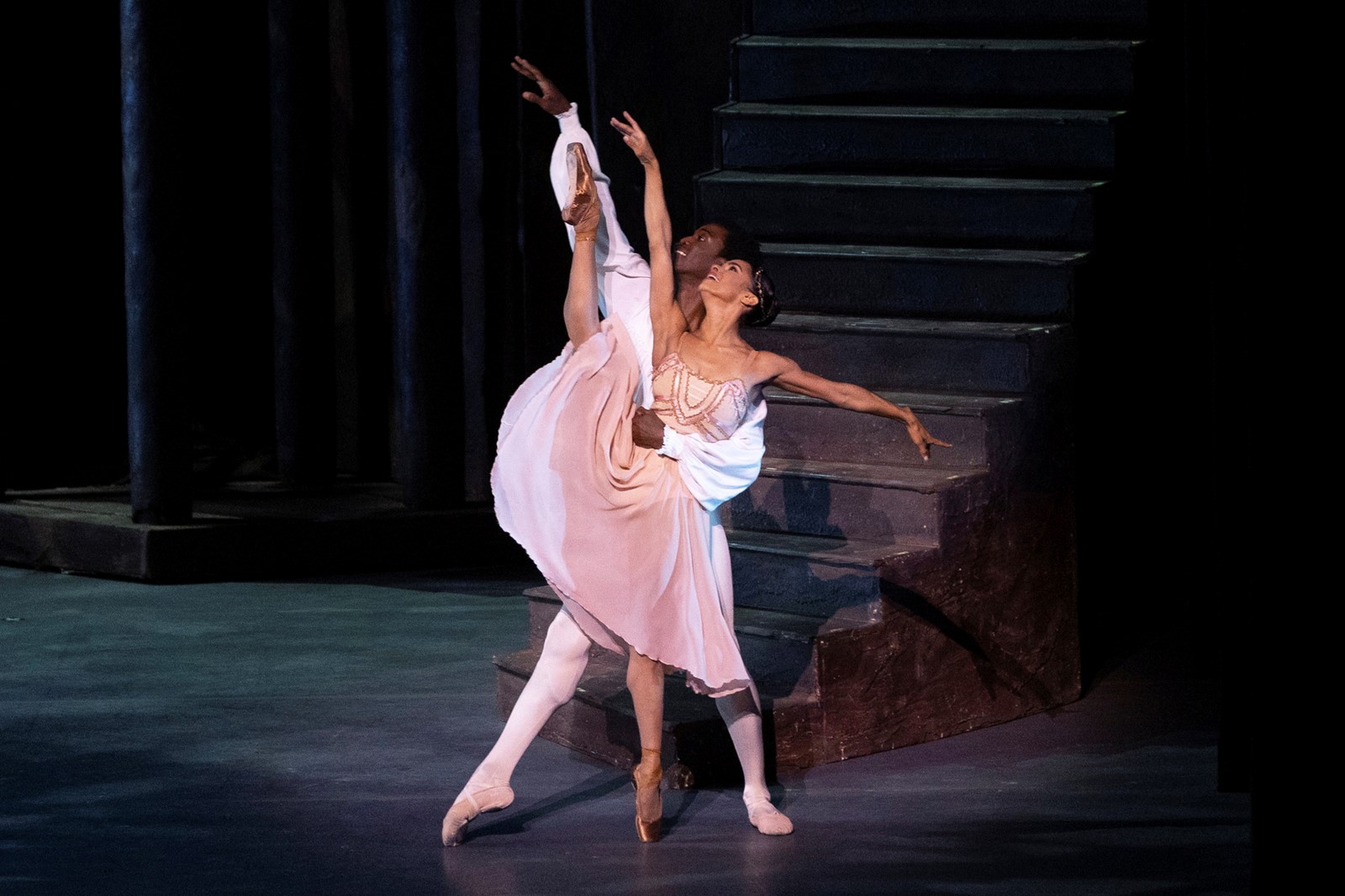


NEW YORK — Misty Copeland took one last spin on her pointe shoes Wednesday, showered with golden glitter and bouquets as she retired from American Ballet Theatre after a trailblazing career in which she became an ambassador for diversity in an overwhelmingly white art form.
Copeland, who a decade ago became the first Black female principal dancer in the company’s 75-year history, was feted at its star-studded fall gala at Manhattan’s Lincoln Center. Oprah Winfrey and Debbie Allen were among the featured speakers.
Winfrey spoke of the power of young people of color seeing Copeland lead iconic ballets like “Swan Lake.”
“Misty didn’t just perform ballet,” Winfrey said of the ballerina who has achieved a unique crossover fame. “She changed it. She redefined who belongs, who gets to be seen, and who gets to lead.”
In a way, the gala was both a return and a departure for Copeland, 43. She was dancing with the company for the first time in five years. During that time, Copeland has been raising a son, Jackson, with her husband. The 3-year-old came onstage to hug his mother during curtain calls, wearing a tuxedo.
Copeland has also been continuing her career as an author — the second volume of her “Bunheads” series appeared in September — and working to increase diversity in the dance world with her namesake foundation, including “Be Bold,” an afterschool program designed for young children of color.
But she decided to dust off the pointe shoes so she could have one last spin on the ABT stage — including as Juliet, one of the most passionate roles in ballet and her personal favorite. Copeland’s Romeo in the balcony pas de deux was Calvin Royal III, who in 2020 became ABT’s first Black male principal dancer in two decades.
The duo later reappeared for another duet, this time a modern one, in “Wrecka Stow,” by Kyle Abraham. For Copeland’s final performance of the night, she performed Twyla Tharp’s “Sinatra Suite” with another of her favorite partners, Herman Cornejo.
The night, which also celebrated ABT’s 85th anniversary and was curated in large part by Copeland herself, included speeches and film clips about her career. And her fellow dancers performed excerpts of ballets in her honor. At the end, a beaming Copeland was given a quintessential ballet farewell, as colleagues, teachers, friends and family came out to greet her, with hugs and bouquets, while confetti poured from the rafters.
Though Copeland has not closed the door on dancing altogether, it’s clear an era is ending.
“It’s been 25 years at ABT, and I think it’s time,” she told the Associated Press in an interview in June, when she announced her retirement. “It’s time for me to move to the next stage.”
She added: “You know, I’ve become the person that I am today, and have all the opportunities I have today, because of ballet, (and) because of American Ballet Theatre. I feel like this is me saying ‘thank you’ to the company. So it’s a farewell. (But) it won’t be the end of me dancing. … Never say never.”
On the carpet before her performance, she said: “I feel good. I feel ready to take this next step.” She noted that she would be continuing her work promoting diversity: “There’s so much work and effort that has to be continuous.”
Allen told reporters that Copeland had “helped to redefine the face of ballet. She’s inspired millions of people around the world and hopefully, American Ballet Theatre will not wait another 50 years before they have another beautiful Black principal dancer.”
The evening at Lincoln Center’s David H. Koch Theater was streamed to Alice Tully Hall across the plaza, with attendance free to the public — another sign of Copeland’s unique brand of fame in the dance world.
 PREVIOUS ARTICLE
