


Participants take to streets; advocacy groups decry move
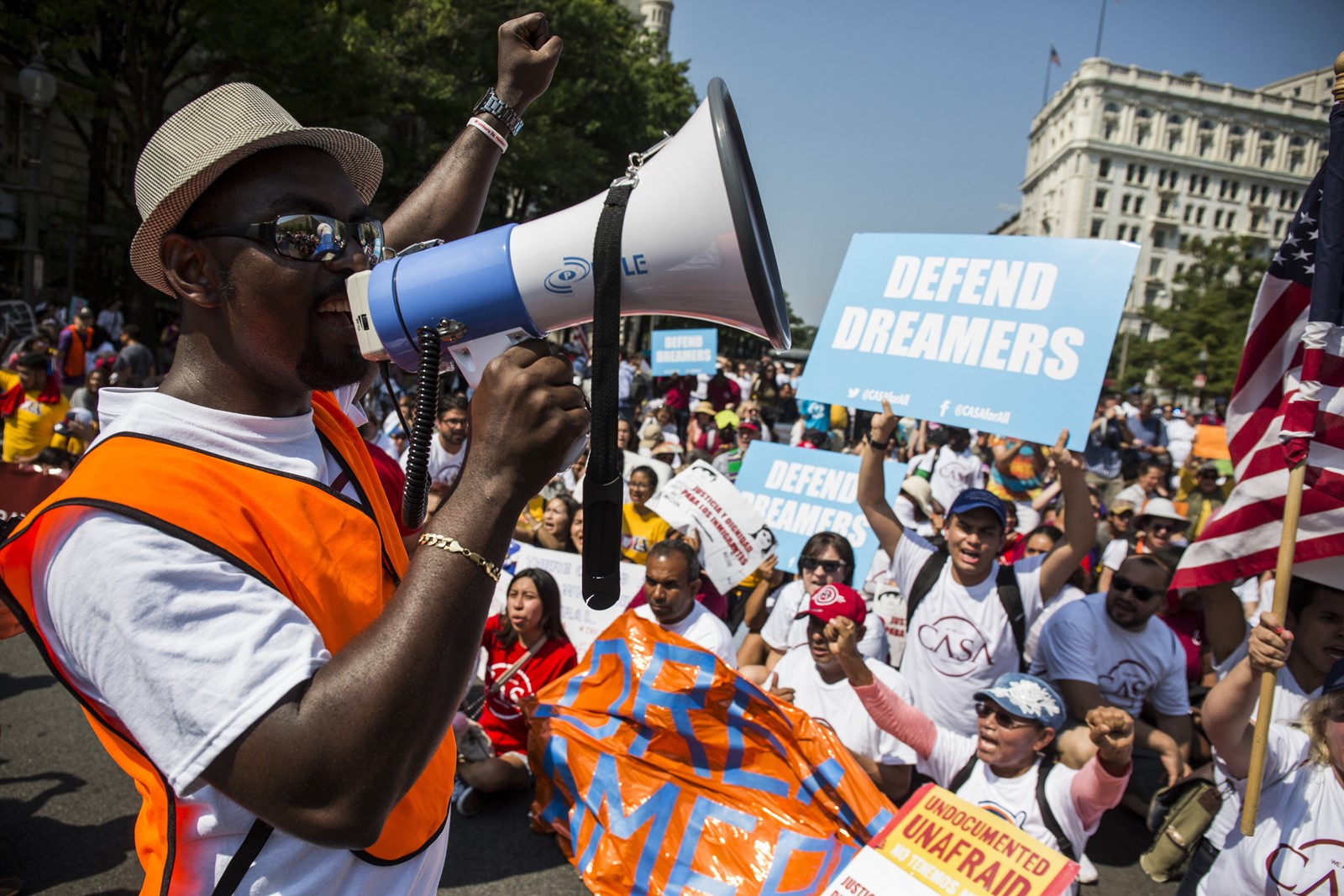


As protests began swiftly spreading across the country, advocacy groups decried the decision as cruel, capricious and illogical, saying it targets the very immigrants who are most likely to make significant contributions to the U.S. economy and society.
Trump’s backers say he is acting in accordance with the law, and that President Barack Obama overstepped his executive bounds when he created the Deferred Action for Childhood Arrivals program, or DACA, five years ago.
Attorney General Jeff Sessions, announcing the move, declared that the Obama-era policy had been “implemented unilaterally, to great controversy and legal concern.”
Obama has remained largely silent on his successor’s policies in the nearly eight months that Trump has been in office, but the administration’s decision drew an unusual online rebuke from the former president.
“Ultimately, this is about basic decency,” Obama wrote in a statement posted on social media. “This is about whether we are a people who kick hopeful young strivers out of America, or whether we treat them the way we’d want our own kids to be treated. It’s about who we are as a people — and who we want to be.”
From across the border, Mexico expressed “profound regret” over Trump’s move.
The announcement throws some 800,000 of the program’s beneficiaries into a dread-filled legal limbo. While their status will not be immediately affected, the Trump administration’s self-described “orderly wind-down” of the policy could eventually leave them vulnerable to either deportation or an undocumented netherworld.
“To have your future being played with, and tossed around like it’s a football — no!” said Jesus Perez, a 25-year-old research assistant at Johns Hopkins University in Baltimore, who joined a crowd of protesters near the White House.
Perez, who came to the U.S. with his parents from Mexico when he was 5, said he and other DACA participants were ready to “stand up and fight.”
Demonstrators also marched in cities including Denver, Phoenix and New York.
“We never had hopes of anything better from Trump, since he ran a campaign based on hatred of immigrants,‘’ said Gloria Mendoza, 26, an artist who went to Texas as a child from Mexico and now lives in Brooklyn.
Word of Trump’s decision was a heavy added blow to some who had already seen their lives blighted by disaster.
In hurricane-hammered east Houston, 27-year-old Dulce Puente, who moved from Mexico to Texas at 13 with her mother, was busy with repairs to the home she shares with her husband and two sons, ages 5 and 3.
The house was flooded with four feet of water after Hurricane Harvey hit Texas on Aug. 25.
“We lost everything,” said Puente, a DACA participant who most recently renewed her status in July. Now, she said, “We are wondering what’s going to happen. … I’m scared.”
Elsewhere, some already saw a dreamed-of future slipping away. Rainy Leonor, 23, who arrived from the Dominican Republic as a 6-year-old, worried that her hopes of transferring to a four-year college after graduating from Reading Area Community College in Reading, Pa., would be dashed.
“I worked really hard to get where I am,” said Leonor, who traveled to Washington to protest the decision. “It’s not fair that he just rips it all away.”
Major advocacy groups denounced the White House decision, which sets March 5 as the program’s end date unless Congress enacts a new version of it. Effective immediately, no new applications will be accepted, the White House said.
Richard Cohen, president of the Southern Poverty Law Center, called it “one of the most senseless, heartless, inhumane acts of any president in recent memory.”
 PREVIOUS ARTICLE

