




May’s night skies turn the skywatcher’s gaze away from the dazzling brilliance of the Milky Way and toward grand walls, chains, fields and groups of galaxies in the great beyond.
May marks the heart of galaxy season, when the Virgo-Coma region opens its deep-sky treasures to medium-sized telescopes under dark skies.
To find this region, start due south with Constellation Virgo, the maiden goddess of agriculture for at least 3,000 years. It reaches its highest position of the year on the north-south meridian — culminates — around 10 p.m. May 25. Look for Spica, Virgo’s magnitude 0.95 alpha star, about 38 degrees above the horizon.
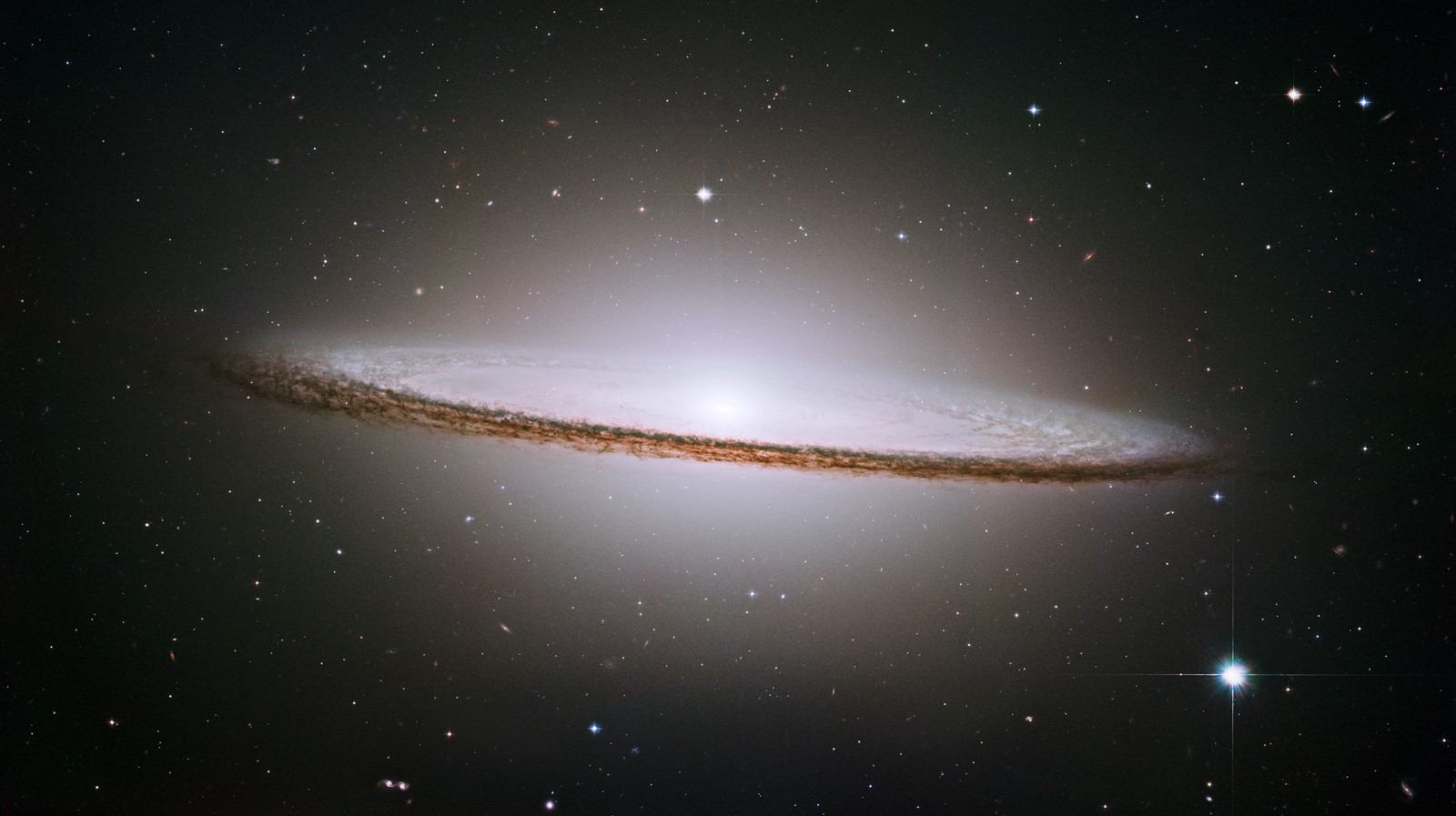
Find M104, the Sombrero Galaxy, low in Virgo near its border with Corvus, the crow.
From there, move north and slightly east into the heart of Virgo to find M49, one of the brightest galaxies in the Virgo Cluster. Continue northward toward M87, Virgo A, the giant elliptical galaxy famous for the first black hole image, and then slide west to M84 and M86, the bright gateway pair at the beginning of Markarian’s Chain. From there, follow the chain’s gentle curve through the Virgo Cluster, picking up M88, M90, and nearby M58, M59, M60 and M61 as conditions allow.
Scan the surrounding spring constellations around Spica. Alpha star Diadem in Coma Berenices, Berenice’s Hair, is about 29 degrees — roughly three outstretched fists at arm’s length — directly above Spica.
Below and west of Spica lies Corvus; its alpha star, Alchiba, is about 23 degrees from Spica. Farther west is Crater, the cup, whose modest alpha star, Alkes, sits about 35 degrees west of Spica and slightly lower in the sky.
Taken together, Diadem, Spica, Alchiba, and Alkes form a loose, lopsided quadrilateral across the spring sky — a useful doorway into the Virgo-Coma region, known to many amateur observers as the Realm of Galaxies.
The Virgo Cluster is a massive, gravitationally bound concentration of more than a thousand galaxies about 54 million light-years away, forming the nearest major galaxy cluster to the Milky Way and the dense core of the larger Virgo Supercluster.
In amateur telescopes, however, even these enormous systems usually appear as faint, unresolved smudges.
Galaxies are the first victims of the moon’s glare and artificial light pollution. May opens with a full moon May 1 and closes with a second full moon May 31, making the moon-dark middle of the month the best time to search for galaxies. The best observing window centers around the new moon May 16, roughly from May 9 to 23. Even then, you need to be far enough from urban light pollution to observe these faint galactic clusters with any degree of satisfaction. That makes location as important as equipment.
Fortunately, there are several dark-sky places within driving distance of Longmont and Boulder. Jackson Lake State Park, a certified International Dark Sky Park, is about 90 minutes east and is the best overall certified option for many Front Range skywatchers. Also-certified Florissant Fossil Beds National Monument is a bit more of a haul, so it’s best to treat it as an overnight destination. Closer parks such as Golden Gate Canyon and Staunton are good options for darker skies, although they are not yet certified dark-sky parks.
Keep an eye on the weather, dress appropriately and prepare for emergencies.
May days can be warm, but its nights can be cold and unforgiving, especially when standing at a telescope. Bring layers, sturdy shoes, water, a red flashlight and one warm item more than you think you will need.
For all their millions of stars, galaxies are diffuse and offer low surface brightness. Because of that, aperture size makes a major difference. A 4-inch telescope can reveal the brightest objects, such as the Sombrero Galaxy and the brighter Virgo ellipticals, but most will appear as small, pale patches.
A 6-inch scope is a solid minimum, but an 8-inch telescope is a much better tool for this realm. An 8-incher gathers nearly 80 percent more light than a 6-inch scope, a major advantage when hunting the faint glow of distant galaxies. A 10-inch telescope gathers more, but it also is significantly bulkier and more expensive for only about a 56 percent gain in light-gathering power over an 8-inch.
Regardless of aperture, use low to medium magnification. Let your eyes adapt for at least 20 minutes, and look slightly to the side of each target rather than directly at it, a technique called averted vision. A GoTo system or app-assisted mount can help enormously in this crowded, subtle region. You won’t be seeing Hubble-grade images, but part of the reward is the knowledge that what you’re seeing is the light of billions of stars shining tens of millions of light-years away.
The moon is full 11:23 a.m. May 1, the Flower Moon (Algonquin and Ojibwe), and again 2:45 a.m. May 31, a so-called Blue Moon.
 PREVIOUS ARTICLE
