


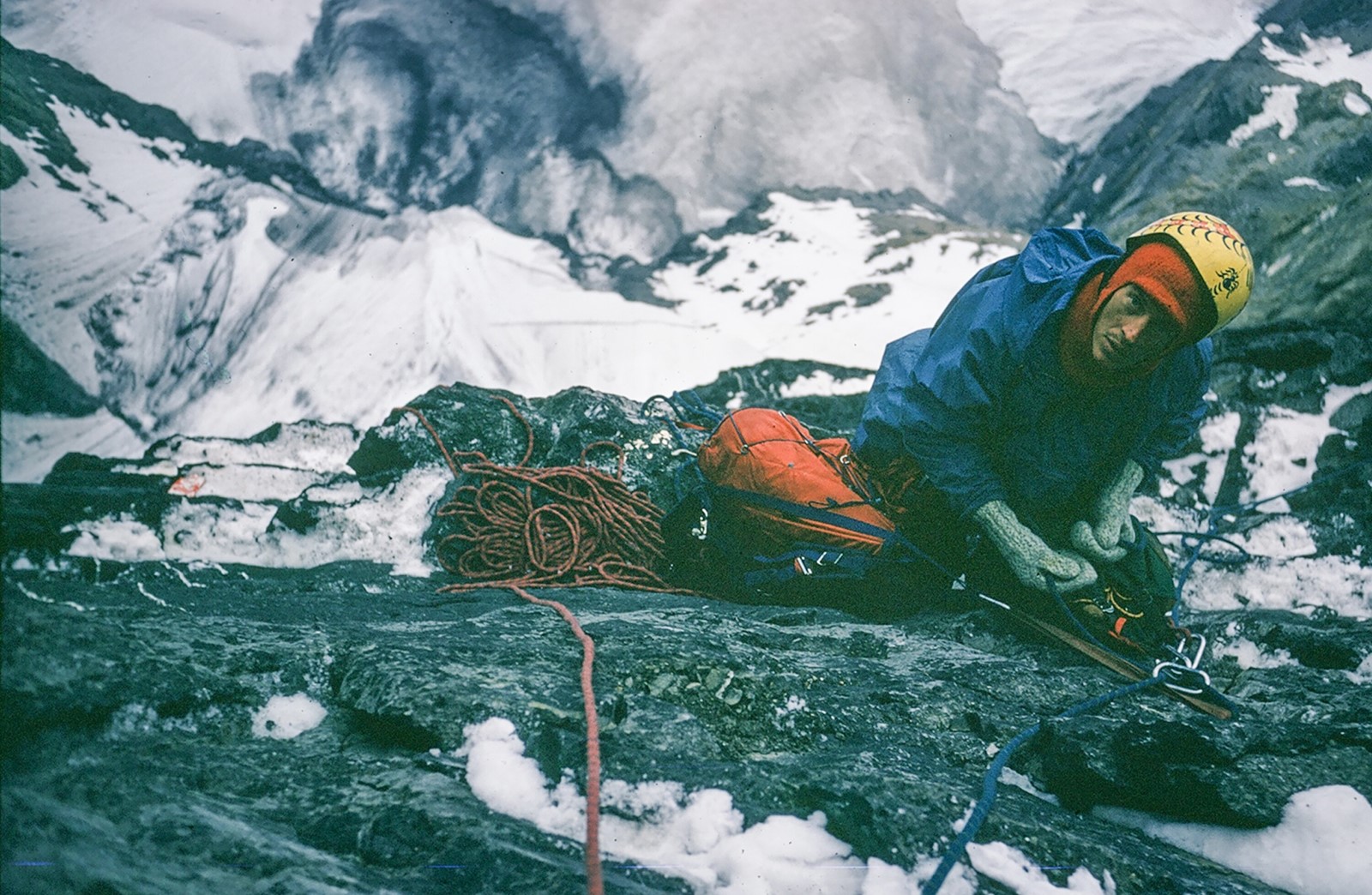


“It is, hands down, the hardest face in the Canadian Rockies,” wrote esteemed alpinist Barry Blanchard in the 2002 American Alpine Journal. “Five thousand feet of sheer, black, and north-facing limestone, steeper than the Eiger, one and a half times as high as El Cap, a great dark cape of a peak.”
He was referring to North Twin, whose foreboding face was first climbed by George Lowe and Chris Jones in 1974. Not only was this — by far — the most difficult climb in Canada, it was, as Blanchard suggests, “the hardest alpine route in the world.”
The two men faced atrocious weather 4,000 feet up the vertical wall of shattered rock, snow and ice. Retreat was impossible; the route above looked no better. To survive, they had to keep climbing. Jones, immobilized by fear, belayed Lowe as he probed different options upward, leading this way and that — taking a 30-foot fall in the process — until he eventually found a way through.
George H. Lowe III is known for tackling first ascents labeled “bold” and “most difficult” — routes like the Infinite Spur on Mount Foraker in Alaska, the immense Kangshung Face of Mount Everest (later dubbed the “Lowe Buttress” after he led the crux) and the near-perfect line Lowe calls his “best climb”: the north ridge of Latok I in 1978. After more than 100 pitches of complicated alpine terrain, Lowe and his three partners retreated just 500 feet short of the summit due to illness and storm.
While Lowe’s pioneering ascents have become legend, his commitment to the environment — and to climbing’s future — is equally worth celebrating.
This year he earned the prestigious Lifetime Achievement Award from the Access Fund, America’s organization dedicated to keeping climbing areas open. The award honors someone whose long-term contributions have proven crucial to the organization’s success.
In 1989 Lowe became the Access Fund’s first recorded donor, and with 33 active years, he remains its longest-standing member. “Back then there was a lot of concern that climbing areas were getting shut down by landowners,” Lowe told me during a Zoom call. “I wanted to preserve the environment, as well as our right to climb.”
Raised in Ogden, Utah, Lowe began climbing in college in 1962. Just three years later he and Mark McQuarrie made the first ascent of The Dorsal Fin (5.10d, four pitches), a nearly featureless granite slab outside of Salt Lake City that ranked among the hardest free climbs in North America.
Notably, this was long before sticky rubber climbing shoes — instead, they wore tightly-laced hiking boots on this committing route.
“The boldness of the first ascent cannot be overplayed,” wrote Stuart and Bret Ruckman in their Wasatch Range climbing guidebook. “It marks a milestone in Utah’s climbing history.”
In 1973 — one year before the North Twin epic — Lowe earned his Ph.D. in physics from the University of Utah. He later became a highly respected systems engineer, working on classified intelligence projects for the U.S. government — a career he says means as much to him as his climbing. “My strength was being able to look at the big picture and think about all the things you have to take into account in order to solve a problem,” he said. “In that sense, systems engineering is very similar to solving problems while climbing in the mountains.”
I asked Lowe, a father of four, to recall a favorite memory from his climbing life.
Without hesitation he reminisced about the time he climbed the Grand Teton with both his son and his father in 1980 — and how, years later, he returned to the summit with his youngest daughter.
Now 81, Lowe has physical limitations that keep him from the high mountains, yet he seems unbothered. “I can still have fun rock climbing in Eldorado,” he says, grinning. A longtime Golden resident, he moved to Boulder 10 months ago.
“You know, it doesn’t matter how hard you climb. The problem-solving, even if you’re climbing at a much lower level, like I am now, is just as fun. And I still love being outside with a good friend, climbing.”
Contact Chris Weidner at cweidner8@gmail.com. Follow him on Instagram @christopherweidner and X @cweidner8.
 PREVIOUS ARTICLE
