


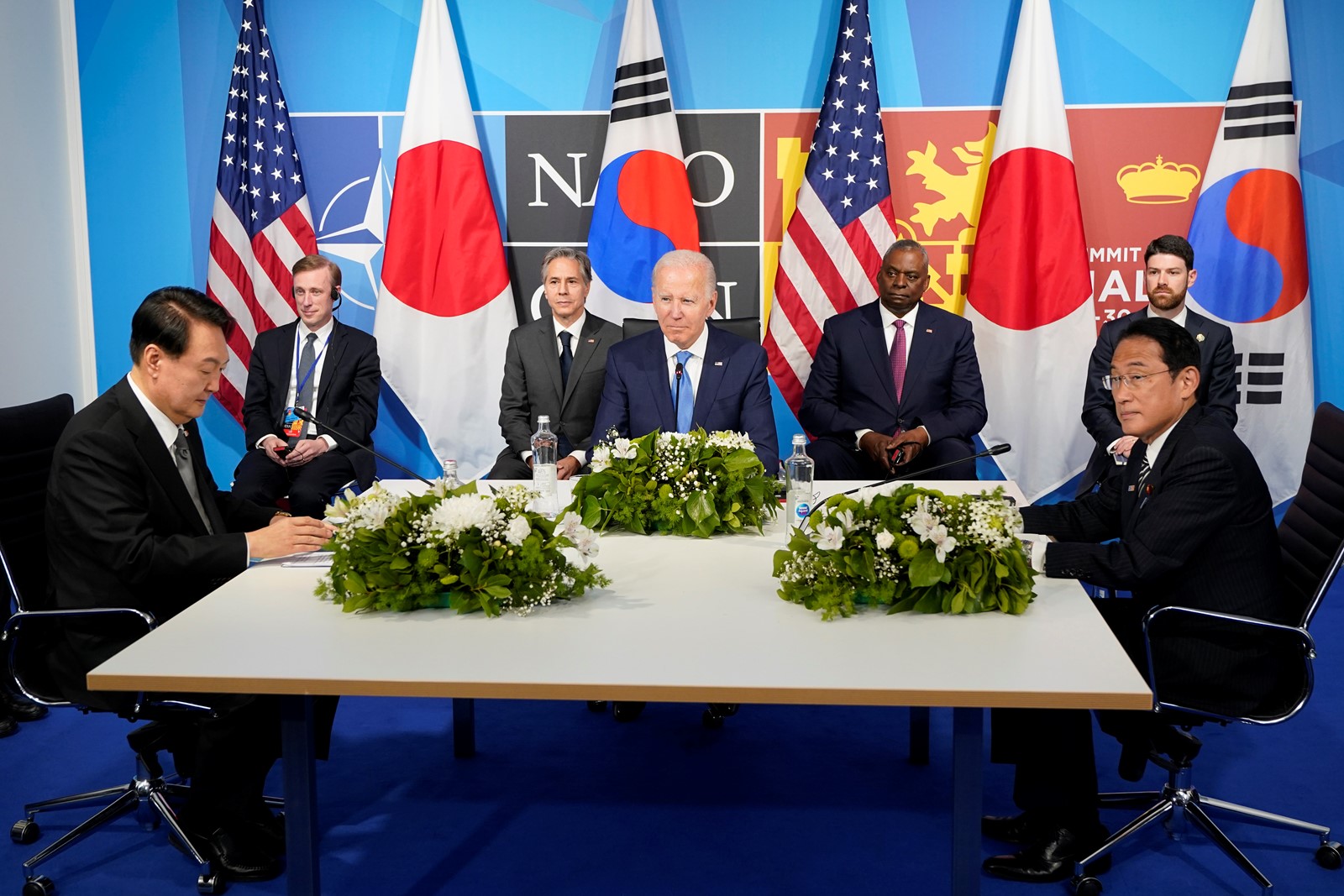


WASHINGTON >> President Joe Biden aims to further tighten security and economic ties between Japan and South Korea, two nations that have struggled to stay on speaking terms, as he welcomes their leaders to the rustic Camp David presidential retreat Friday.
Historically frosty relations between South Korea and Japan have rapidly thawed over the last year as they share concerns about China’s assertiveness in the Pacific and North Korea’s persistent nuclear threats. Biden is now looking to use the summit in Maryland’s Catoctin Mountains to urge South Korean President Yoon Suk Yeol and Japanese Prime Minister Fumio Kishida to turn the page on their countries’ difficult shared history.
The Japan-South Korea relationship is a delicate one because of differing views of World War II history and Japan’s colonial rule over the Korean Peninsula. Past efforts to tighten security cooperation between Seoul and Tokyo have progressed with fits and starts.
But the White House hopes the current rapprochement offers an opportunity for a historic shift in the relationship.
“What we have seen over the course of last couple of months is a breathtaking kind of diplomacy that has been led by courageous leaders in both Japan and South Korea,” Kurt Campbell, Biden’s top Indo-Pacific adviser, said at an event at the Brookings Institution in Washington on Wednesday. “They have sometimes, against the advice of their own counselors and staff, taken steps that elevate the Japan- South Korean relationship into a new plane.”
Biden administration officials say the leaders will announce in their summit communique a series of joint efforts that aim to institutionalize cooperation among the three countries as they face an increasingly complicated Pacific.
The expected major announcements include plans to expand military cooperation on ballistic defenses and make the summit an annual event. The leaders are also expected to detail in the communique plans to invest in technology for a three-way crisis hotline and offer an update on the progress the countries have made in sharing early-warning data on missile launches.
In picking Camp David, where presidents over 80 years have hosted historic peace summits and intimate leader-to-leader talks, Biden is looking to demonstrate the importance of relations with South Korea and Japan.
His administration says it remains determined to place greater foreign policy focus on the Pacific even as the U.S. grapples with the fallout of the Russian invasion of Ukraine. Earlier this year, Biden honored Yoon with a state visit and picked Kishida’s predecessor, Prime Minister Yoshihide Suga, for the first face-to-face visit of his presidency.
The retreat was where President Jimmy Carter brought together Egyptian President Anwar Sadat and Israeli Prime Minister Menachem Begin in September 1978 for talks that established a framework for a historic peace treaty between Israel and Egypt in March 1979. In the midst of World War II, President Franklin Roosevelt and British Prime Minister Winston Churchill met at the retreat — then known as Shangri-La — to plan the Italian campaign that would knock Benito Mussolini out of the war.
Biden frequently visits Camp David with family, but today’s summit will be the first time he has used the retreat to host international leaders.
Kishida before departing Tokyo for Washington on Thursday called the summit a “historic occasion to bolster trilateral strategic cooperation based on our stronger-than-ever bilateral relations with the United States and South Korea.”
The relationship mending has come with a significant measure of political risk for Yoon as bitterness in his country over Japan’s colonial rule from 1910 to 1945 lingers. Polls show a majority of South Koreans oppose Yoon’s handling of the forced labor issue with Japan.
Biden is expected to impress on Yoon and Kishida that the U.S., Japan and South Korea are at a crucial moment and need to stay on the same page.
“I think it’s fair to say that a few months ago both President Yoon and Prime Minister Kishida might have been a bit uncomfortable with the prospect of a meeting at Camp David,” said Christopher Johnstone, a senior adviser and Japan chair at the Center for Strategic and International Studies.
“Both would have been hesitant to endorse any implication that somehow the U.S. was brokering an improvement in Japan-ROK ties,” he said, referring to the Republic of Korea. “But we’re in a very different stage now.”
 PREVIOUS ARTICLE
