


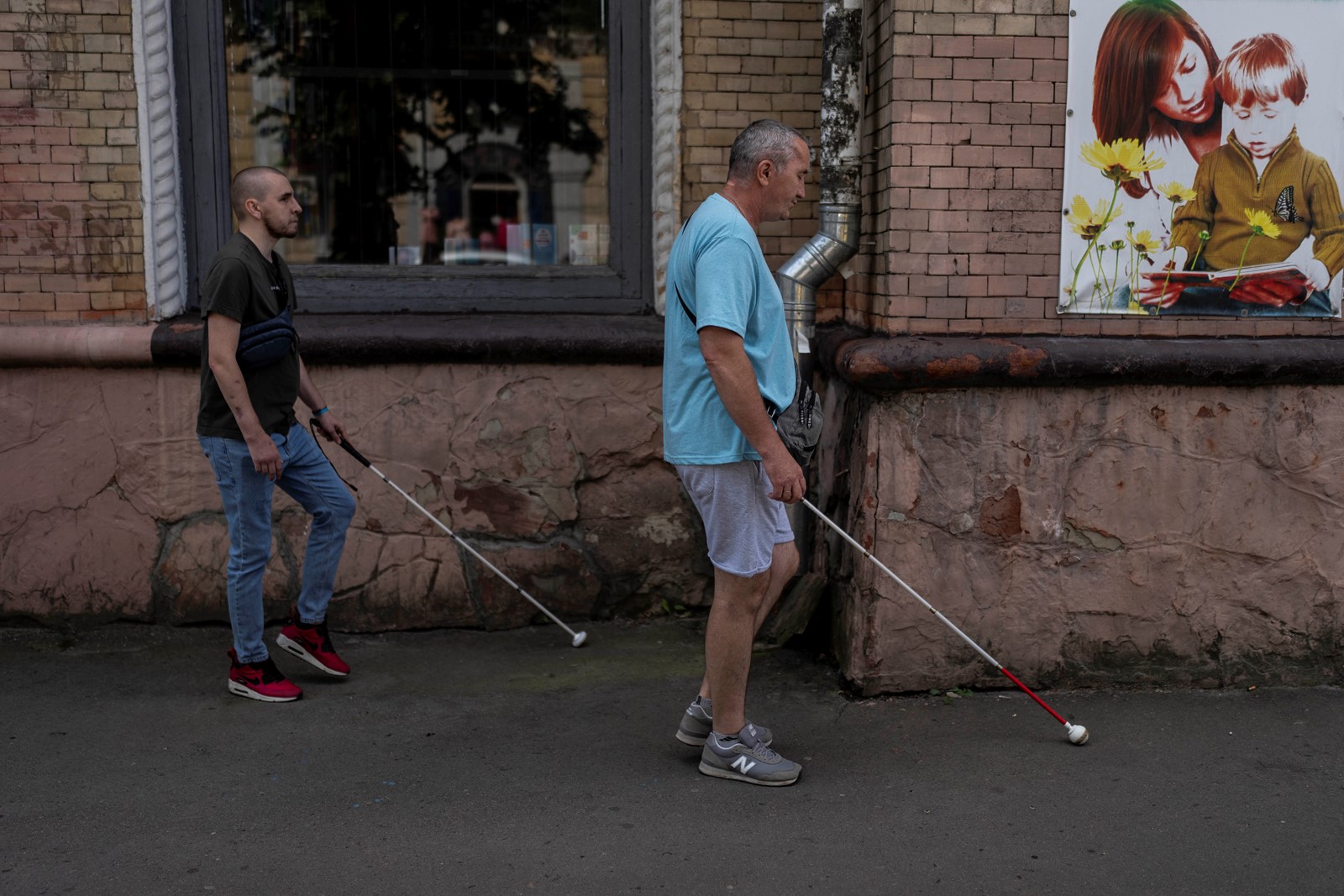


RIVNE, Ukraine >> Along a bustling street in a western Ukrainian city, Denys Abdulin takes his first independent strides since he was severely wounded and blinded while fighting invading Russian troops more than a year ago.
The 34-year-old former soldier, wearing black glasses and gripping a white mobility cane, steps onto a more crowded stretch of sidewalk. His movements become tentative and tense. He accidentally blocks the path of a woman approaching an ATM to withdraw cash.
Like many other pedestrians, she responds with a compassionate smile and gracefully moves aside. Gradually, Abdulin covers almost three-tenths of a mile, guided by a trainer walking ahead of him with a bracelet of small metal bells.
The war Russia launched in Ukraine on Feb. 24, 2022, has killed tens of thousands of fighters on both sides. Countless others, both Ukrainian military personnel and civilians who took up arms to defend their country, have been maimed or suffered other injuries that irreversibly reshaped their lives.
No statistics currently exist for how many service members have lost their sight due to severe wounds sustained in the war, according to Olesia Perepechenko, executive director of Modern Sight, the non-governmental organization that puts on the camp. But demand for the program is growing as the war nears its year and a half point.
Over the course of several weeks, the veterans, accompanied by their families, reside at a rehabilitation center outside of Rivne. Most receive their first canes here, take their first walks around urban and natural environments without assistance and learn to operate sound-based programs for using cellphones and computers.
“Our goal isn’t to retrain them, not to change them, but simply to give them a chance to become independent and self-reliant,” Perepechenko, who is herself blind, said.
Modern Sight held its first rehabilitation camp in 2019 and organized about 10 more since then. However, only two camps have taken place during the war. Although there is a waiting list of 30 people for the next session, the nonprofit’s primary hurdle is funding: each camp costs about $16,400 to put on.
The men and their partners spend camp breaks and evenings in a gazebo on the rehabilitation center’s grounds. An atmosphere of tranquility prevails, occasionally interrupted by hearty laughter and jokes from their time as soldiers.
By the time they leave the center, the men will know they have the tools to get around a city and gained something equally vital — a sense of community forged through shared experiences and a common trauma.
 PREVIOUS ARTICLE
