


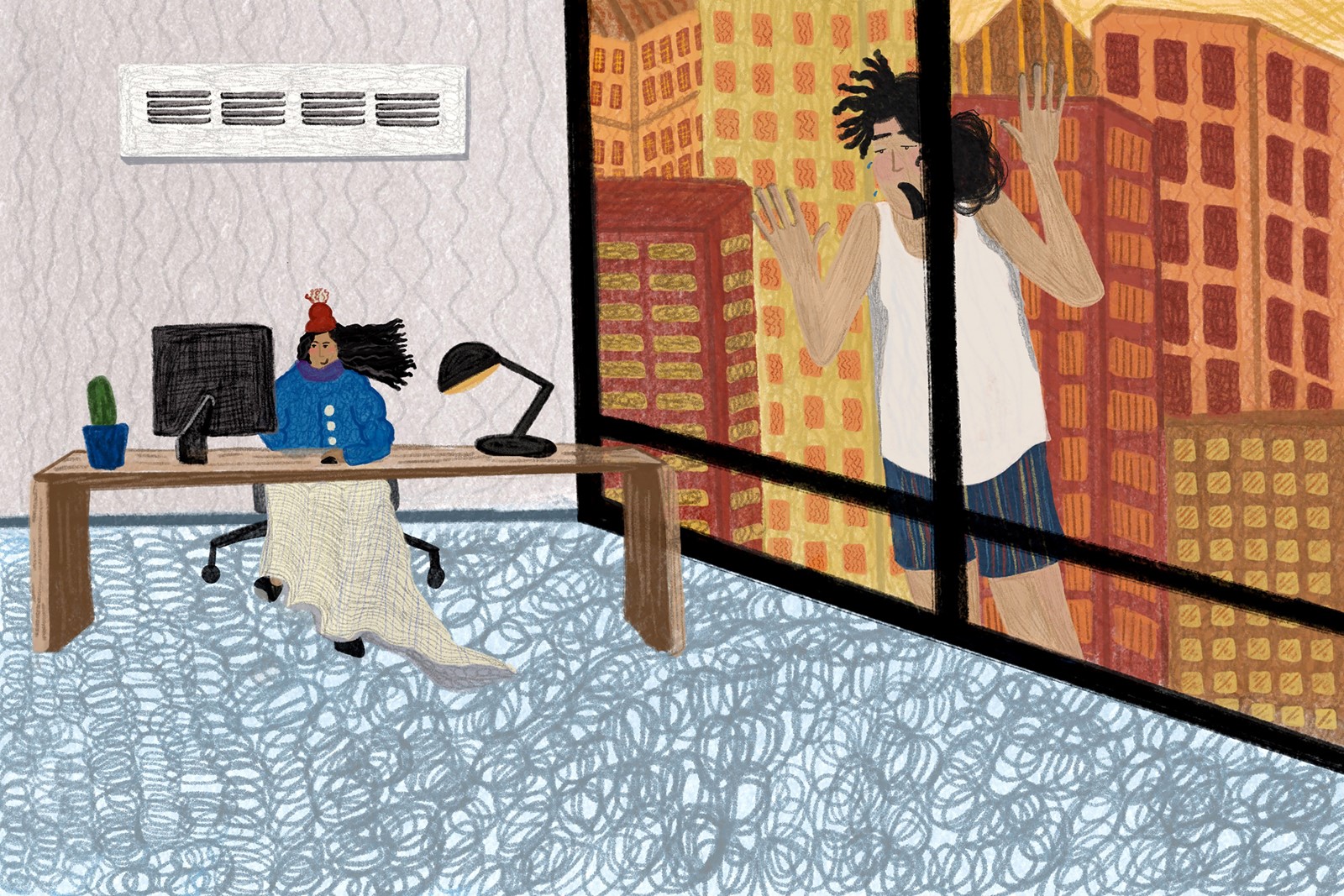


At first, working from home felt like getting away with something. People rejoiced in taking meetings in sweatpants and squeezing in a load of laundry between calls. Commutes shrank and flexibility expanded. Nobody worried about their lunch being stolen from the communal fridge anymore.
Then, after more than a year of dialing in, the physical office, in all its fluorescence, began to beckon. After a heat wave in the Northeast and triple-digit temperatures in the West, some employees started to wonder if the grass might be greener — or, at least, the cubicle cooler — on the other side.
Earlier this year, Michelle Ozuna asked her boss if she could start going back into the office twice a week. While she loves the charm of her studio apartment in Anaheim, California, the building has no central air and the windows can barely keep out the heat.
“I’ve got my portable air conditioner on my left, a fan on my right, and I’m still miserable,” said Ozuna, 44, who works in human resources for a community college. “I realized I really need to be in the office for my own sanity. I just want to be freezing again.”
Seeking the solace of air-conditioned spaces is nothing new, said Salvatore Basile, author of “Cool: How Air-Conditioning Changed Everything.”
The first high-rise air-conditioned office building in the United States — the 21-story Milam Building in San Antonio — did not open until 1928, and even then it was something of an anomaly, Basile said.
“The idea of installing air conditioning in an office was expensive, and the ductwork took up a lot of space,” he said. “Workers got nothing from management but awnings free of charge, and it was BYO electric fans.”
By 1951, the Empire State Building was air-conditioned, and in 1953, the Woolworth Building followed suit — though only in a third of its offices. When the Chrysler Building joined the party in 1954, “it was becoming apparent that AC was a must in the modern American office,” Basile said.
And now, modern American office workers have had that luxury taken away.
“Before COVID, you were usually at work during the dog days of summer, so you didn’t realize how grim it could get at home,” said Eileen Pozniak, a project manager who moved to London from New York 10 years ago.
Not everyone is excited about having a subsidized place to cool off.
A 2015 study revealed that most office buildings set their temperatures based on a formula developed in the 1960s that uses the metabolic rates of men — meaning plenty of employees find it far too cold for comfort.
“I’m not looking forward to the AC-induced shivering again,” said Emily Shields, 36, a content designer in Chicago, whose office thermostat is set so low that she has spent many a summer workday running her hands under the hot water in the bathroom just to get the feeling back.
 PREVIOUS ARTICLE
