


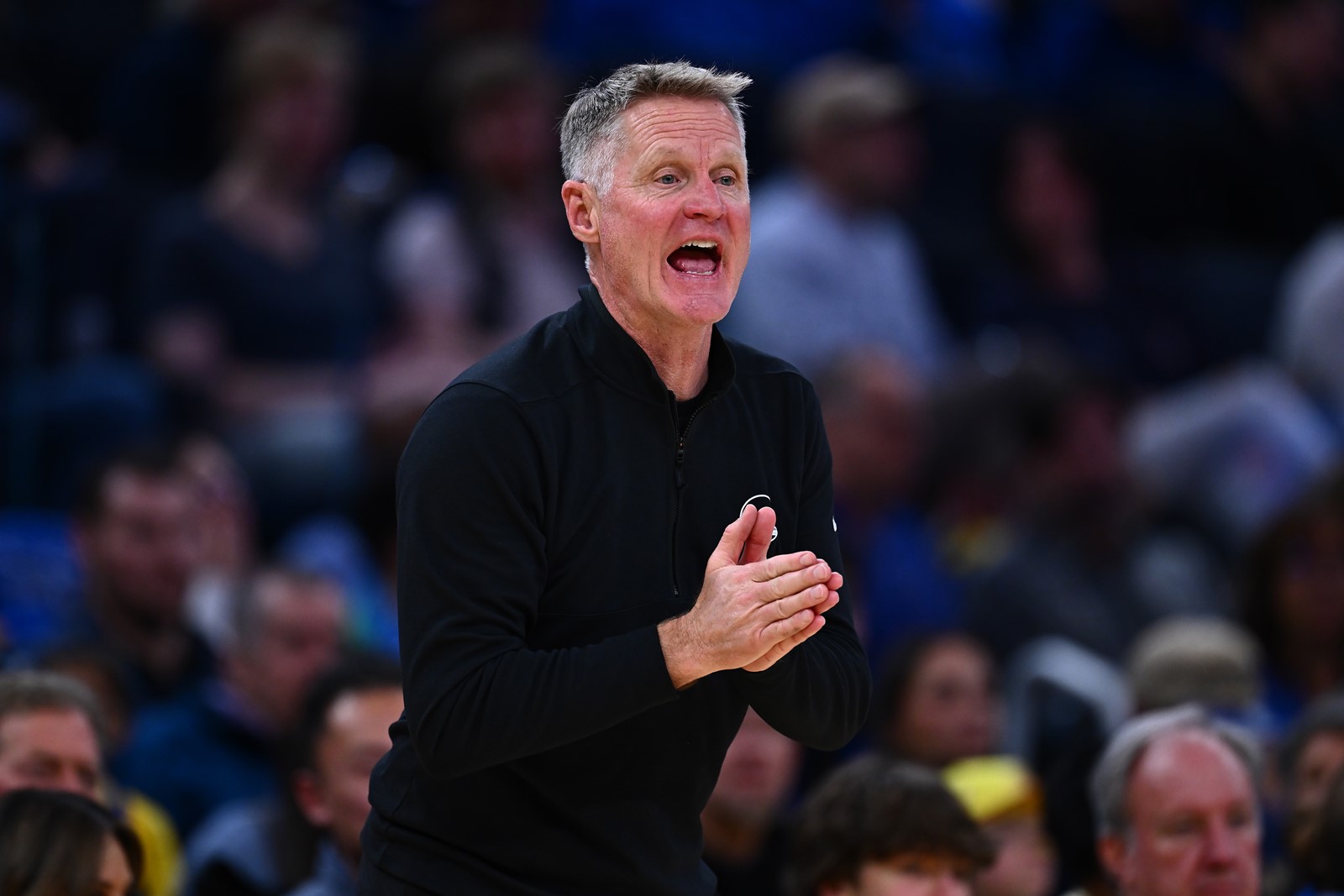


CHICAGO — Before he became the coach of four Warriors championship teams, and long before he helped revolutionize basketball by pushing the boundaries of offense, Steve Kerr had three jobs for the 1990s Chicago Bulls:
Knock down enough shots to space the floor for Michael Jordan and Scottie Pippen, make the correct reads in Chicago’s famed triangle offense and help get any newcomers up to speed in coach Phil Jackson’s complicated attack.
“Whenever we would get new players, we would have to help them adapt to the new offense,” Kerr told the Bay Area News Group earlier this month. “Sometimes, I would help the new guys understand the nuances of the triangle, and I’d shoot with them and give them tips.”
So it was little surprise that one day the triangle’s architect, Tex Winter, delivered a prophecy to the point guard.
“You should coach someday,” Winter, an assistant on Jackson’s staff, told Kerr. “You should teach some of this stuff.”
Kerr followed the legendary coach’s advice in more ways than just becoming a coach.
He still endorses elements of Winter’s tactics, and Kerr’s interpersonal approach is reminiscent of Winter’s stern yet thoughtful philosophy.
It has served Kerr well during the second act of a basketball career that saw him coach his 11th and perhaps final Christmas Day game this week against the Dallas Mavericks. Kerr, 60, is in the last year of his contract and will not entertain talks of a possible extension until after the season.
Though Winter died in 2018, his influence still lives on in Kerr.
“He was a man of principle, a man of humor,” Kerr said. “He loved the game, and lived an incredible basketball life at every level.”
Raised in Northeast Texas during the Dust Bowl of the 1930s, Morice Fredrick “Tex” Winter and his family moved cross-country to Huntington Beach when he was a teenager.
“I lived through when we hardly had enough,” Winter once told Chicago sportswriter Sam Smith. “I don’t forget.”
Smith recounted how a young Winter would spend hours collecting boxes for a local baker in exchange for the day-old bread that would feed his family.
“He grew up at a time where you didn’t waste anything,” Kerr said. “That sense of waste, of material possessions, all of that impacted his life and his coaching.”
After serving in the Navy during World War II, Winter enrolled at USC and received his basketball education from Sam Barry, who taught him an early version of the triangle.
Over the next 60 years, Winter became a collegiate head coach — including at Marquette and Washington — was hired by Bay Area legend Pete Newell to lead the Houston Rockets, and eventually settled in as a trusted NBA assistant with Jackson on dynastic Bulls and Lakers teams.
So what was it about the triangle that made Winter so coveted?
In an era where many offenses were rudimentary, content to have a single player dominate the ball, the triangle dared to create a more egalitarian version of the sport.
“It affords every player on the team the opportunity and ability to utilize their talents,” Winter told the Chicago Tribune. “For some reason, they try to make it more complicated and don’t keep it nearly as simple as it is.”
All five players had to stand at least 15 to 18 feet away from one another, creating three-man ‘triangles” and running complicated passing and cutting patterns. And whether it was Michael Jordan, Shaquille O’Neal or Kobe Bryant, even the stars had to follow the rules.
Viewed through modern eyes, the triangle appears downright archaic. But compared to what most of the NBA was doing before Steph Curry, it was totally futuristic.
It took until 2011 for Winter to be enshrined in the Naismith Basketball Hall of Fame, but his peers had long recognized his brilliance.
Bulls GM Jerry Krause called Winter “the finest offensive mind in basketball.” Jordan dubbed Winter a “pioneer and true student of the game.”
“That level of complexity was not something that was super common in the ’80s or ’90s in offenses, and I think that’s what made the triangle unique,” NBA historian Ben Taylor of Thinking Basketball said. “The spacing was an advantage.”
Many of the system’s pillars are still held up by Kerr … to a degree.
“We run the principles of the triangle,” Kerr said, detailing some of the Warriors’ preferred split-cut actions before adding, “It is just very different now.”
But the fundamentals Winter unflinchingly supported? Kerr believes his team, which ranks among the NBA’s worst in turnovers, could use those.
“I frequently say to myself after I see a one-handed pass, ‘Tex Winter would roll over in his grave,’” Kerr said, shaking his head.
Scheme is not the only part of Winter’s philosophy that Kerr has drawn from.
In an era where fire and brimstone reigned and verbal abuse from coach to player was the norm, Winter’s and Jackson’s more measured approach has stood the test of time.
Though Kerr is more than willing to raise his voice at players, he also knows that coaching the modern player requires a heightened level of sensitivity. That duality was expressed neatly last week, when he shouted at Draymond Green during Monday night’s game and took the blame for the exchange on Wednesday.
Critiquing a careless turnover or dumb shot? Perfectly acceptable. Attacking an athlete’s character? That now crosses the line.
But that process of helping players become what Kerr calls “the best versions of themselves” brought Winter great satisfaction.
“One of the best parts of coaching is when you say something to a player and it clicks, and you can see it’s actually helped them,” Kerr said. “It’s equally as satisfying whether I’m talking to Draymond or whether I’m talking to (rookie) Will Richard.”
The Warriors — and by extension Kerr — have been forced to adapt to the changing league. But oftentimes, the solution to new problems is found by looking to the past, to Kerr’s days in Chicago and his revered former coach.
“While you adapt, you can’t forget all the fundamentals and the basics,” Kerr said. “That’s where you turn back to the Tex Winters of the game, and say these guys, their principles, their ideals, will never fade.”
 PREVIOUS ARTICLE
