


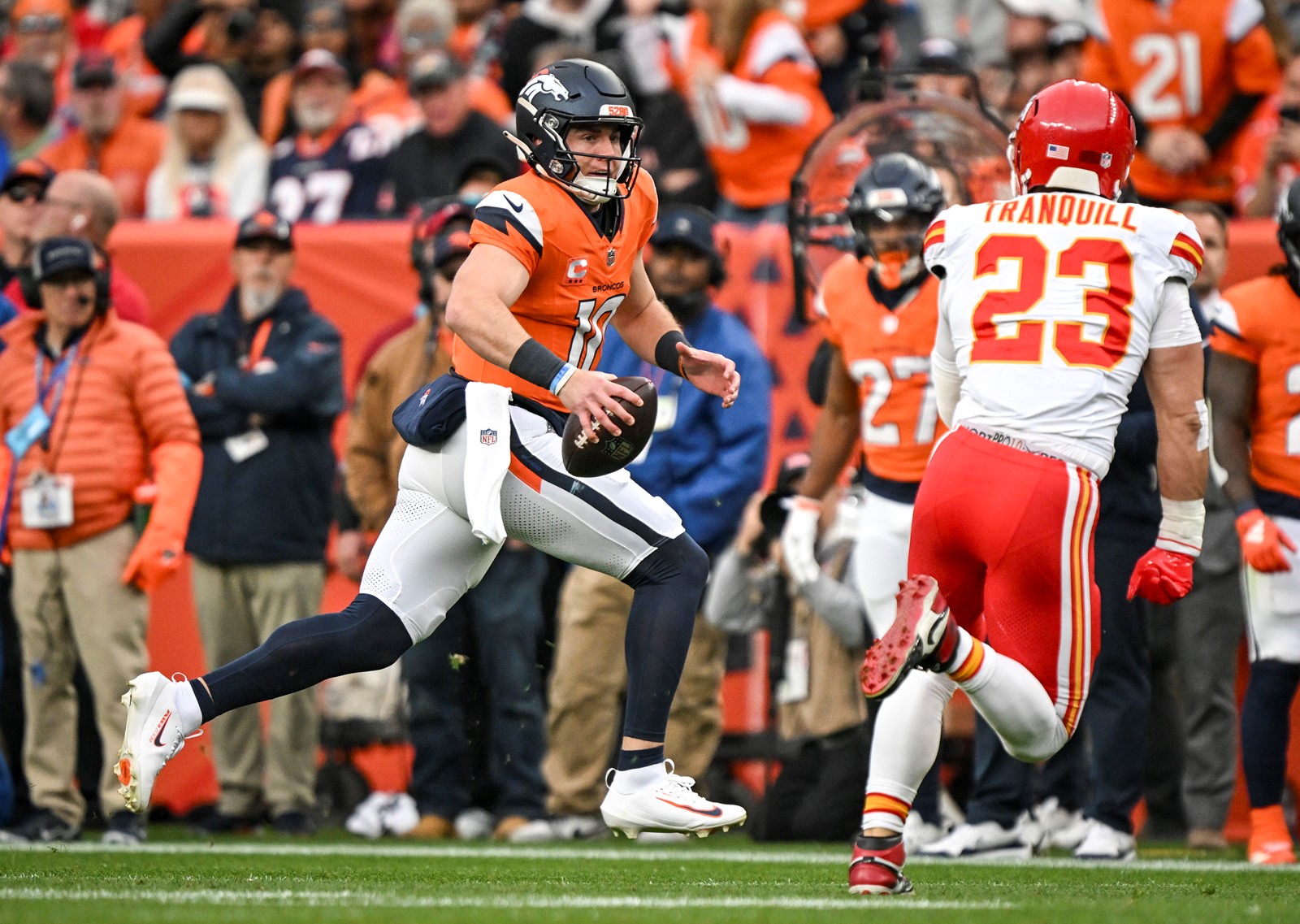
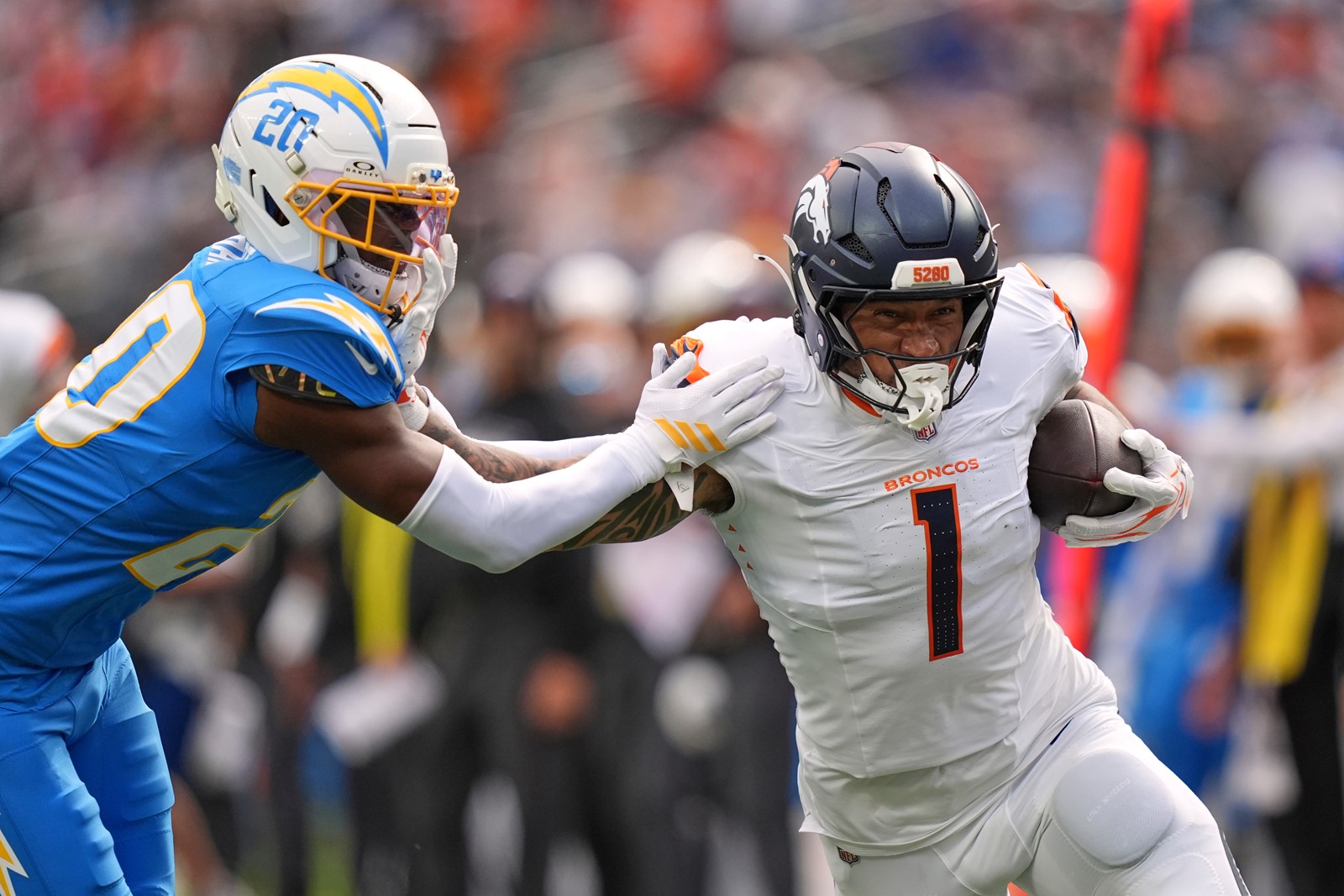


The Broncos could hardly ask for better positioning among AFC contenders as they prepare to return from their bye week to work Monday.
As the team dives into prep for a home game against Las Vegas, though, it will do so against the backdrop of an off week that was anything but ordinary.
Denver swung a trade for Los Angeles Chargers linebacker Daiyan Henley on Tuesday at the NFL’s trading deadline, then backed out Wednesday and saw a brush fire turn into a conflagration Thursday when Chargers coach Jim Harbaugh made it clear he didn’t like how Denver did business during the trade.
Now, though, the Broncos are about to get back to the business of trying to win games. They will watch this weekend’s action at 7-2 and know they will be no worse than a game off the conference’s top mark. By the time Pittsburgh and Cincinnati wrap a matchup of 6-2 AFC North squads on Sunday night, as many as five teams in the conference could be 7-2 or better or as few as three — Denver, Buffalo and the winner of the Sunday night game.
The race for the AFC West with Kansas City will officially be on, as will the jockeying for seeding among the conference’s postseason contenders.
Right now, Sean Payton’s team leads the West, has won five straight, and has averaged 28 points per game over its past three outings — up from 19 per game in its first six.
The Broncos know they’re in terrific standing, even as they acknowledge the route to this point hasn’t always been scenic.
So, what comes next? A second straight season with a mega win streak and a run at the No. 1 seed? A stretch of paying the piper for a mind-boggling 16 straight one-score wins? Or something in between?
The answers to these four questions will help determine whether the Broncos can continue their run and steam to a division title in the second half, or end up staring down a potential road gauntlet through the AFC playoff field as a wild card team.
How do the Broncos get their top offensive weapons more involved?
In training camp, Denver looked like a team with an enviable offensive setup. Quarterback Bo Nix heading into his third year. An offensive line stacked with veterans. And a skill group upgraded by the spring acquisition of Jaylen Waddle.
Fast forward nine games into the year and Waddle is on pace for 636 yards. Courtland Sutton is on pace for 502. Evan Engram is on pace for 319. Those marks would each easily constitute the worst statistical season of each player’s career. Waddle is playing his sixth year, Sutton his ninth and Engram his 10th. J.K. Dobbins entered the season averaging 5 yards per carry for his career and has lost the top running back job to rookie Jonah Coleman while averaging 3.3 per carry. Even role players like Troy Franklin, Adam Trautman and others have seen their 2026 production fall off from 2025 rates.
While it is possible that a couple of Denver’s veterans have started to slow down, that doesn’t explain such a dramatic across-the-board drop. Neither, entirely, is quarterback Bo Nix’s slow start or an uneven four-game play-calling debut for offensive coordinator Davis Webb.
Payton and the offensive staff have to figure out what else has held Denver back.
Payton’s offenses in New Orleans never averaged fewer than 372 yards per game until his final season there, when the average plummeted to 304. His first year in Denver, that mark ticked down to 298. Last year, Denver was No. 10 at 342. So far this season: No. 29 at 277.3
Scoring has ticked up in recent weeks, but the Broncos will have to move the ball more consistently and explosively to get where they want to go. That starts with getting their best playmakers the ball more consistently and letting them work.
Will Denver regret backing out of a deadline trade for LB Daiyan Henley?
The Broncos front office did what it felt it had to do in backing out of an agreed-to trade for Los Angeles Chargers linebacker Daiyan Henley. It then became a firestorm when the Chargers accused Denver of using a “loophole” to ask for less compensation for Henley after discovering what multiple sources described as long-term concerns about one of Henley’s knees.
The Chargers have called it bad ball. The Broncos and general manager George Paton will probably say they were looking out for the organization’s best interests.
The bottom line in the short term is that it meant Denver walked away from the trade deadline with nothing.
So far, inside linebackers Alex Singleton and Justin Strnad have played at a high level this season. Singleton is the NFL’s leading tackler and Strnad has had a really good year overall in coverage.
All the same, the Broncos have major question marks behind them and their usage rates are through the roof. Singleton has played the most defensive snaps in football and Strnad’s 82% is beyond anything he’s approached in his career. If they stay healthy and productive over the next eight games and a deep playoff run, the Henley trade will fade in importance much more quickly — at least on the Front Range. If the Broncos have to dip into untested waters down the stretch this year and it doesn’t go well, the way this deadline deal fell apart will sting Denver even more.
The Broncos’ concerns about Henley weren’t necessarily about his immediate ability to play, but about whether they could realistically consider him a longer-term option beyond this fall, the final year of his rookie deal.
Now the risk is that the last year of his rookie deal turns into the one the Broncos really needed him for. Only time will tell how that plays out in the middle of Vance Joseph’s defense.
Is change afoot on the Broncos’ offensive line?
Payton made a bye-week appearance on Colin Cowherd’s show and, among other things, signaled that he wasn’t thrilled with how Denver’s offensive line played against Carolina last week.
The Broncos’ offensive line is full of veterans and the group has certainly played well at times, but there have also been struggles, too, at multiple spots.
Ben Powers has dealt with injuries and at times seen his level of play flag. Luke Wattenberg struggled to snap the ball consistently and deal with power rushes early in the season, though his play was on the climb as the bye week approached. Right tackle Mike McGlinchey played perhaps the best ball of his career in 2025 but has been more up and down so far this fall.
Denver, meanwhile, has spent years developing a crop of players who represent depth now and could be starters in the future.
Is the future starting to arrive?
“Man, I am watching the cutups of the game we just played and we did not block them very well,” Payton said on “The Herd.” “And I’m just being honest. That has to improve. We have got plenty of depth on the offensive line. During this bye, we are going to look at all those little things closely.”
Alex Palczewski has continued working a unique combination of right tackle and left guard and showed last year he can handle playing on the interior when he started nine games while Powers raced back from a torn biceps. He’s the next man up.
Frank Crum is on injured reserve but is a player Denver believes can play tackle. Kage Casey is a fourth-round rookie the team thinks can man either guard or tackle in a pinch. Alex Forsyth has filled in ably at center when Wattenberg missed time. And that’s before veteran depth options like Matt Peart and Calvin Throckmorton or somewhat lesser-known but intriguing quantities in undrafted rookies Gavin Ortega and Tyler Miller.
All of that is to say Payton did not sound like a coach assuming the status quo would hold for the next seven games.
Can Bo Nix put together a prolonged run of efficient play?
Another point Payton made clear on Cowherd’s show: There’s room for Nix to improve, sure, but Payton hasn’t wavered in his overall confidence.
“So much of what we are able to do offensively — run the ball, have balance — can really make Bo’s job easier. I know we have the right quarterback in the building. I have just seen it in the behavior, the things you need in clutch moments, the arm strength. That was probably the biggest false narrative relative to him coming out (of the draft) was arm strength. He has way above average arm talent.”
Nix got off to a slow start in his third season, playing some of the worst football of his NFL career over Denver’s opening stretch. The mental hurdle of fully putting a pair of offseason ankle surgeries behind him proved a factor. So, too, did a string of six upper-echelon defenses to start the season.
Nix hasn’t been fully top-shelf the past three weeks, but his game has started to come around. He’s pushing the ball downfield more and finding more chunk plays in the process.
Nix also has been better post-bye in each of his first two seasons.
As a rookie, it was just four games down the stretch, but his quarterback rating jumped from 87.9 before the bye to 110.9 after. Last year, the rise was more modest, from 86.1 to 90.1.
Through nine games this year, Nix sports an 84.7 rating, though that number — along with most passing-game metrics and points production for Denver — is a rosier 94.8 over the past three games.
There will be opportunities upcoming for that increase in efficiency to continue. Nix can play better, and the schedule looks navigable, too.
Six of Denver’s first nine games came against teams ranked in the top 10 defensively by EPA/snap — No. 2 Jacksonville, No. 4 Seattle, No. 5 L.A. Rams, No. 8 San Francisco and two against No. 10 Kansas City.
Three of the team’s next five are against the two worst defenses in the NFL by that metric (two against No. 31 Las Vegas and then No. 32 Miami) and the only top-10 group left in the final eight games is No. 7 Pittsburgh.
 PREVIOUS ARTICLE

