


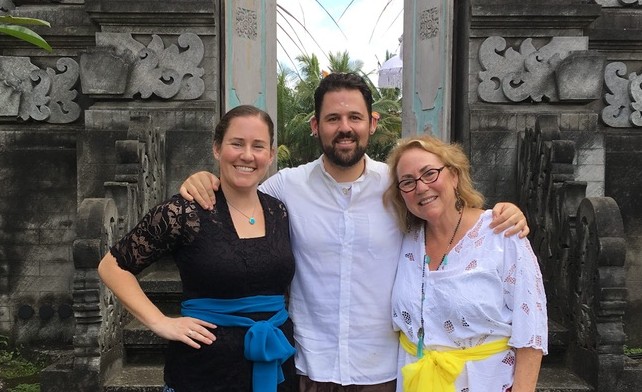


Back in 2003, I decided to take a short vacation to Bali, Indonesia. I needed to take a breather after almost 20 years of pouring myself into a multitude of jobs, such as serving as Gymboree’s marketing director, owning my own marketing and events business and having a consulting job with the Institute of Noetic Sciences in Novato. Bali sounded like a soft landing for me to reflect and explore new possibilities that might be less focused on career advancement and working so hard. I decided to head there on my own and arranged for three weeks of paradise.
Walking out of the Bali airport into a hot, humid breeze, I quickly noticed there were almost no tourists. I hadn’t done my travel homework and quickly learned that foreigners were afraid to return to Bali in the wake of a terrorist attack that happened one year earlier. More than 200 people had been killed, and several hundred more wounded. Tourism — nearly 85% of the island’s economy — had collapsed. The Balinese people were desperate to have foreigners return. Wandering into temples, rice fields, tiny art shops and local food markets, I was asked numerous times if I could help bring back tourists.
Why would foreigners turn their backs on this amazing culture? Here was a tiny island in the center of the world that was full of opportunities to explore a sacred place that lived its values. I learned that they practiced and honored a way of life that wove together people, the natural world and spiritual beliefs. I was bowled over by the island’s indigenous knowledge and the way its culture embodies what it believes. I could see that rituals and offerings weren’t just ceremonies — they’re a way of life, a living philosophy that honors balance, reverence and interconnectedness.
What I didn’t know then was that this trip would completely change the course of my life. As a longtime Marin resident, my career had been built around marketing, conferences, event production and entrepreneurial ventures in training and innovative programs. Yet Bali opened my heart to a different kind of learning — one rooted in community, spirit and the shared wisdom of everyday life.
Couldn’t I do something, in some small way, to encourage people to come back — not as tourists, but as global learners?
I began to imagine bringing people there to learn with the Balinese people rather than about them — to be part of a cross-cultural dialogue that could help us all see the world differently. That dream grew into a desire to create a global gathering in Bali where the Balinese people and Westerners would come together to explore what might be possible by sharing and learning from each other. Pulling together a group of colleagues and friends to help, we settled on the name Quest for Global Healing: A Conference for the 21st Century and within a year produced a series of three international conferences — 2004, 2006 and 2007 — that drew more than 1,200 participants from around the world, with more than 120 speakers, including Archbishop Desmond Tutu, Indonesia’s former President Abdurrahman Wahid and leaders from Bhutan, Cambodia, Thailand and Afghanistan. Numerous Balinese and other Indonesian leaders, authors, royal families and government and educational officials also participated.
Those gatherings became the foundation for the Bali Institute, a global learning center near Ubud, Indonesia, now celebrating its 15th year. More than 2,000 students, professors, high schoolers and adult learners have participated in three-to-five-week customized cultural immersion programs.
Today, that vision lives on through my son Ryan Feinstein, who got involved at 19 years old and now operates our company in Bali. Under his leadership, he has developed and produced more than 100 university programs on specific academic themes that he co-designs with individual faculty. Recently, he has created a separate foundation — Makadaya — that provides a space, strategic network and learning lab to empower a community of change-makers in Indonesia.
Highly skilled individuals are carefully selected, and they must already be developing sustainable solutions toward pressing issues facing their own communities.
More than 30 “fellows” have now gone through the Makadaya social entrepreneurial training and meet regularly.
The heart of this story is about listening to what calls you — even when you can’t yet see where it leads. Watch out for those little vacations.
Marin resident Marcia Jaffe is writing a book about her 20 years in Bali. IJ readers are invited to share their stories of love, dating, parenting, marriage, friendship and other experiences for our How It Is column, which runs Tuesdays in the Lifestyles section. All stories must not have been published in part or in its entirety previously. Send your stories of no more than 600 words to lifestyles@marinij.com. Please write How It Is in the subject line. The IJ reserves the right to edit them for publication. Please include your full name, address and a daytime phone number.
 PREVIOUS ARTICLE
