




Editor’s note: The following is from The Book Pages, Erik Pedersen’s free weekly newsletter about books, authors, booksellers and bestsellers. You can find the newsletter online at bit.ly/TheBookPages or sign up on this newspaper’s website at the bottom of the homepage or by typing /newsletters after its URL.
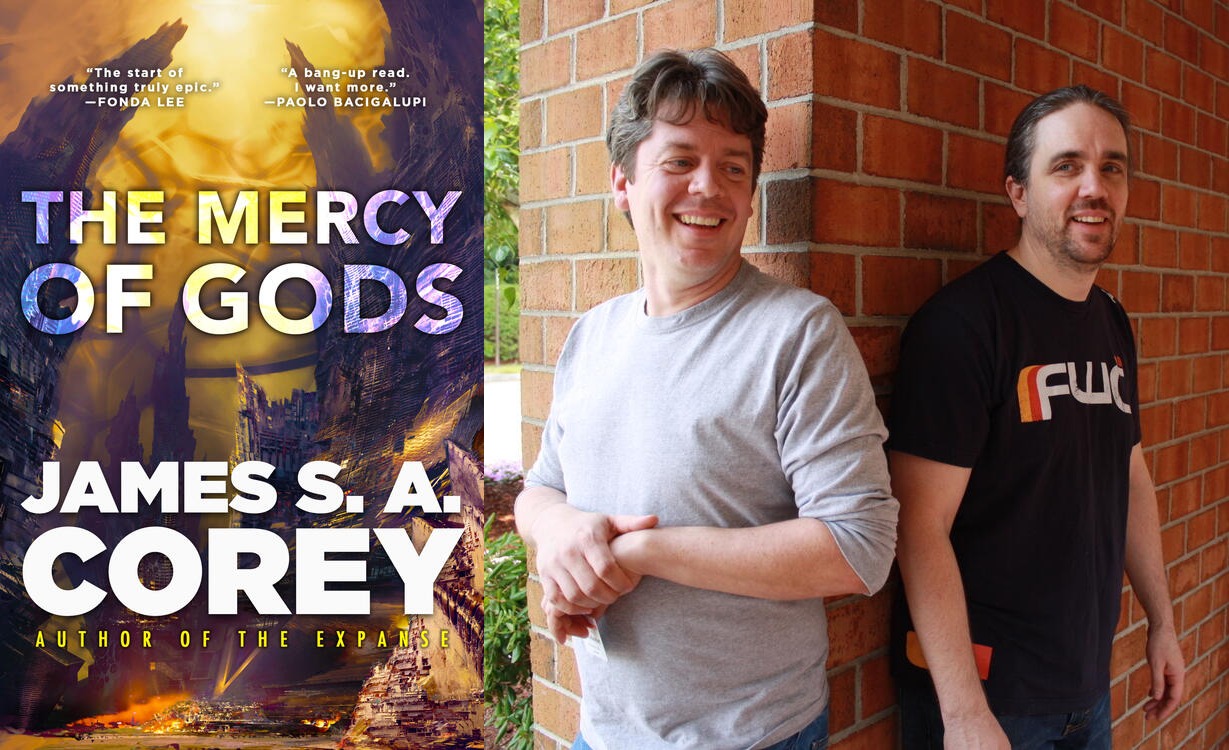
James S. A. Corey is the pen name of Daniel Abraham and Ty Franck. In addition to writing “The Expanse” stories and novels, they also wrote and produced the television series of the same name. The pair’s latest collaboration is “The Mercy of Gods.”
Q Please tell readers about your new book.
A “The Mercy of Gods” is the first in a new trilogy, so you don’t need to have read any of our other stuff before you pick it up. It’s space opera, with galactic empires and weird alien species and all that kind of thing, inspired by the biblical Book of Daniel. It’s following a handful of people taken prisoner by a vastly more powerful civilization, and how they hold onto who and what they are, even under the worst circumstances.
Q Writing as a team is a little unusual. Can you talk a little about that?
A It started off with Ty having a really good idea for a book, and Daniel having some experience writing novels. The two things fit together well, and so a decade and a half in, we’re still doing it.
Q Is there a book or books you always recommend to other readers?
A If folks are looking for other work in this corner of science fiction, we recommend the Dread Empire’s Fall books by Walter Jon Williams, starting with “The Praxis.” Walter is a friend and a mentor for us both, and the Dread Empire’s Fall books don’t get as much love as they deserve.
Q What are you reading now?
Abraham >> Right now, Will Durant’s “The Life of Greece.” His Story of Civilization books have been looking at me from the shelf for a while now, and it seems like their time may have come.
Franck >> Just finished “Fairy Tale” by Stephen King.
Q Can you recall a book that felt like it was written with you in mind (or conversely, one that most definitely wasn’t)?
Abraham >> For me, Joe Abercrombie was kind of a revelation. Writers have their own voices, and usually they are pretty distinct. When I picked up Abercrombie’s “The Heroes,” it was like I’d found a book that I’d written myself and then forgotten about. The way he uses language and builds story just make sense to me. And “The Heroes” is a wonderful book.
Franck >> Alfred Bester’s “The Stars My Destination” was probably my first truly adult science-fiction novel and it rewrote the way my brain sees fiction. It was incredibly dense with ideas, presented a compellingly loathsome protagonist, and took place in a dark and gritty future largely ruled by people so wealthy they are above the law. I’ve been writing fan fiction in that universe ever since.
Q Is there a genre or type of book you read the most — and what would you like to read more of?
Abraham >> In the past few years, I’ve actually fallen pretty far behind on my science-fiction and fantasy reading. There’s a point when I’ve spent all day working on my own projects that reading something adjacent to it feels like still being at work. I know there’s a whole generation of speculative fiction writers out there doing interesting, challenging work, and I’d like to get back in and understand better what they’re up to.
Franck >> I find myself reading a lot of horror lately. I need to read more history. History is my first love and it is the fuel that drives my creative engine. I need to get back to it.
Q Do you have a favorite book or books?
Abraham >> Dozens of them, probably. The ones I go back to over and over are “Strong Poison” and “Gaudy Night,” by Dorothy Sayers; “The Plague,” by Albert Camus; Dorothy Dunnett’s “House of Niccolò” books; and “Homo Ludens,” by Johan Huizinga. But I could wax poetic about a bunch more.
Franck >> “Alice in Wonderland” and “Through the Looking Glass” have never stopped being my two favorite books since I was 4 years old. Probably the reason I’ve always been a bit of a weirdo. Surrealism just presses my buttons.
Q Is there a person who made an impact on your reading life — a teacher, a parent, a librarian or someone else?
Abraham >> For me, it was my dad. When I was growing up, we didn’t have a television, and my father spent a lot of time reading to me. I grew up on a massive variety of stories — mysteries, sea adventures, South American literature, science fiction, you name it. He was the one who made me think that stories were as much a part of life as breathing or sleeping.
Franck >> I mostly read books my mother bought and then left laying around the house, so I’d have to say early on it was her. Thankfully, for my future career as a writer, she was a sci-fi and fantasy reader.
Q What’s a memorable book experience — good or bad — you’re willing to share?
Abraham >> In 2017, I was on vacation with my family in Hawaii, and the book I’d taken to read — a wonderful novel — was “Fingersmith,” by Sarah Waters. Part of the story takes place in a freezing, squalid flat in Victorian London. So there I was, sitting on this breathtaking beach in the warm sun with the soft sound of waves, imagining that I was shivering to death in a crappy, unheated apartment. I don’t know. It seemed odd to have gone all that way to be someplace beautiful and then amuse myself by imagining myself into someplace awful.
Franck >> My family moved a lot. I got dumped into a class halfway through fourth grade in a new city after a move where the teacher had no idea what to do with me, so I was left to sit in the back reading whatever I wanted. I basically skipped fourth grade and read “Tom Sawyer” and “Huckleberry Finn” instead. I feel like I got the better end of that deal.
 PREVIOUS ARTICLE
