


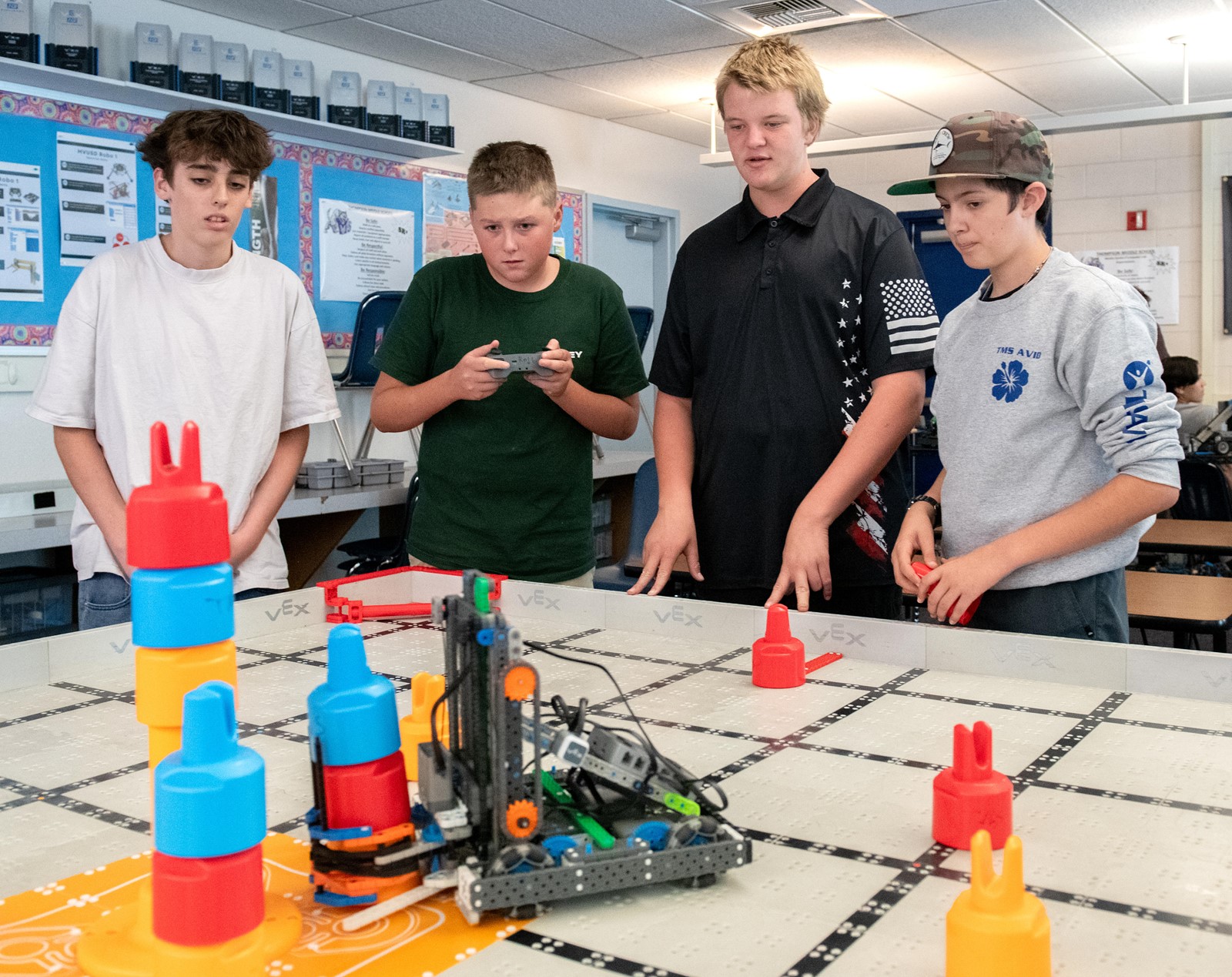
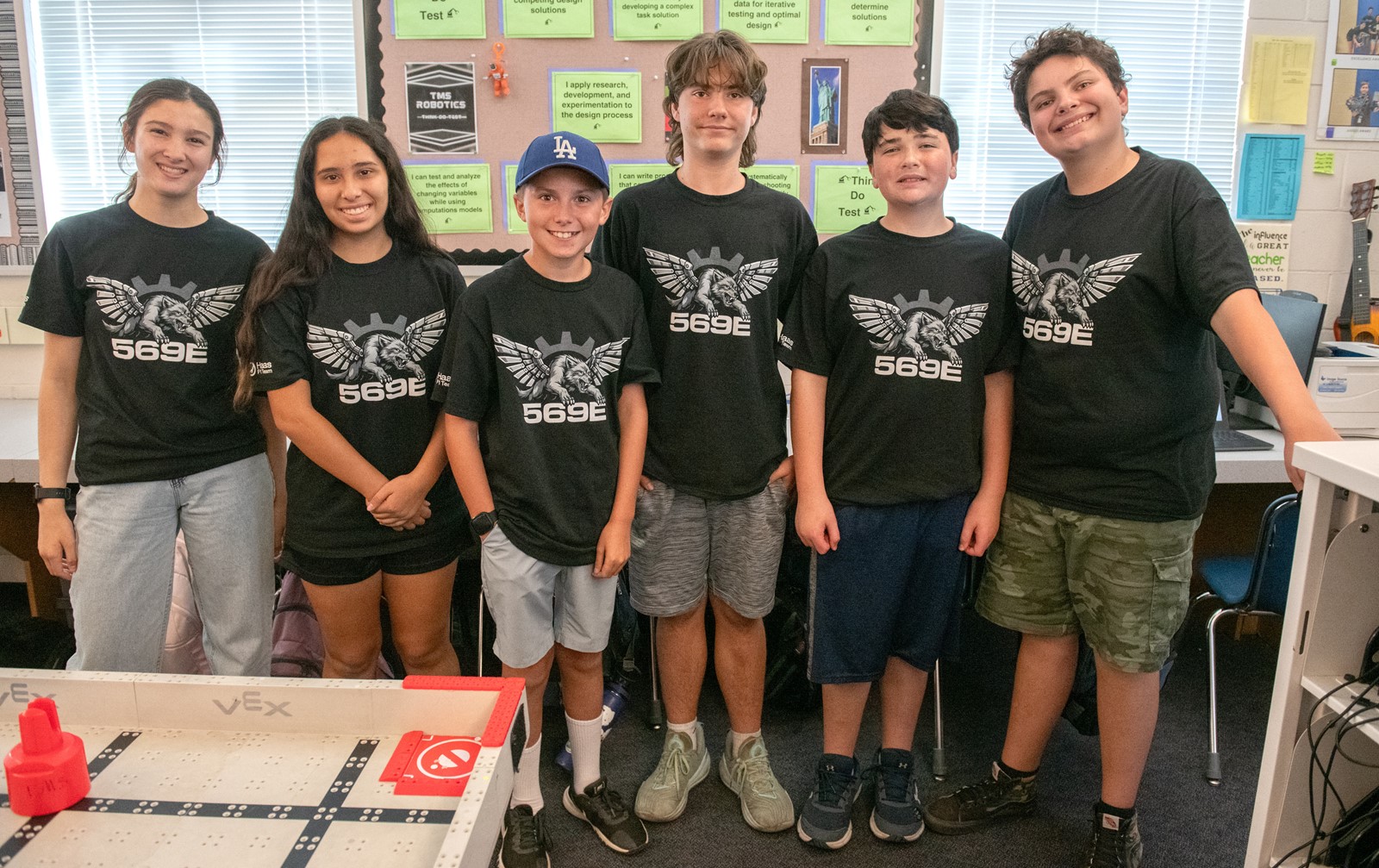
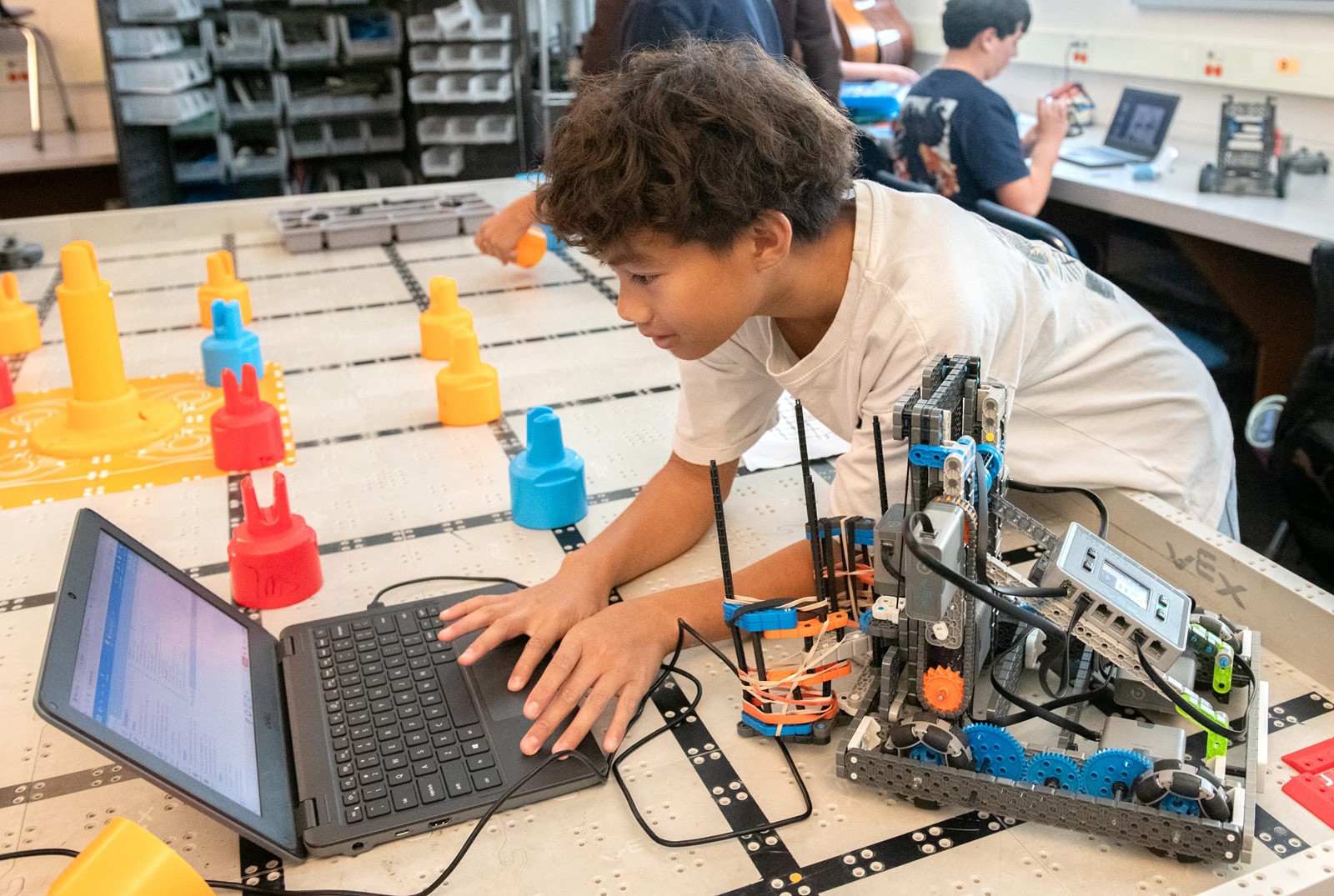


The first word that comes to mind in Ben Wallace’s Murrieta robotics classroom is chaos.
Then comes the second word — though out of order, it’s just as critical — organized.
It’s “organized chaos” in the Thompson Middle School class as about 35 kids work, talk, play and experiment amid more than 150,000 robotic parts.
It’s the ultimate in moving parts.
Wallace has taught the class for seven years and if you think about the world’s future like these kids surely do, this is it.
There is artificial intelligence and then there’s the smarts of middle school kids — and I don’t mean the smart aleck some associate with the age.
The machines they make are moving and seemingly everywhere. Kids are talking nonstop too, but it’s business, not the norm for this age group. These folks are on a mission and idle chitchat is not part of the itinerary.
The school’s teams have qualified for the Southern California middle school championships the past two years, finishing 33rd in its division the first time and 18th last year. The goal this year is to make the world championship in St. Louis next April, Wallace said.
Wallace, 46, came across as a big kid himself as he hopped around the classroom recently. An elementary school teacher first, Wallace said he eagerly started teaching robotics in 2019. All four of Murrieta’s middle schools offer robotics as an elective. Makes sense, given the future.
I substituted in one class at another school for a few days and the pieces Wallace talked about are truly endless. A former robotics teacher jokingly told me he’d have nightmares about the pieces endlessly strewn around the room.
It was also interesting to see the catapults, launchers and other items kids had built. The need to create is easily satisfied in robotics.
“Things can get messy,” Wallace agreed, “so a large degree of our teams’ success depends on my ability to implement systems of accountability, from organized parts cabinets and kits, to detailed engineering notebook documentation; every student has multiple jobs and responsibilities.”
Wallace also said the exploration appealed to him.
“I’ve always loved tinkering and trying to figure things out, especially when it comes to technology,” he said. “Of course engineering is our primary focus, but the development of collaborative and interpersonal skills may be the most foundational benefit students take with them from our program.”
The class’s mantra is think, do and test, Wallace said. Posters around the room emphasize this plan.
As they make their robots, then have them move, pick things up and do other tasks, his students often become immersed, Wallace said. “I think this is because it’s fascinating to see robots as something futuristic, but they’re also increasingly common in everyday life, from vacuum cleaners to warehouse package transporters.”
Eighth-grader Yvonne Columbaro said she signed up for the class because “I’ve always loved engineering and I really wanted to learn how to do robotics and become a problem solver and I thought it would be a fun class to take.”
She said she’s learned how to code, make different mechanisms for different purposes, and apply them to a robot.
“I absolutely love being in robotics because it’s so much fun and you get to spend time with friends, but you also learn a lot being in that class and it’s a lot of fun creating and designing your robot,” she said.
Seventh grader Hudson Montgomery chimed in about the class being fun, “because you build robots and who wouldn’t want to do that!”
He wants to be an electrical engineer like his dad. As for outsiders who might be interested in the program, he said, “I would like to add to please donate so we can continue to build bigger and better robots.”
A worthy cause now and in the future.
Reach Carl Love at carllove4@yahoo.com.
 PREVIOUS ARTICLE

