




By Ross Eric Gibson
Sports hero Marion Hollins developed Pasatiempo Golf Course but had a fascinating career before she became a Santa Cruzan.
Marion Hollins was born into privilege Dec. 3, 1893, living in East Islip, Long Island, near Hollins Island (a.k.a. Greater Fire Island). Her father had staved off a financial panic in 1884 by using his entire fortune of $400,000 to buy Vanderbilt stock. Forever grateful, the Vanderbilt and Hollins families became inseparable in business and society. They hobnobbed with J.P. Morgan, entertained the prince of Wales (later crowned Edward VII) and had other high society friends.
Her father encouraged opening the nine-hole Westbrook Golf Club in East Islip in 1895, the first private golf club in the U.S. Then Mr. Hollins found a caddy in Scotland named Arthur Griffiths (called “Griff”), and brought him back as the pro at Westbrook. Griff gave Marion her first golf lessons at age 6 (1899), and she was considered a good player by age 10 (1903).
As the only girl in a family of four brothers, Marion toughened up to compete with her brothers in boyish vigor. The boys were sportsmen, hellions and pranksters, often running around the grounds naked, unheedful of visiting guests. Marion was a tomboy, but the boys’ sense of reckless privilege didn’t rub off on her. She deplored snobbishness, and when visiting robber baron mansions, Marion would get bored with the “society” affairs and go play poker with the servants. While her brothers grew up as charming alcoholics (except one), Marion put her efforts into sports, and causes.
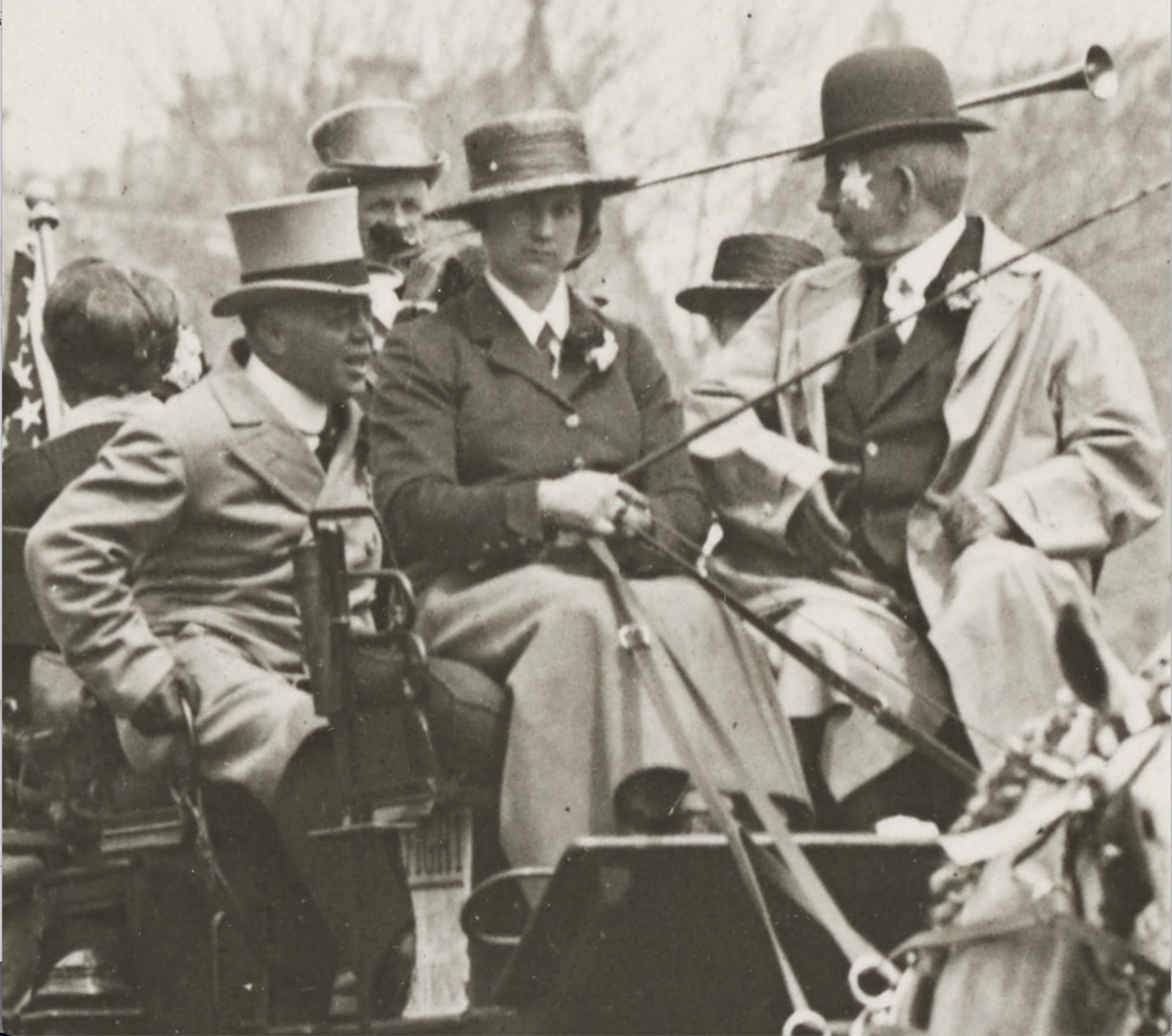
Marion was a born equestrian, learning to ride as a toddler, excelling in coachmanship, steeplechase jumps and polo. A guest was once awakened in bed by Marion’s pony, which she had brought upstairs as a surprise. Marion was the first woman to drive a car in an auto race, entering the Vanderbilt Cup when it was a yearly chaotic street race with accidents galore. By 1912, the 19-year-old entered the U.S. Women’s Amateur golf tournament, then at age 20 (1913) became runner up, while also winning the trophy of the Metropolitan Golf Association (MGA) as well. That was the year her father’s Wall Street Brokerage, right next to the Stock Exchange, went bankrupt. The Hollins moved to the “farmhouse,” with three living rooms and a par-3 golf course on the grounds.
Causes
As for Marion’s causes. When California gave women the vote in 1911, 18-year-old Marion boldly joined the New York City “March of 3,000 Women” for suffrage. Marion saw little reason to sacrifice her personal liberty to suit restrictive gender norms. She carried a banner that said: “Failure Is Impossible,” a quote from Susan B. Anthony, which became Marion’s lifelong motto. (New York State didn’t get suffrage until 1917). Marion had crossed the Atlantic on the Lusitania in 1910. Then on May 7, 1915, the Germans sunk the passenger liner, killing 1,195 people, among them over 120 Americans, including one of the Vanderbilts, who gave away his life jacket. Moved by this, 22-year-old Marion hitched Vanderbilt’s four gray horses to a coach and drove it four-in-hand for 450 miles from Buffalo to New York City and down 5th Avenue, selling Liberty Bonds along the way.
The Junior League of New York was a women’s activist organization, devoted to breaking down social barriers between rich and poor, and aiding in women’s causes. As a fundraiser for the league, in 1916 Marion was one of the stars of a Vitagraph movie, “The Flame of Kapur,” written by Grace R. Henry and directed by Wm. P.S. Earle. Marion’s scenes included a fox hunt at Meadow Brook Hunt Club (Long Island), a golf tournament and an automobile race on the Vanderbilt track. The film packed the Waldorf ballroom for a week as its only known screening.
When America declared war on Germany in 1918, the 25-year-old Marion donated her 38 trophies (even those by elite designers), to be melted down for the war scrap drive. When a maid liked one of her trophies, Marion gave it to her. Marion joined the Red Cross to make bandages for soldiers. A ship foundered in a storm off Long Island in 1919, and survivors made it ashore to find Marion and her friends in rain gear serving coffee and cake on the beach.
Her anti-snob appeal left her unconcerned about her appearance. She wore comfortable sports clothes most of the time, even to formal functions, and never wore makeup. But as an ambassador of golf, it was how people liked to remember their hero, ready for action. In competition, she never dishonored her opponents, often becoming good friends with them, even giving advice during competition. Her interest in the game was that of solving a puzzle, feeling good when she did, and taking a loss with good humor, then inviting the players to dine with her. Confident in her abilities, Marion felt she was only playing against herself.
Women’s golf
While American women had been playing golf since the 1880s, many courses only permitted men to golf or didn’t even allow their wives as observers. Some wives were termed “golf widows” for their marriage to a golf fanatic who seldom came home. But the 1920s brought out a new kind of devoted women golfers, who were nicknamed “golferines.” In 1922, Marion decided to build a championship golf course for women. But it wouldn’t exclude men, so long as they were accompanied by a female club member. Marion surveyed British golf courses, replicating or adapting championship holes. She based the standard distance of a drive not on her own (which many women couldn’t match) but on three-time golf champ, Alexa Stirling. Marion also determined that women who were short, or strategic, should have two or three alternate ways of playing a hole, costing an extra stroke, but eliminating a more challenging drive.
Meanwhile in England, Marion was looking for a golf pro to teach her club members. She came across golfer Ernest Jones, who’d lost his leg in World War I. He wanted to golf again but had to adjust for his balance. He discovered the only imperative in golf is to hit the ball with the club. He began finishing under par but realized what he was teaching himself could help improve other golfers. One of his famous devices was making a pendulum out of a penknife attached to a handkerchief, and holding it while you swung, to achieve what Marion called “poise.” Marion brought Ernest Jones back to America to work at the Women’s National Golf & Tennis Club. It opened in 1923 in Glen Head, Long Island as the first club entirely owned, financed and managed by women. Unlike elsewhere, Marion made sure their golf pro was allowed inside the clubhouse. With the Jones Techniques, his students learned the eccentric lesson that golf could be fun instead of torture.
Marion became ill and went to California for a rest. S.F.B. Morse was delighted to hear she was nearby and invited her to see the brand-new golf course he just opened called Pebble Beach. She was impressed, so he made her director of Pebble Beach athletics and land acquisitions. Marion seized the initiative and established men’s and women’s golf tournaments at Pebble Beach, splitting her time between Pebble Beach and the Women’s National Club. Marion won at Pebble Beach in 1922, 1923 and 1924, and even though she won the 1924 Metropolitan Golf Championship back east, she was now a Californian, making Pebble Beach shine as the West Coast stage for golf championships. She set up a New York City office to promote Monterey Peninsula and Carmel land sales.
California suited her free spirit, playing polo with men as well as bridge and poker. But she was a one-woman hurricane of energy attending her interests spread across the globe. When asked why she didn’t marry, she said, “Good heavens, what would I do with a husband? I barely have time in my schedule as it is!”
In 1927 Marion envisioned a beautiful golf course at Cypress Point, a dream attributed to her at times by Morse, Roger Lampham, and others. At first she called on Women’s National course architect Seth Raynor, but he died, so she selected Dr. Alister MacKenzie, whom she had met while competing in a British golf tournament. At the time he’d designed 63 golf courses, which Marion appreciated as playable resumes. Trained as a doctor, MacKenzie had often advised patients to take up golf for their health and seldom saw them in his office again! In the British army, he realized the principles of camouflage closely related to golf course design.
Marion felt she and MacKenzie has similar philosophies on golf course design. They must preserve as much as possible the natural setting, with any changes applied in a naturalistic manner. Each hole should have its own personality. They walked the Cypress Point site together, hitting drives and such to see how the land played. Indeed, while MacKenzie was the course architect, it was Marion who insisted on the creation of the 16th hole, the most photographed golf hole in history. She said she wanted it to be a heroic hole, and demonstrated by driving her ball across the ocean inlet and landing where the hole is now located. It was often Marion who set the championship standards for the drives to Cypress Point greens.
Yet the best golf course in the world had trouble generating money via memberships, dues and fees, but few people knew what beauty was here. Then, on a tip from a golfer, Marion considered becoming a wildcatter, by sinking $40,000 in a dry well in the desert.
Next time: Marion Hollins’ life in Santa Cruz.
Further reading
“The Pasatiempo Story” by Margaret Koch, 1990. The exceptional “Woman In A Man’s World,” Biography of Marion Hollins, by David E. Outerbridge, 1998.
 PREVIOUS ARTICLE
