


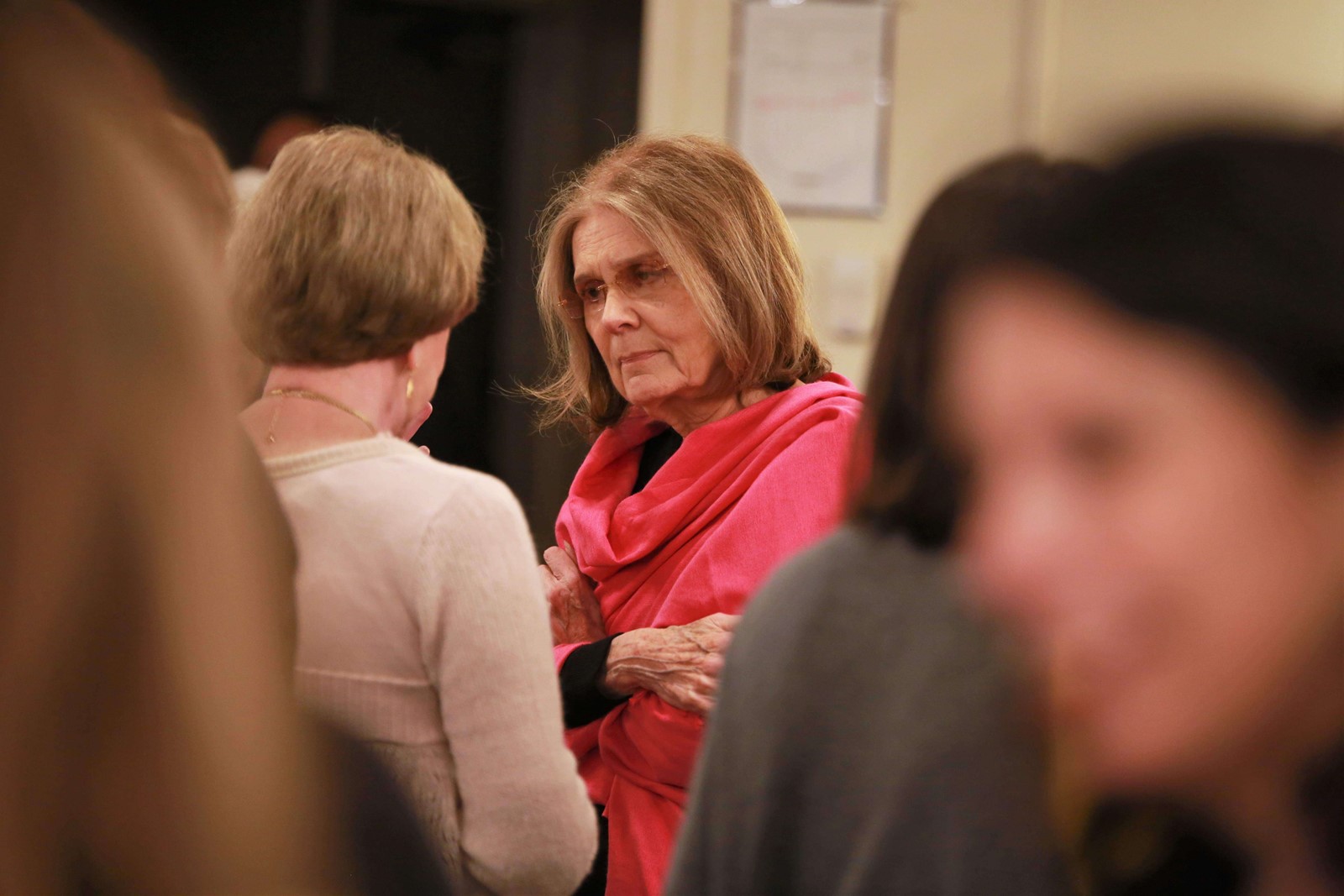


Gloria Steinem, the feminist icon who died Sept. 2 at the age of 92, was remembered locally as both a fierce and highly articulate advocate for women but also a humble leader who shared her massive platform generously throughout her decades at the forefront of the women’s movement.
“There isn’t enough to say about Gloria Steinem,” said Molly Murphy MacGregor. “She was remarkable in every way.”
MacGregor knows of what she speaks.
MacGregor, and a small cohort of colleagues, founded the first Women’s History Week in Sonoma County Schools in 1978. President Jimmy Carter, just two years later, elevated the effort and called for Women’s History Week to be a national event. In 1987, Women’s History Month was established nationwide.
MacGregor spent decades as co-founder and executive director of the National Women’s History Alliance.
“(Gloria Steinem) was a North Star of my life from the beginning,” said MacGregor, who lives in Santa Rosa. “I came to this as a secondary teacher who really didn’t know that women had been written out of history and Gloria and her whole group enlightened me, shall we say … Steinem was just that voice that woke people up with such love and gentle connection.”
She had that effect on “countless others,” MacGregor said. That was one of her crucial gifts and leadership skills.
“I think that part of what she left us is thousands of those leaders,” she said of the next generation of voices for women. “She said, ‘I can’t pass you my torch, but I can sure light yours.’ She inspired other leaders, other people to care. She modeled the way to move forward.”
In 1972, the former journalist launched Ms. magazine, a periodical owned by, and led by, women. As much as it was embraced by women desperate to see themselves and their stories in print, it was mocked by many in power. Famously, President Richard Nixon was heard ridiculing both Steinem and the magazine.
Joan Tabb Waisbein, 71, of Santa Rosa was an early supporter of Ms. magazine and in the 1980s spent $1,000 to become a lifetime subscriber. Tabb Waisbein, a career coach and author who attended Steinem’s talk in Santa Rosa in 2017, said the feminist’s work was revolutionary.
“(Media) was not telling the whole story of boredom, of underutilized talent — women were being shrunk. Women needed to be expanded,” she said. “It resonated with people. There was understanding. It’s very hard for fish to see the water they are in.”
For Connie Codding, 91 of Santa Rosa, that awakening came in the form of the fight for reproductive rights and freedoms — something Steinem, who spoke of her own illegal abortion at 22, championed for decades.
A young mother of soon-to-be five children, Codding said for much of her early life the goal was “the perfect house and we didn’t question things.”
Until she read about a woman who had to go to great lengths to get an abortion.
“If you are not ready to be a parent, you should have a choice whether you bring a child into this world,” she said.
“It was kind of a revelation to me,” Codding, former executive of Codding Enterprises and the Codding Foundation, has supported a long list of organizations and nonprofit groups including the 4-H Club, the Sonoma County Museum, Southwest Community Health Clinic, the Earle Baum Center of the Blind, Santa Rosa Boys & Girls Club, the Santa Rosa Junior College Foundation, the Sonoma County Community Foundation and the Children’s Health Network.
Codding became a strong supporter of Planned Parenthood and through decades of that advocacy, came to meet Steinem on several occasions.
“I really admired her,” she said.
Codding called Steinem the “driving force” behind the feminist movement in part because many women found her relatable.
“I wasn’t part of the hippie, bra-burning movement; it didn’t really appeal to me,” she said. “There was something about her, maybe success had a lot to do with it, but her presence and her command of the situation, you couldn’t help but admire her.”
Steinem, according to Tabb Waisbein, made efforts to include women of color, women along the arc of socioeconomic classes, and those who identified with the LGBTQ community.
“They didn’t want to see this as an upper middle class effort,” she said of the feminist movement. “She had to make a bigger tent. She was very good at that. Of course, she had her limitations. Many voices needed to be heard. With Ms. she really made a big tent to get many voices heard.”
Steinem visited Santa Rosa in 2017 to give a talk as part of Sonoma Media Investments’ Sonoma County Women in Conversation series. Sonoma Media Investments is the former owner of The Press Democrat.
Speaking here in the early months of President Donald Trump’s first term, Steinem described it as a “time of danger,” with racism on the rise, attacks on news media and environmental safeguards, as well as women’s reproductive health rights and freedoms. She urged the hundreds of people who turned up to the Luther Burbank Center for the Arts to take action, not simply press “send” on an email as an act of advocacy.
“There’s something about coming together in this room and coming together in a march that can’t be replicated,” she told the crowd.
It was a call to action Cynthia Papermaster, 79, of Sebastopol has held onto for years. An organizer with CODEPINK, a grassroots feminist organization working to end U.S. warfare and support peace, Papermaster was ending an advocacy event Thursday afternoon when reached by phone.
Papermaster was stationed outside General Dynamics in Healdsburg, a facility which produces guidance systems for tactical missiles and extended range munitions that advocates for years have contended supplies arms to Israel in its war on Hamas.
“I look at her as a person having courage in a culture that doesn’t really value women still,” she said. “She provided a model, an example that you could speak out and not be cowed by patriarchy and sexism.”
CODEPINK is on that continuum of women-led advocacy, she said.
“We are women-led, we are a feminist organization,” she said. “We welcome people of all genders and identities to work with us, but we are women-led.”
Steinem was fierce and “uncompromising,” said Elaine Holtz, who for years hosted the “Women’s Spaces” radio show on KBBF before retiring this summer.
“I would say her tenacity,” Holtz said when asked about Steinem’s legacy. “Her willingness to speak out and hold her values even though sometimes she wasn’t agreed with. I think that is the biggest lesson we can learn from women like her.”
Holtz, like many other women, expressed concern that the nation is moving backward under President Trump’s administration — that hard-fought victories of equality are being dismantled.
“They are trying to take a lot away from women,” Holtz said, while dismissing the argument that it is all part of the pendulum swing of politics. “It will swing back but look at all the dead bodies while it’s swinging.”
Angela Ryan, executive director of the Sonoma Valley Catalyst Fund through the Community Foundation of Sonoma County, studied Steinem and her work in college and grad school some quarter of a century ago.
“She was already an elder statesman in the feminist movement and the women’s movement. I was studying her in the history books already,” she said. “To see that legacy go another 25 years is part of the reason she had the role she had in our imagination.”
And part of that staying power was due Steinem’s openness in talking about her own evolution and learning, said Ryan, 45 of Sonoma.
“She owned up to the fact that she wasn’t always as inclusive in her definition and the way she spoke about feminism,” she said. “I think it was a learning experience over time. We saw her learn over the course of 50 or 60 years in the spotlight how to share that spotlight. White women’s struggles were not those universally experienced by women of color.”
In addition, Steinem was smart and savvy, Ryan said.
“She put a face on feminism at a time when people were only having surface-level conversations and having knee-jerk reactions to that word,” she said, and in doing so “gave more women access to connect and see each other.”
But the work is not finished, Ryan said.
“How I would want her to be remembered is as somebody who used the privilege that she had in the world to try to have conversations that other people were not having,” she said. “She knew she had that role and she played it well. I think she is responsible for a lot of the progress. It’s not done yet, but she clearly blazed the trails.”
National Women’s History Month’s MacGregor said that in the wake of Steinem’s death, she was focused less on sadness and loss than on gratitude for having lived at the same time as a giant.
“With Gloria’s passing you just have to be grateful that she was here,” MacGregor said. “You can’t move to a place of sorrow because you are just so grateful that she was here and that she had the power that she had.”
You can reach Staff Columnist Kerry Benefield at 707-526-8671 or kerry.benefield@pressdemocrat.com. On Instagram @kerry.benefield.
 PREVIOUS ARTICLE

