


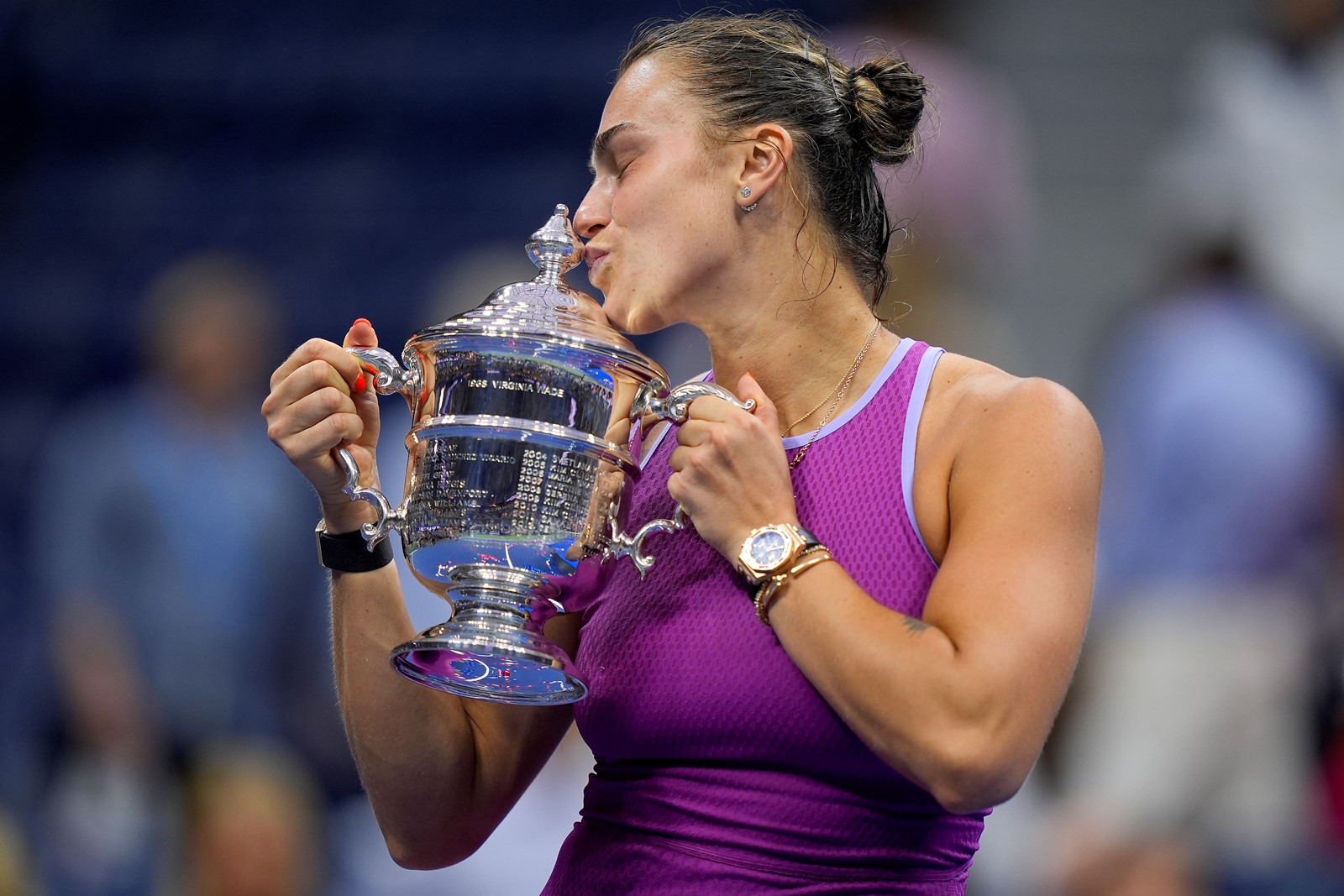


NEW YORK >> Aryna Sabalenka left the U.S. Open in tears 12 months ago as the runner-up. She exited in the semifinals each of the two years before that. This time, Sabalenka was in a joking mood after winning her first championship at Flushing Meadows and the third Grand Slam title of her career.
Sabalenka, the No. 2 seed, got past No. 6 Jessica Pegula 7-5, 7-5 in a rollicking final under a closed retractable roof at Arthur Ashe Stadium on Saturday, adding this triumph to the two she earned at the Australian Open each of the past two seasons, also on hard courts.
“So many times, I thought I was so close to get a U.S. Open title. It’s been a dream of mine. Finally, I got this beautiful trophy. It means a lot,” said Sabalenka, a 26-year-old from Belarus, who is on a 12-match winning streak.
“I remember,” she said, “all those tough losses in the past here.”
That includes in the semifinals in both 2021, against Leylah Fernandez, and 2022, against No. 1 Iga Swiatek.
Most poignant, of course, was last year, when Sabalenka was rattled by the Ashe crowd, blew a set advantage and was defeated by Coco Gauff. Like Gauff, Pegula is an American, but the spectators were far more generous toward Sabalenka on Saturday, applauding her best efforts and even obliging when she waved her arms to ask for extra noise.
Afterward, Sabalenka thanked the fans for cheering for her — which probably (wink, wink) was unrelated to her kidding offer of “Drinks on me” after an earlier victory.
Pegula, a native New Yorker whose parents own the NFL’s Buffalo Bills and NHL’s Buffalo Sabres, was participating in a major final for the first time at age 30. She’s won 15 of her past 17 matches over the past month; both losses came against Sabalenka.
“I know how tough it is to lose in the final, but you’re showing some amazing tennis, and I’m more than sure that one day, you’re going to get one,” Sabalenka told Pegula during the on-court ceremony, then paused and added with a chuckle: “I mean, not (just) one. Maybe more. But let’s start from one Grand Slam.”
To Pegula’s credit, she did not fold after Sabalenka reeled off five consecutive games to grab the opening set and move ahead 3-0 in the second. In the next game, Pegula dropped a point and showed her frustration by whacking a ball off the video wall behind the baseline, dislodging a little square panel.
Maybe that released some tension, because suddenly Pegula asserted herself, using her own five-game run to go up 5-3. But when she served at 5-4 with a chance to force a third set, Pegula let Sabalenka level the second with a break.
“Was able to find some good tennis, just wasn’t quite able to sustain it,” Pegula said. “She played some big tennis in big moments.”
Indeed, that began a three-game surge for Sabalenka, who soon was collapsing to the court, dropping her racket and covering her face with both arms.
Sabalenka finished with far more winners than Pegula, 40-17, and also more unforced errors, 34-22. Sabalenka controlled most exchanges, with Pegula mainly stuck responding as best she could.
“She’s super powerful. Goes for her shots. She’s definitely not going to give you anything,” Pegula said. “I was happy I was able to fight back and give myself a chance, but in the end it wasn’t enough.”
 PREVIOUS ARTICLE

