


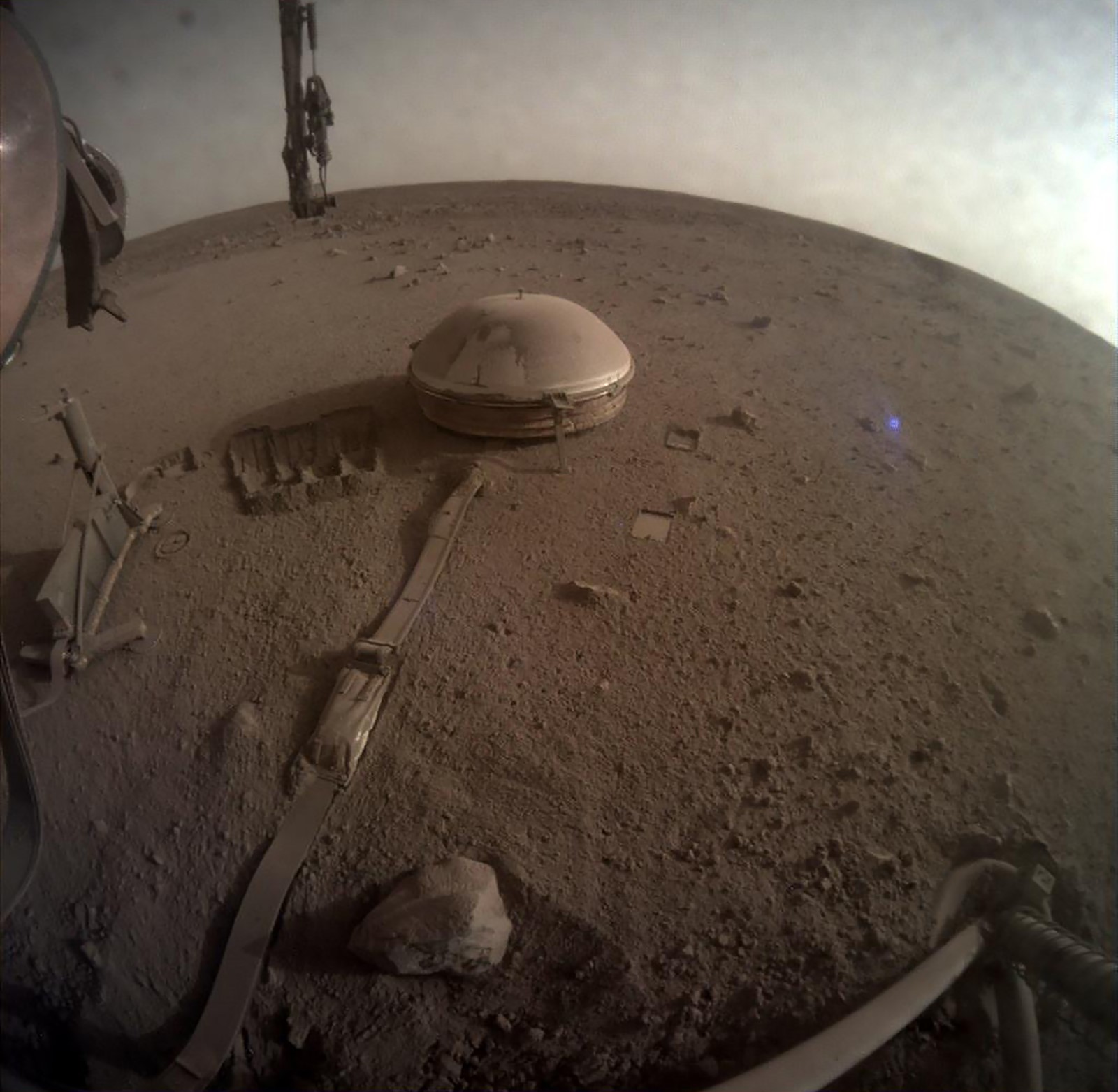


NASA’s Mars InSight spacecraft is dead.
For months, mission managers have been expecting this as dust accumulated on the lander’s solar panels, blocking the sunlight the stationary spacecraft needs to generate power.
InSight, which arrived on the surface of Mars more than four years ago to measure the red planet’s seismological shaking, was last in touch Thursday. But nothing was heard during the last two communication attempts, and NASA announced Wednesday that it was unlikely for it ever to hear from InSight again.
“We broke new ground, and our science team can be proud of all that we’ve learned along the way,” Philippe Lognonne of Institut de Physique du Globe de Paris, principal investigator of InSight’s seismometer, said in a statement from NASA.
InSight — the name is a compression of the mission’s full name, Interior Exploration Using Seismic Investigations, Geodesy and Heat Transport — was a diversion from NASA’s better known rover missions, focusing on the mysteries of Mars’ deep interior instead of searching for signs of water and possible extinct life on the red planet.
The $830 million mission aimed to answer questions about the planet’s structure, composition and geological history.
Mars lacks plate tectonics, the sliding of pieces of crust that shape the surface of our planet. But marsquakes occur nonetheless, driven by other stresses such as the shrinking and cracking of the crust as it cools.
The mission’s final year proved particularly eventful, as its instruments detected vibrations from a sizable space rock, 15 to 40 feet in diameter, hitting Mars 2,000 miles away from the spacecraft on Christmas Eve last year. NASA’s Mars Reconnaissance Orbiter was then able to photograph the new crater and chunks of underground ice that were kicked up to the surface by the impact. That ice discovery was closer to the equator than any spotted previously, a potential resource for future astronauts.
In May, InSight measured a marsquake registering 4.7 magnitude, the largest of the mission.
The spacecraft’s seismometer lived up to scientists’ expectations. It was the first time that quakes have been detected on another planet. (It was not the first off-Earth quakes, however. During the Apollo missions, NASA astronauts left seismometers on the moon that registered numerous moonquakes.)
The seismic waves bouncing around the interior of Mars essentially provided a sonogram of the planet, offering new details about the crust, mantle and core. The crust below InSight turned out thinner than expected, about 15 to 25 miles.
The red planet’s core is still molten, somewhat a surprise to scientists because Mars is much smaller than Earth.
 PREVIOUS ARTICLE
