


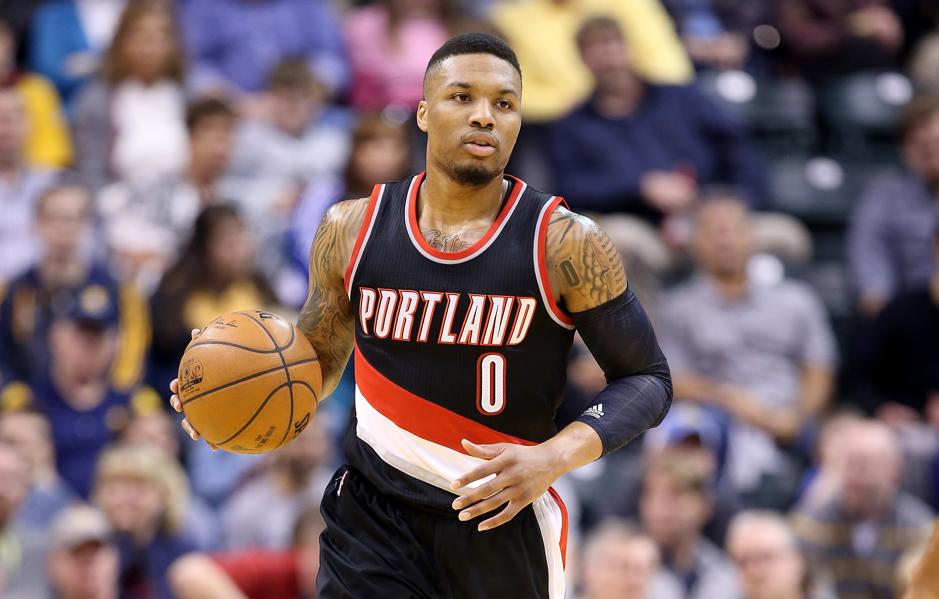
The predictions had to serve as motivation for Damian Lillard, who has spent most of his early career proving he and his team are worthy.
The Portland Trail Blazers were projected to win 25 games this season by most prognosticators, no more than 30. Players were bailing on Rip City. LaMarcus Aldridge signed with the Spurs. Wesley Matthews bolted for the Mavericks. Robin Lopez agreed to a deal with the Knicks, as did Arron Afflalo.
The Trail Blazers apparently were relegated to rebuilding, as general manager Neil Olshey acquired a bunch of youngsters and workmanlike players, including Al-Farouq Aminu, Ed Davis, Maurice Harkless, Noah Vonleh, and Gerald Henderson, and blended them with Lillard, an underrated point guard, and emerging scorer C.J. McCollum, whose first two seasons had been filled with injuries.
The result currently is the sixth seed in the Western Conference, as the Blazers, who host the Celtics on Thursday, are closing in on a winning record, and Terry Stotts is a Coach of the Year candidate. Lillard has been the leader, averaging 25.7 points and 6.9 assists per game.
He didn’t make the All-Star team, and he will let you know about it. Aldridge, who had an uneven first half with the Spurs, was named as a reserve instead, motivating the Oakland-bred Lillard even more.
“It’s a great feeling and it’s rewarding,’’ Lillard said of the Blazers’ surprising season. “We put so much time in together. Once our roster came together, we started spending time together right away. We went to San Diego together and worked out for a week. We came to Portland a month and a half early, played pickup. We worked out together, hung out together, and formed a bond with each other.’’
Portland started 4-2 but lost 18 of its next 25 games and looked fried by Christmas. But a 29-point victory over the defending Eastern Conference champion Cavaliers on Dec. 26 sparked a resurgence. The Blazers have rolled off 26 wins in their last 42 games, with Lillard and McCollum becoming one of the league’s top scoring tandems.
“When the season started, we knew there would be growing pains on the floor, and it would come down to how we responded to that,’’ said Lillard. “All the things we went through to start the season, it made us better, and now we’re in position to be a playoff team.’’
Olshey gathered a bunch of players who had been forgotten or overlooked in previous locales. McCollum is a Most Improved Player candidate, averaging 20.1 points after just 6.8 last season as a reserve. Davis and Aminu have played strong defense, while Harkless, who was demoted in Orlando, has played his way into the starting lineup.
Allen Crabbe, who spent his first two seasons as a little-used reserve, is averaging double figures as a sharpshooter off the bench.
“It’s not me just doing everything,’’ Lillard said. “I’m not carrying the team and having to do it all by myself. It’s the group. I came into camp and in my mind I’m saying we’re going to be better than people think, having a lot of pride. We’ve been able to do what we’ve done because everybody felt that way. Everybody came in and said, ‘I’m better than what they say I am. I can bring more to this team than they say I can bring.’ And they took it personal.’’
Taking it personal has been the consistent theme of Lillard’s career. He was a draft unknown coming out of Weber State, fueled by being ignored by bigger schools coming out of Oakland High School.
The Blazers have adopted his underdog mentality. Lillard signed a five-year, $125 million contract extension, becoming the face of the franchise. A city that feels overlooked is represented by a player that has felt overlooked. It seems to be a perfect fit. The Trail Blazers invested in the Little Point Guard That Could, and there is a lot left for Lillard to overcome.
“I always believed that I could do more, I always believed that I could improve,’’ Lillard said. “You can put more weight on my shoulder. Every time there’s a challenge in front of me, I kind of block out that there’s a challenge and I go after it. That’s the one thing that I really noticed about myself. I really take it to heart when there’s a challenge in front of me.’’
REASON FOR OPTIMISM
Bucks’ Parker starting to emerge
It’s been an interesting second season for 2014 No. 2 overall pick Jabari Parker. He tore his left anterior cruciate ligament as a rookie and is just reaching full health and full trust in his body. While Parker showed flashes of being the brilliant combo forward projected when he exited Duke following his freshman season, the Bucks went into a tailspin.
Once thought to challenge the Bulls for second place in the Central Division and perhaps become one of the top four seeds in the East, the Bucks are headed for the draft lottery after a season filled with injuries, underachieving performances, and the lack of a true point guard.
Still, Parker has taken a major step forward in the second half. In 18 games since the All-Star break, he is averaging 18.7 points, 6.1 rebounds, and shooting 50.2 percent from the field. He averaged 11.3 points in the first half.
“The half season of last year really helped me out this year,’’ he said. “I can trust my body again, my legs I’ve got underneath me, and that really makes a difference.’’
There remains great optimism for the Bucks. Parker will return along with centers John Henson and Greg Monroe, swingman Khris Middleton, and future star Giannis Antetokounmpo, who has played the point since a season-ending injury to Hamilton native Michael Carter-Williams.
Perhaps the expectations were too great. The Bucks never had a true point guard as Carter-Williams seems much more comfortable coming off the bench as an energy player and scorer. The Bucks are a legit point guard away from being a formidable opponent in the East. Jason Kidd’s club could also use a reliable 3-point shooter. In a league that emphasizes long-range shooting, the Bucks are 29th in the NBA in 3-point makes and 30th in attempts.
Milwaukee tried to win with defense and inside scoring this season, and failed miserably. But Parker said this season has been a learning experience for the younger core.
“It’s going to be a good environment, we’ve just got to rely on each other,’’ he said. “We have guys that are going to grow together for a numerous amount of years, so that makes a difference when you build up an organization from scratch.’’
During the draft process Parker became attached to Milwaukee, and he wants to be part of the rebuilding process. While he was out with the torn ACL, the Bucks made a spirited playoff run, losing to the Bulls in six games in the first round.
With Parker back, this season was supposed to be their most successful in years, but the Bucks took a considerable step back. However, Parker’s faith remains strong.
“They really put their trust in me and I can only go to whoever wants me the most, that’s why I feel in love with the organization because they were pretty upfront with me,’’ he said. “Even though we’re young it’s really hard because other teams are doing really good, pretty much successful, and that’s where we want to be. We want to be them so fast. We’re just not giving up on ourselves. We’re trusting our abilities and coming out with the same mentality regardless of the situation.’’
ETC.
Silver has issue with age limit
NBA commissioner Adam Silver continues to push for an adjustment to the one-and-done rule that would force prospects to wait until at least two years after completing high school to enter the draft. It has become more complicated with the extension of the filing deadline that could allow potentially dozens of hopefuls to attend the pre-draft combine with the option of returning to college.
Several draft hopefuls already have declared, including LSU standout Ben Simmons, and more are expected to test the waters in the coming weeks. Silver said it is a growing issue but one that is considered minor when dealing with the players’ union.
In order words, the one-and-done rule is not going to derail a new labor agreement.
“I’m a big fan of college basketball. I’ve been watching the [NCAA] tournament, it’s been incredibly exciting,’’ Silver said. “I’d say from the league’s standpoint, our stance remains the same. We’d rather these young men spend two years out of high school rather than one, which is our current rule, before entering the NBA.
“Having said that, I recognize it’s an incredibly complicated issue, and there are all kinds of life factors for these players that they need to balance. I understand it, the right to earn a living as a professional, the league interest in their spending additional time away from their homes, the maturation of them as young men, the maturation of them as players. We try to balance all of that. So we’re currently at 19 as the minimum age. Again, I recognize that there are two sides to this issue. I’m very sympathetic to the players and their families in terms of they’re feeling they’re at the point in their lives at 18 that they should be able to come directly to the NBA.
“At the same time, I’m making a business decision for the NBA, which is to the betterment of the league and the roughly 430 jobs we have in this league. We feel that these players are better off having more time developing as players before they enter into this league.’’
Silver noted that a lot of younger players, including Anthony Davis, Jahlil Okafor, Bradley Beal, and Michael Kidd-Gilchrist, are dealing with serious injuries early in their careers.
“We’re now seeing the type of injuries in young players that we used to see when they were much older,’’ Silver said. “I think there needs to be more of a holistic response to this. It isn’t just about whether the minimum age should be 19 versus 20. I think, as I’ve said before, we need to get together with the larger basketball community and talk about the number of games these young players, boys, are playing, beginning 12, 13, 14, often eight games in a weekend at tournaments. For example, I’ve said before, in Little League there’s a pitch count. And this is a place where historically at least when I got involved in the league, people were telling the NBA to stay out of youth basketball. I think it’s clear now we need to be more involved in youth basketball.
“The age issue is part of it, but I think back to the question about Kobe [Bryant], it’s something that he’s been particularly focused on. The last two times we’ve met, it’s almost exclusively what he wanted to talk about as he was stepping away from the game, about his experience growing up as a player, largely outside of the United States, versus sort of how the system works now and how we can do a better job preparing these young men for the NBA.’’
The owners and players’ union have also agreed to shorten the free agent moratorium, i.e. the “DeAndre Jordan Rule’’ from 10 days to five. Jordan infamously committed to signing with the Mavericks last summer before deciding to return to the Clippers during the 10-day window.
“I think that is an indication of the level of respect, the level of trust, that we’re building with the Players Association, with Michele Roberts, who’s the relatively new executive director, with Chris Paul, who’s the president of the union, and that was one of those issues where we sat down and we said, both of us, that it truly can be a win-win if we shorten that period,’’ said Silver. “We still can accomplish what we think is necessary by having a moratorium, but it didn’t need to be 10 days or the number of days that was built into the collective bargaining agreement.
“I think that’s how we should be able to conduct business with partners, where we sit down and everybody listens to both sides of the issues and tries to work through things behind closed doors for the betterment of the game.’’
Layups
An interesting development in the coming weeks could be the job status of Timberwolves coach Sam Mitchell, who took over the club on an interim basis when Flip Saunders became ill. Saunders died from lymphoma during the preseason, and Mitchell has coached this young team all season. The results have been mixed at best, with the Timberwolves being competitive in the early season and then sliding down the Western Conference standings. The Timberwolves are again headed for the lottery, and the last thing they need is another lottery pick. Minnesota needs veterans, and it needs Andrew Wiggins to develop into a superstar. The question is whether Mitchell can lead that charge. His coaching decisions regarding the younger players have been questioned all season, and the Timberwolves struggle defensively. With Wiggins, Zach LaVine, and sparkling rookie Karl-Anthony Towns, the job would be very attractive to coaching candidates . . . University of Washington freshmen Marquese Chriss and DeJounte Murray decided to enter the NBA Draft and hire agents, a stunning development considering players can test the draft waters, participate in the combine, and then choose to go back to school, as long as they haven’t hired an agent. Chriss was beset with foul trouble during his lone college season, but he is a splendid athlete with a high upside. Murray is a 6-foot-5-inch swingman who physically isn’t ready to contribute, but like Duke’s Brandon Ingram has immense skills . . . 76ers center Joel Embiid is on schedule and the big man should be able to make his NBA debut next season after missing his first two years with stress fractures in his right foot. If healthy, the 76ers could be an intriguing team next season with Nerlens Noel, Okafor (who is out for the season following meniscus surgery), Embiid, and another three first-round picks. The question is whether with the increased salary cap the 76ers can attract even a B-level free agent. Brett Brown is a solid coach and the addition of USA Basketball chairman Jerry Colangelo to the management staff has brought legitimacy.
Gary Washburn can be reached at gwashburn@globe.com. Follow him on Twitter at @GwashburnGlobe. Material from interviews, wire services, other beat writers, and league and team sources was used in this report.

