


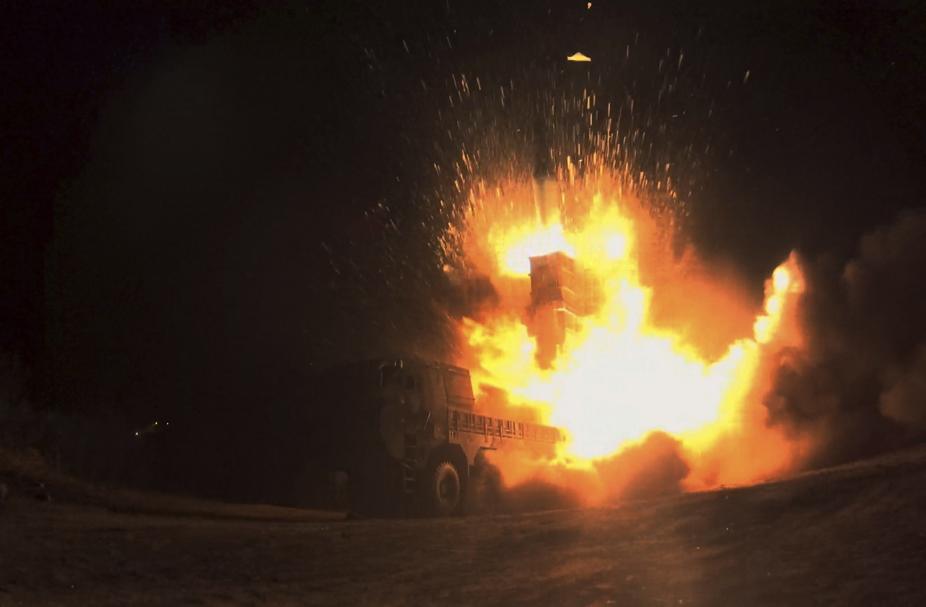
HONG KONG — The pilots of three commercial jets reported seeing what appeared to be the missile that North Korea launched last week, raising questions about the possible risk to civilian flights from the North’s weapons program.
The flight crew of Cathay Pacific Flight 893 from San Francisco to Hong Kong last Wednesday saw “what is suspected to be the reentry’’ of the North Korean missile, the airline said this week.
In addition, the pilots of two Korean Air flights bound for Incheon International Airport near Seoul, South Korea’s capital, saw “a flash, and everyone is assuming it should be the missile because of the timing,’’ said a Korean Air spokesman.
The intercontinental ballistic missile flew for 53 minutes before crashing in waters 600 miles to the east. It had the potential to fly more than 8,000 miles, analysts said, putting all of the continental United States in range. North Korea called the new missile the Hwasong-15, and photos suggested advancements over earlier models.
Because the Hwasong-15 and several other missiles North Korea recently tested were launched at a high angle, they landed far closer to home than they could have. Still, several recent missiles have traveled out of North Korean airspace and closer to areas frequented by civilian flights. The North has been carrying out its missile tests without warning for years.
The missiles “are predominantly reentering into Japanese airspace,’’ Flight Service Bureau, a Florida-based aviation consulting firm, said in August. “This creates a new risk to civil aviation.’’
Cathay Pacific said its plane was “far from the event location’’ Wednesday, but it did not say how far. The sighting was reported to air traffic controllers in Japan, and the flight’s “operation remained normal and was not affected,’’ the airline said.
Korean Air said it was unclear how far the apparent missile reentry was from its planes, whose flights originated in Los Angeles and San Francisco.
Military weapons have sometimes downed civilian flights, including Malaysia Airlines Flight 17, which investigators say was hit by a Russian surface-to-air missile over Ukraine in 2014. While the intercontinental ballistic missiles, or ICBMs, that North Korea has recently tested are not meant for use against aircraft, they could pose a risk to planes.
“It is something to be concerned about,’’ said Peter Harbison, executive chairman of CAPA — Center for Aviation, a consultancy in Sydney. But he said that while such missiles pose a danger to commercial flights, the risk is “low in terms of probability.’’
Both Cathay Pacific and Korean Air said they were not taking any new precautions. “We have been in contact with relevant authorities and industry bodies as well as with other carriers,’’ Cathay Pacific said. “At the moment, no one is changing any routes or operating parameters.’’
“The risk is small,’’ said Roger Mulberge, an aviation safety consultant in Bangkok. “Even with the amount of air traffic you get these days, in the airspace there’s a fair amount of room.’’ But North Korea’s tendency to launch without warning is “worrying,’’ he added.
North Korea stopped giving advance notice of its missile tests in 2014. After the North launched dozens of rockets and ballistic missiles that year, South Korea complained to the United Nations Security Council and international aviation and maritime organizations about the lack of warning.
As North Korea began testing ICBMs this year, the Federal Aviation Administration and the authorities in several other countries issued warnings about the threat of unannounced launches.
US carriers have long been banned from flying over most of North Korea because of the risk of planes being targeted by the North’s military. In 1998, the FAA decided to allow US airlines to operate in the Far East of North Korean airspace, over the Sea of Japan. Last month, the FAA restricted US carriers from that slice of North Korean airspace, as well.

