


MOSCOW — As president of Georgia, he survived a disastrous war with Russia. As a regional governor in Ukraine committed to fighting corruption, he clashed with just about everybody, including his estranged former ally, Ukraine’s president, Petro O. Poroshenko.
On Tuesday Mikhail Saakashvili, a onetime darling of the West, took his high-wire political career to bizarre new heights when he climbed onto the roof of his five-story apartment building in the center of Kiev, the Ukrainian capital, with law enforcement officers in hot pursuit. As a crowd of hundreds of supporters gathered below, he shouted insults at Ukraine’s leaders and, according to several local news outlets, threatened to jump if security agents tried to grab him.
Dragged from the roof after denouncing Poroshenko as a traitor and a thief, the former Georgian leader was detained but then freed by his supporters, who, amid raucous scenes on the street, blocked a security service van before it could take Saakashvili to a Kiev detention center and allowed him to escape.
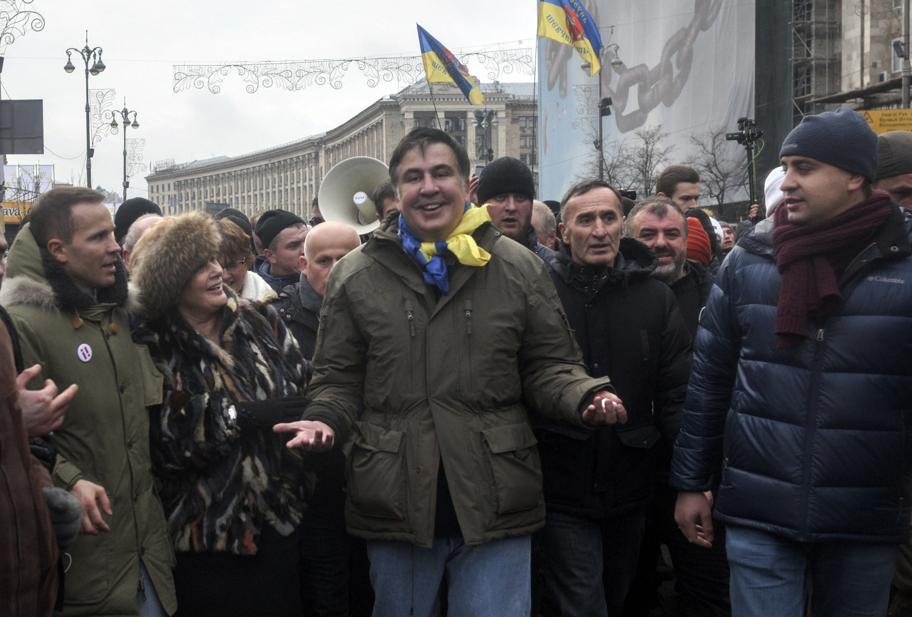
With a Ukrainian flag draped across his shoulders and a pair of handcuffs still attached to one of his wrists, Saakashvili then led hundreds of supporters in a march across Kiev toward Parliament. Speaking through a bullhorn, he called for “peaceful protests’’ to remove Poroshenko from office, just as protests had toppled the former president, Viktor F. Yanukovych, in February 2014.
Russia reveled in a spectacle that only buttressed its view that Ukraine is a chaotic shambles incapable of running its own affairs. State television repeatedly broadcast footage of Saakashvili screaming from the rooftop and of the melee on the street below. The Kremlin spokesman, Dmitry Peskov, took delight in mocking Saakashvili, telling journalists in Moscow, “You know, we’re not used to reacting to statements made by people who are sitting on roofs.’’
He added: “We are observing events overall with interest. Of course, this is Ukraine’s headache. This is something you wouldn’t wish even on an enemy, that’s how I’d put it.’’
The US Embassy in Kiev issued a statement calling “on all sides to de-escalate tension and avoid violence. We are monitoring the situation closely and expect any investigation will be conducted expeditiously and in accordance with Ukrainian law.’’
The European Union mission in Kiev also called for a fair inquiry in accordance with the law and asked that Saakashvili’s rights be respected.
The scenes outside Saakashvili’s apartment on Kostelnaya Street left some aghast, with Mustafa Nayyem, a reform-minded member of Parliament and a key figure in the 2013-14 protests against Yanukovych, describing them as “idiotism’’ on Facebook.
“Whatever your opinion of Saakashvili, the government’s actions now concern all of us,’’ he wrote. “This could happen to anybody who doesn’t cut a deal with them.’’
Seeking to explain why Ukraine’s security agency, the SBU, had tried to grab the former Georgian leader, Ukraine’s prosecutor general, Yuri Lutsenko, accused Saakashvili of assisting a criminal organization led by Yanukovych, the ousted pro-Russian president, and receiving $500,000 to fund his political activities from a fugitive Ukrainian businessman, Serhiy Kurchenko.
The prosecutor’s office released an audio recording featuring what it said was a conversation between Saakashvili and Kurchenko and their aides about the organization of protests aimed at toppling Poroshenko.
The move to arrest Saakashvili, Lutsenko told journalists in Kiev, “broke the plan of revenge by pro-Kremlin forces.’’
Ukrainian political rivals routinely accuse each other of working in cahoots with the Kremlin, whatever the reality of their affiliations. The prosecutor’s accusation that Saakashvili was collaborating with Yanukovych seemed to be largely aimed at discrediting the former Georgian leader, who has attracted support in Ukraine by positioning himself as an uncompromising enemy of Russia, corruption, and Poroshenko.
The day’s dizzying events suggested that the feud between Saakashvili and his former sponsor, Poroshenko, has escalated to a dangerous new level. They also marked a surprising twist in the tumultuous career of a former leader who has burned so many bridges over the years that, stripped of his citizenship by both Georgia and Ukraine, he is now stateless and effectively a refugee.
But Lutsenko, the prosecutor general, said that Ukraine had no immediate plans to return Saakashvili to Georgia, which has demanded his extradition to face corruption charges.
Saakashvili took to the roof in protest after Ukrainian prosecutors came to his apartment early Tuesday morning and demanded to search it. As a flash mob of supporters gathered on the street below, he gave a rambling speech from the rooftop, urging “all Ukrainians to take to the streets and drive out the thieves.’’
“They want to kidnap me, because I rallied to the Ukrainian people’s defense. They wanted to kidnap me unnoticed, but they failed to do this,’’ Saakashvili proclaimed. He pleaded with police officers not to carry out what he called criminal orders to arrest him.
As president of Georgia for nearly a decade, Saakashvili initially won plaudits in Washington and other Western capitals for rooting out corruption and turning his small nation into a rare success story among former Soviet lands. But his image as a heroic reformer lost much of its sheen after a 2008 war with Russia and waves of arrests that targeted not only the corrupt but also his political enemies.
He left Georgia in 2013 and, after the ouster of Yanukovych in 2014, was appointed governor of Ukraine’s Odessa region, a notorious swamp of corruption, by the country’s new president, Poroshenko.
Saakashvili quit the Odessa job in 2016, complaining that Poroshenko and other senior officials were blocking his efforts to fight graft. He was stripped of his Ukrainian citizenship last year while out of the country and ordered not to come back.

