


HEALTH CARE
Baker won’t say if he will veto legislation on containing health care costs
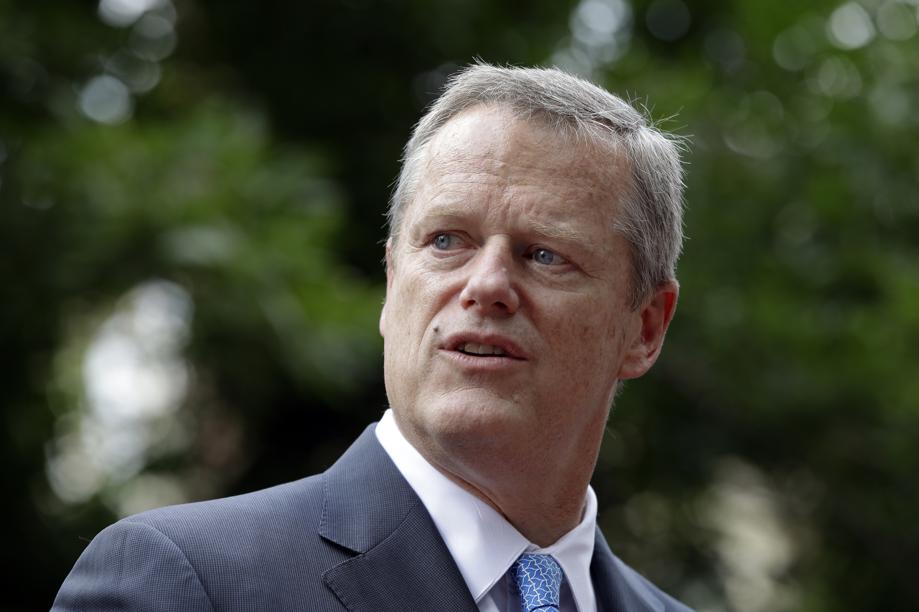
Governor Charlie Baker declined to say Thursday whether he would veto legislation approved by the state Legislature that omits his administration’s plans for containing state health care costs. By wide margins, lawmakers Wednesday passed a measure to impose new fees on employers to help fund the state Medicaid program, called MassHealth. But they rebuffed Baker’s proposals for containing MassHealth costs, in part by shifting some low-income poor adults off of the program. The governor had asked legislators to approve his cost-saving measures along with the new fees on businesses, which would raise an estimated $200 million in the fiscal year that began this month. Business groups oppose paying extra fees unless the state also takes steps to tackle costs. Baker told reporters at the State House that he wanted to continue working with the Legislature on health care. “I fully expect that we’re going to continue to talk to them about this this summer and into the fall,’’ Baker said. “And I hope we can reach some reasonable accommodations and make sure everybody in Massachusetts continues to have health care coverage, which is something we started doing long before anybody else.’’ He added, “But at the same time, we need to do this in a way that’s sustainable.’’ The costs of MassHealth have soared in recent years, amounting to about $16 billion a year, which is split between the state and federal governments. The governor didn’t say what he would do with the bill before him. He could accept or veto the bill. If he vetoes it, the Legislature has enough votes to override. If Baker does nothing for 10 days, the legislation would go into effect as is. The House and Senate are expected to be on recess for much of the next several weeks. They would have to call formal sessions in order to vote. Last month, Baker administration officials asked lawmakers to approve several proposals to help rein in state medical spending, but lawmakers said they didn’t have enough time to debate the complex set of proposals. MassHealth provides benefits to 1.9 million people in the state. Baker’s plan would move 140,000 adults, including 100,000 parents, from MassHealth onto commercial health plans. —PRIYANKA DAYAL MCCLUSKEY
FAST FOOD
Dunkin’ to pare menus in an attempt to speed up service
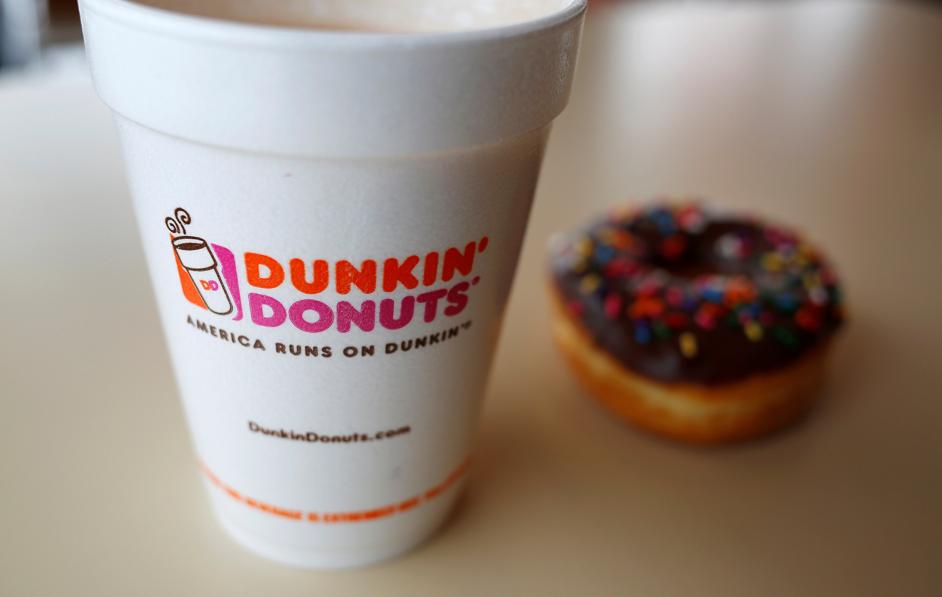
If Americans do indeed run on Dunkin’ Donuts, the company wants to serve more of them midstride. Dunkin’ Brands chief executive Nigel Travis said Thursday that the Canton-based chain will pare both its menu and expansion plans in an attempt to better establish Dunkin’ Donuts as an “on-the-go’’ brand. The changes will soon be reflected in updated store designs that will focus on serving customers who place orders on mobile devices and pick them up in Dunkin’ shops, Travis said. It also will put more emphasis on drive-throughs and curbside pickup. The overall goal is to increase store traffic, which last quarter dipped in comparison with the same period last year. Travis said 70 percent of Dunkin’ customers who use mobile ordering within the chain’s DD Perks app are repeat customers. Those orders now account for 2 percent of all store sales. As part of an effort to stress beverage sales, Dunkin’ also is simplifying the menu at 1,000 locations, including some New England stores. Starting next month, it will remove some menu items in markets that include Bristol County and Providence. Items that could be eliminated in some stores include all afternoon sandwiches, honey bran, raisin, and reduced-fat muffins, and some types of bagels — including garlic, blueberry, onion, salt, and whole wheat. Drinks on the chopping block include flavor shots and smoothies. Cookies, brownies, and “bagel twists’’ may also be eliminated. But company spokeswoman Michelle King in a statement, said there will be no changes to any menus at Dunkin’ locations “in the Boston market.’’ There are more than 1,100 Dunkin’ Donuts shops in Massachusetts, and more than 8,900 nationwide. Testing of the simplified menus will start in the Providence area on Aug. 7. — DANNY MCDONALD AND JANELLE NANOS
ALCOHOLIC BEVERAGES
Retailers can sell at deep discounts if they bought in bulk
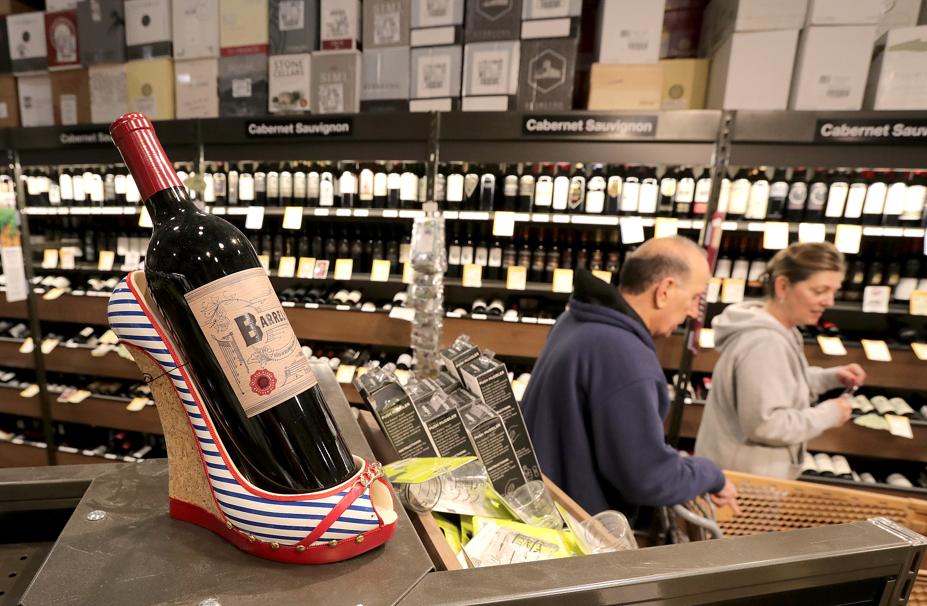
A Boston judge has ruled that Massachusetts alcohol retailers can legally sell booze at deep discounts when they order it in bulk, rebutting state regulators who said the practice can violate a state law that prohibits selling alcohol at less than cost. The decision Tuesday by Suffolk Superior Court Judge Robert B. Gordon came in response to a lawsuit brought by the country’s largest alcohol chain, Maryland-based Total Wine & More, against the state Alcoholic Beverages Control Commission. In January, the agency slapped Total Wine’s Everett and Natick stores with several-day license suspensions for allegedly selling Smirnoff vodka, Bacardi rum, and other liquors for $1 to $6 below their wholesale costs. State alcohol laws and regulations forbid retailers from offering such below-cost “loss leaders,’’ a policy the state says is necessary to prevent excessive drinking and predatory pricing. Total Wine sued to overturn the license suspensions. The company argued its prices for consumers weren’t actually below its costs but were based on quantity discounts the company expected to receive from its wholesalers later on, after it had ordered enough of the products to qualify. The ABCC, Total Wine said, unfairly refused to acknowledge the true, ultimate cost of the liquor to the company, and instead looked only at initial invoices that listed a higher cost. Gordon, the judge, agreed, saying the ABCC’s “starchy’’ and “semantic’’ definition of cost “bears no rational relationship to the legislative policy of prohibiting anti-competitive pricing practices.’’ “There was clearly no predatory pricing carried out in this case,’’ Gordon wrote in his decision, “only a salutary effort by a retailer to pass along savings derived from volume purchasing at the wholesale level to its customers. This is something the law should promote rather than punish.’’ However, Gordon declined to rule on Total Wine’s argument that the pricing law violated US antitrust laws, a claim the company also pursued in an ultimately unsuccessful federal lawsuit challenging a similar minimum pricing requirement in Connecticut. That means Massachusetts retailers are still barred from selling below cost, a reprieve for the owners of smaller package stores who say the requirement prevents large chains such as Total Wine that can afford to sell products at a loss from unfairly undercutting their prices and driving them out of business. — DAN ADAMS
INSURANCE
SBLI policy holders are now in charge
It’s official: The banks are out as owners of the Savings Bank Life Insurance Company of Massachusetts, and the policy holders are in charge. The Woburn-based SBLI took the unusual step of converting into a mutually owned firm. The company spent $57.3 million in surplus funds and debt to buy out its 30 bank shareholders. About 10 percent of SBLI’s policy holders, about 61,500 people, took part in voting on whether to convert the firm into a mutual company. A vast majority of those voting, 92 percent, were in favor, said James Morgan, the insurer’s chief executive officer. But the conversion process did hit some road bumps along the way. Earlier this summer, a New Hampshire woman with an SBLI policy asked a Suffolk County Superior Court judge to block the conversion. She argued that SBLI was paying the bank shareholders — including Bank of America Corp. and Citizens Financial Group — too much for their shares, leaving policy holders with millions of dollars in debt. The insurance company had also failed to adequately inform policy holders of its intentions, the complaint said. Superior Court Justice Mitchell H. Kaplan, however, denied the request for an injunction. — DEIRDRE FERNANDES

