


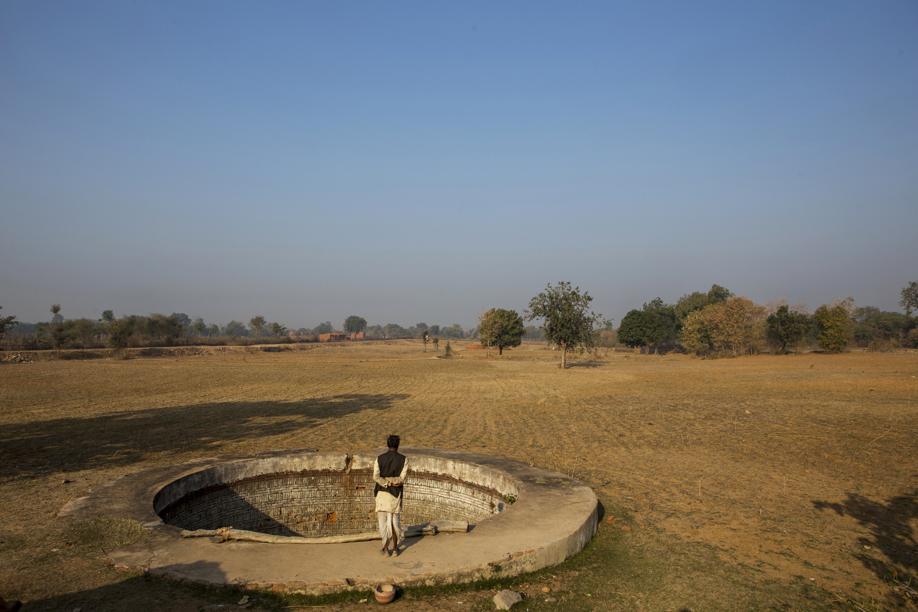
SHIVOOR, India — In the blistering sun and swirling dust, farmer Dhananjay Hanumant Suryavanshi squats on his empty land and caresses the parched earth.
‘‘There is only one thought that runs over and over again in my head. Will there be good rain this year? Will there be good rain this year?’’ Suryavanshi, 25, said.
Four years of drought and crop loss have forced his family to take two loans and sell a third of his land, and driven him to do menial labor. In January, his mother gave up. She drank a bottle of pesticide and fell dead near the holy basil plant in the courtyard.
Relentless drought coupled with a record-breaking heat wave and bad farming practices in the western state of Maharashtra have slashed farm output and driven farmers to desperation.
This year is the worst in decades, officials say, because most farmers are also burdened by years of accumulated debt as they continue to deplete the precious groundwater.
About 330 million Indians are struggling under grueling heat and drought conditions across 10 states this year, the government said, severely harming the economy of a nation where nearly half the people rely on farming.
Reservoirs and rivers here in Maharashtra’s drought districts are almost dry, and a 50-car train now delivers water to Latur city, near Suryavanshi’s village. Thirsty Indians place long lines of plastic pots and drums at the municipal water tank and village wells, and fights have broken out at water pumps.
In many places, children have turned into porters for their families, carrying water pots all day. A 12-year-old girl collapsed and died last month here in the searing 111-degree heat after she made five trips to fetch water.
‘‘My whole family is in a constant state of panic over water,’’ said Kasi Mali, as she placed her pots in a long line. ‘‘I have missed many hours of my work as a laborer because I stand here.’’
Nearly 30 percent of Indians in cities and 70 percent in villages rely on water pumped from deep underground, because the tap water supply is either insufficient or nonexistent.
Only 17 percent of India’s farms have access to surface irrigation projects. Most farmers rely on the elusive annual rain or pump water from underground.
The practice has depleted the country’s groundwater supply precipitously, alarming environmentalists and raising concerns about India’s future agricultural output. Water levels have declined in 47 percent of India’s village wells over the past decade, the government said.
In Latur city, there is no groundwater even 700 feet down, residents say. In the villages nearby, the water table is in far worse shape, in some places dropping to 1,000 feet below the surface.
Environmental experts have repeatedly warned that the water table will disappear soon if India’s water usage is not regulated.
‘‘We have gone on digging so aggressively in the last 10 years to draw water for our crops that we have used up the groundwater that is meant for the next two generations,’’ said Raju Dongare, a farmer. ‘‘But what else could we depend on? There were no canals or pipes coming to our farms.’’
Analysts also say that the drought is not a natural disaster but a consequence of decades of bad farming practices.
In recent years, the state government allowed the proliferation of sugar factories owned by local politicians, which led to a sort of gold rush among farmers here to cultivate water-guzzling sugar cane, said Pradeep Purandare, former professor of water studies at the Water and Land Management Institute.
Seventy percent of the water from the state’s dams goes to cane farms. But cane growers have drawn on groundwater, further sapping the aquifers.
This year, somewhat belatedly, the administration in Latur district launched a drive to encourage farmers to shift away from cane to oil seeds, lentils, and soybeans.
Repeated droughts have pushed tens of thousands of farmers to leave their villages to look for work in India’s overburdened cities and towns.
In Matola village, about 500 people, mostly men, have left in just the past six months. Many of the women and children left behind are selling their cattle in distress.
‘‘There is no water in the sky or under the earth; there is nothing left here,’’ said Bai Gidappa Pawar, as she poured freshly ground chili powder into a jar in her kitchen. In December, her husband left for Pune city with their 16-year-old son to work in a quarry. ‘‘There is not a single family here that does not have a loan hanging over its head.’’
Severe droughts are also affecting other countries. In Zimbabwe, a relentless El Nino-induced drought has left as many as four million people in need of food aid and ravished the country’s natural resources, decimating crops and drying up water sources. At least 16,500 cattle have died.
Last year, the Zimbabwean government drew scrutiny and the ire of conservationists when it began selling elephants to China. The sale, government officials admitted, would reduce the booming elephant population but also raise money.
Officials said the reduced number of wildlife would unburden grasslands and water resources until the next rainy season.

