


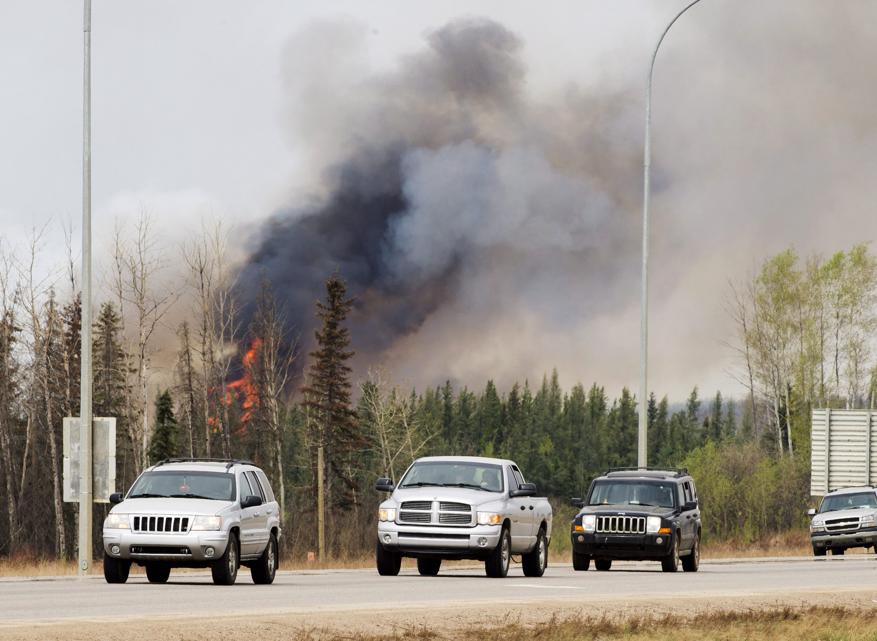
LAC LA BICHE, Alberta — Canadian officials were completing the mass evacuation of work camps north of Alberta’s main oil-sands city of Fort McMurray on Saturday, fearing a growing wildfire could double in size and reach a major oil-sands tract and even the neighboring province of Saskatchewan.
Chad Morrison of Alberta Wildfire said the massive blaze in the province covered more than 600 square miles (or 384,000 acres) Friday, and was expected to grow to 1,100 square miles by the end of Saturday because of high temperatures, dry conditions, and high winds.
The size estimate includes burned areas and those sections still in flames.
‘‘The fire may double in size in the forested areas today. As well, they may actually reach the Saskatchewan border. In no way is this fire under control,’’ Alberta’s premier, Rachel Notley, said.
The temperature in the area exceeded 80 degrees Saturday.
More than 85,000 people have left Fort McMurray in the heart of Canada’s oil sands, where the fire has torched 1,600 homes and other buildings.
They were evacuated by planes and vehicles, including about 4,000 scheduled to leave Saturday.
Fanned by high winds, scorching heat, and low humidity, the fire grew from about 30 square miles Tuesday to 39 square miles on Wednesday, but by Thursday it was almost nine times that — 330 square miles. That’s an area roughly the size of Calgary, Alberta’s largest city.
Thousands of displaced residents were getting a sobering drive-by view of some of the burned-out neighborhoods as convoys continued.
The images were largely ones of devastation: scorched trucks, charred homes, and telephone poles, burned out from the bottom up, hanging in the wires like little wooden crosses. No deaths or injuries were reported.
Notley said about 12,000 evacuees have been airlifted from air fields over the past two days and about 7,000 have been evacuated in police-escorted highway convoys. She said the goal was to complete the evacuation of people from northern work camps by late Saturday.
Notley’s comments came as officials said the fire could burn to the edges of the Suncor oil-sands facility, about 15 miles north of Fort McMurray. Nonessential staff have been leaving and efforts to protect the site were underway.
‘‘This facility, it should be emphasized, is highly resilient to forest fires as we have seen in past, when it’s previously been threatened by very large fires,’’ Notley said.
Oil-sands mines are resistant to fires because they are cleared and have no vegetation, said Chad Morrison of Alberta Wildfire. He said the sites also have very good industrial fire departments.
The fire and mass evacuation has forced as much as a quarter of Canada’s oil output offline and was expected to affect a Canadian economy already hurt by a dramatic fall in the price of oil. The Alberta oil sands have the third-largest reserves of oil in the world, behind Saudi Arabia and Venezuela. Its workers largely live in Fort McMurray, where some neighborhoods have been destroyed.
Police said many parts of smoke-filled Fort McMurray are burnt and visibility is low. Officers wore masks as they checked homes to make sure everyone was out.
Gas has been turned off in the oil-sands city, the power grid is damaged, and water is not drinkable.
About 25,000 evacuees moved north in the hours after Tuesday’s mandatory evacuation, where oil-sands work camps that usually house employees were used to house evacuees. Officials are moving everyone south, where it is safer.
Syncrude, a major oil-sands mining company, became the latest to shut down operations. The company said in a statement that although there is no imminent threat from fire, smoke has reached its Mildred Lake site. They started the evacuation early Saturday, and intend to have all personnel out this weekend.
Syncrude said they will restore operations when there is no risk and said that, despite the extraordinary measures, the jobs of more than 4,800 employees remain secure.
Chad Morrison, with Alberta Wildfires, said the fire is burning away from communities. He said cooler temperatures were expected later this weekend and they could get rainfall. Significant rainfall is needed.
Inspector Kevin Kunetzki of the Royal Canadian Mounted Police said police were canvassing every residence in Fort McMurray and had completed about 30 percent of that work. They found a family of five with small children on Friday who didn’t have the means to get out. He said there are very few who are refusing to evacuate.
Lac La Biche, Alberta, normally a sleepy town of 2,500 about 110 miles south of Fort McMurray, was helping thousands of evacuees, providing a place to sleep, food, donated clothes, and even shelter for their pets. Jihad Moghrabi, a spokesman for Lac La Biche County, said 4,400 evacuees have come through The Bold Center, a sports facility in town.
At the center, tables were piled with clothes, towels, and other items. The center was offering three free meals a day and other services, including mental health services. A kennel housed people’s pets on site.
Philip Wylie; his wife, Suda; and their 13-month-old daughter, Phaedra, were among those staying at the center after evacuating their apartment in Fort McMurray on Tuesday.
‘‘Trees were blowing up against our vehicles,’’ Philip Wylie said of the caravan drive out of town.
‘‘We don’t know what we’re going to go back to, or when we can go back,’’ he said.

