


dance review
The Sleeping Beauty
Music by Peter Ilyich Tchaikovsky. Choreography by Marius Petipa; additional choreography by Frederick Ashton. Staging by Ninette de Valois. Sets and costumes, David Walker. Lighting, John Cuff. Presented by Boston Ballet. At: Boston Opera House, through May 19. Tickets: $55-$154. 617-695-6955, www.bostonballet.org
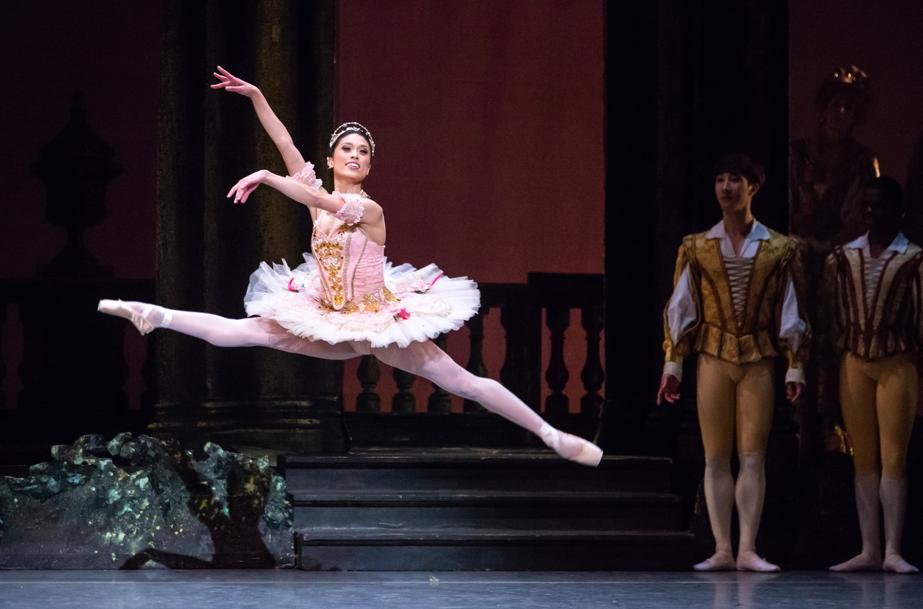
Can a ballet company program “The Sleeping Beauty’’ too often? If the company is Boston Ballet, the answer is no. In Boston Ballet’s repertoire, “Sleeping Beauty’’ has been presented every four years or so, most recently in 2017, but this spring we’re getting an encore staging of five performances. On Friday, with a cast headed by Lia Cirio as Princess Aurora and Lasha Khozashvili as Prince Désiré, the production looked as sumptuous as ever.
One major difference from last year’s performances is the presence of guest conductor Ming Luke in the orchestra pit. Luke is the principal guest conductor for San Francisco Ballet; he’s also led the New York City Ballet Orchestra and the Bolshoi Orchestra. Friday he set a brisk pace for much of the evening. It was enlivening at times in a ballet that, at slow tempos, can sag and seem, well, sleepy. And the Boston Ballet Orchestra played well for him. But too many moments lacked emotional weight, and in some cases the dancing was so fast that it wanted character. The Rose Adagio from act one, in which Aurora balances in attitude on pointe as she’s supported by each of her four suitors in turn, was zipping by until the climax, when Luke put on the brakes. That gave Cirio an opportunity to show off, and she did, but at the cost of Tchaikovsky’s emotional and musical arc.
Friday’s performance did start with a bang. Tchaikovsky’s score opens with a dramatic, heroic burst, music fit for a prince. Only when Carabosse arrives in the prologue do we realize that this opening music is actually her theme. Carabosse is the “bad’’ fairy who, through oversight, wasn’t invited with the other fairies to preside over baby Aurora’s christening. When she shows up anyway, in a hail of thunder and lightning, dressed in black and with an entourage of grotesque creatures, you understand what motivated the oversight. But what makes Carabosse bad? Her gift — yes, she brought a gift — to Aurora is a spindle, an emblem of honest work. (It flummoxes Aurora’s royal parents, who don’t appear to have ever seen one.) And that’s her way of saying that life shouldn’t be all roses and no thorns. Tchaikovsky, at least in his music, appears to sympathize.
Many productions of “Sleeping Beauty’’ cast Carabosse in drag. Here she’s played by a woman, and darkly beautiful, night to the Lilac Fairy’s day. On Friday, Kathleen Breen Combes lit up the stage with sensual, righteous fury; one look and Aurora’s parents quailed with guilt. Addie Tapp’s gentle but unflappable Lilac Fairy was the perfect complement; she and Carabosse eyed each other as if they’d had dealings before. Tapp eyed everyone else with a protective benevolence; she’s very connecting in this role. The one flaw in her performance was her variation in the prologue, where she looked nervous and unsteady. She showed last year that she can handle this variation; perhaps the quick tempo threw her off.
Cirio and Khozashvili were also reprising their roles from last year’s production. Cirio was a convincing 16-year-old, flirtatious with her suitors and attentive to her parents, and she was in control of every moment in the Rose Adagio. But though she’s a strong dancer, she’s not a seductive one. And though the Ballet frequently pairs her with Khozashvili, the two seldom look comfortable together. Khozashvili, so uninhibited with Seo Hye Han in “Romeo and Juliet’’ back in March, seemed constrained here, and he struggled with his first-act meditation. In the grand pas de deux, he managed his four double tours en l’air and his tours à la seconde well enough, but I wanted more bravura.
I got that, and also chemistry, from the miniature pas de deux of Junxiong Zhao’s Blue Bird and Misa Kuranaga’s Princess Florine, part of the wedding divertissements. Zhao eased through his high-flying beats and gliding brisés volés; Kuranaga preened and fluttered with her usual exquisite grace. They made a convincing pair of courting birds; it would have been a treat to see them as Désiré and Aurora.
Friday offered a fine line-up of supporting good fairies, from Dawn Atkins’s crisp, alert Crystal Fountain to Ekaterine Chubinidze’s exuberant Enchanted Garden, Ji Young Chae’s poetically pointed Woodland Glade, María Álvarez’s chirpy Songbird, and Dalay Parrondo’s cheeky Golden Vine. Fairy-tale comic relief at the wedding was provided by Lawrence Rines and Haley Schwan as Puss’n Boots and the White Cat and Nina Matiashvili and Desean Taber as Red Riding Hood and the Wolf.
Even with Luke’s swift pacing, Friday’s performance ran two hours and 50 minutes. But that’s not too long to enjoy David Walker’s French Baroque sets and costumes, or the lively contribution — in roles that range from peasants and nymphs to the fairies’ attendants and Désiré’s hunting party — of the company’s sterling corps.
The Sleeping Beauty
Music by Peter Ilyich Tchaikovsky. Choreography by Marius Petipa; additional choreography by Frederick Ashton. Staging by Ninette de Valois. Sets and costumes, David Walker. Lighting, John Cuff. Presented by Boston Ballet. At: Boston Opera House, through May 19. Tickets: $55-$154. 617-695-6955, www.bostonballet.org
Jeffrey Gantz can be reached at jeffreymgantz@gmail.com

