


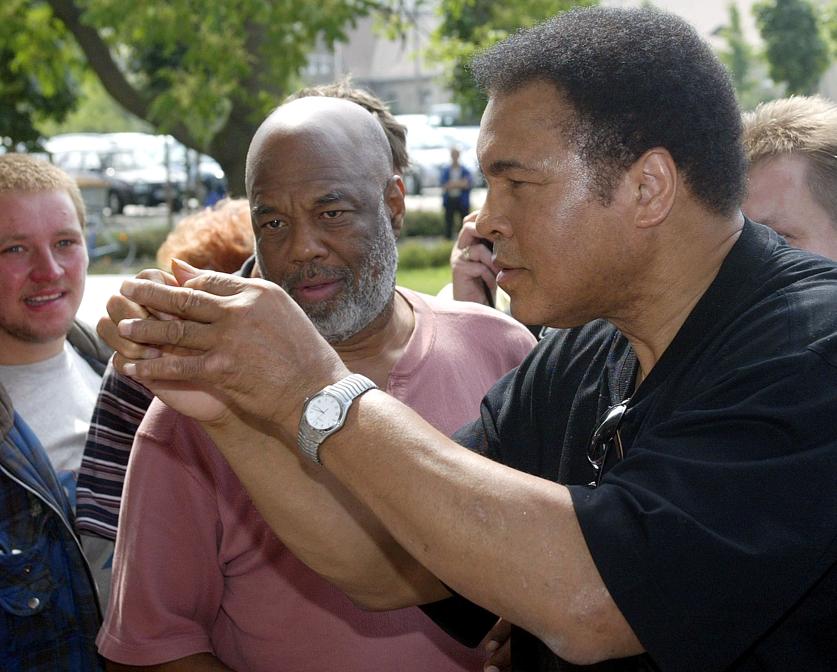
WASHINGTON — Howard Bingham, a photographer who shot millions of images of Muhammad Ali and became a well-known figure in his own right through his long and abiding friendship with the boxing champion and humanitarian, died Thursday at a Los Angeles hospital. He was 77.
The death was confirmed by his agent, Harlan Werner. The cause was not disclosed.
For more than 50 years, until Ali’s death in June, each man described the other as his closest friend. But unlike others in Ali’s entourage, Mr. Bingham was never on the boxer’s payroll, never a yes man.
Instead, he had an independent career as a photographer, working on contract for Life magazine in the 1960s, chronicling urban unrest, poverty, politics, and entertainment. He contributed to Sports Illustrated, Ebony, Look, Newsweek, People, and Playboy and worked on the sets of Hollywood movies, shooting still photographs for such productions as ‘‘The Candidate’’ (1972) and ‘‘All the President’s Men’’ (1976).
Yet the subject he photographed more than any other was Ali. Through public triumphs and private travails, Mr. Bingham was at Ali’s side, recording the boxer’s rise to prominence in the early 1960s, his victories in the ring, his conversion to Islam and his refusal to serve in the Army during the Vietnam War.
Later, as Ali became perhaps the most famous person in the world, Mr. Bingham accompanied him on charitable missions, on visits to world leaders and in private moments at home. They spent an average of 100 days a year together and spoke on the phone almost every day. Their shorthand greeting for each other was ‘‘Hi, Bill.’’
During the long years of Ali’s decline, as the debilitating effects of Parkinson’s disease became all too apparent, Mr. Bingham became something of a gatekeeper for the fading but still charismatic champion.
He coordinated Ali’s poignant appearance at the opening ceremony of the Summer Olympic Games in Atlanta in 1996, when Ali falteringly lifted a torch to light the Olympic flame.
‘‘Millionaires could not have done the things that I have done because of my friendship with Ali,’’ Mr. Bingham told Newsday in 1993. ‘‘I’ve met presidents, kings and queens, [Bill] Cosby, Malcolm X, Nelson Mandela. I feel very fortunate just to have been his friend.’’
They met in 1962, when Mr. Bingham was a budding photojournalist for a black newspaper in Los Angeles. The young fighter — then known by his original name, Cassius Clay — was in town for a boxing match.
‘‘I covered him at a news conference,’’ Mr. Bingham told The Washington Post in 1991. ‘‘Then I was driving by the corner of 5th and Broadway and his brother and him were just watching the girls go by. I asked them if they wanted a ride.’’
He drove them around Los Angeles, including a visit to Mr. Bingham’s mother, and a friendship was born. They took road trips together and met each other’s family. Mr. Bingham even joined Ali, who was married four times, on one of his honeymoons.
‘‘I think we became friends because I didn’t want nothing from him,’’ Mr. Bingham told the Boston Globe in 2004. ‘‘We just became friends, and we stayed friends.’’
Over the years, Mr. Bingham shot an estimated 4 million images of Ali. He photographed the young boxer as he met Malcolm X, who helped engineer Ali’s conversion to Islam. He was in Ali’s training camp and was ringside for nearly all of his fights, including his dramatic 1974 upset of George Foreman in the ‘‘Rumble in the Jungle’’ and his epic 1975 bout with Joe Frazier in the Philippines, the ‘‘Thrilla in Manila.’’
Despite their differences — Ali was loquacious in the early years, Mr. Bingham spoke with a stutter; Ali was Muslim, Mr. Bingham was the son of a Christian pastor — their bond grew stronger with time.
‘‘Howard never infringed upon that friendship, that trust,’’ Ali’s wife, Lonnie Ali, told CBS in 1997. ‘‘He never violates it. Howard would never sell you out.’’
As Ali’s physical struggles made him increasingly frail and silent, Mr. Bingham stepped into a more public role as a protector and conduit to Ali and his family. He overcame his speech impediment to speak on Ali’s behalf.
‘‘Their relationship is transcendental, almost metaphysical,’’ George Jackson, a onetime chief executive of Motown Records, told Sports Illustrated. ‘‘But the evolution of these two men’s lives is really a remarkable story in itself. Now it’s Howard moving into the sun, and Ali can’t be understood so well, but there is Howard, his great friend, who couldn’t speak well, able to speak for him.’’
Mr. Bingham published several books of photographs about Ali, but only with the approval of the boxer and his wife. He was a producer of the 2001 feature film ‘‘Ali,’’ starring Will Smith, and was portrayed in the movie by actor Jeffrey Wright.
Howard Lenoid Bingham was born May 29, 1939, in Jackson, Miss., one of eight children. He was 4 when his family moved to Los Angeles. His father was a minister and baggage handler.
Mr. Bingham said he received an F in a photography course at a junior college, but he nevertheless pursued it as a career, first working at the Los Angeles Sentinel. Later in the 1960s, he distinguished himself while covering urban unrest throughout the country, including the Detroit riots of 1967.
‘‘It was wild, bullets everywhere,’’ he said. ‘‘I didn’t know if we were going to get out alive.’’
His marriage to Carolyn Turner ended in divorce, but they remained close until his death. A son, Damon Bingham, died in April. He leaves another son, Dustin Bingham of Los Angeles, and a granddaughter.

