


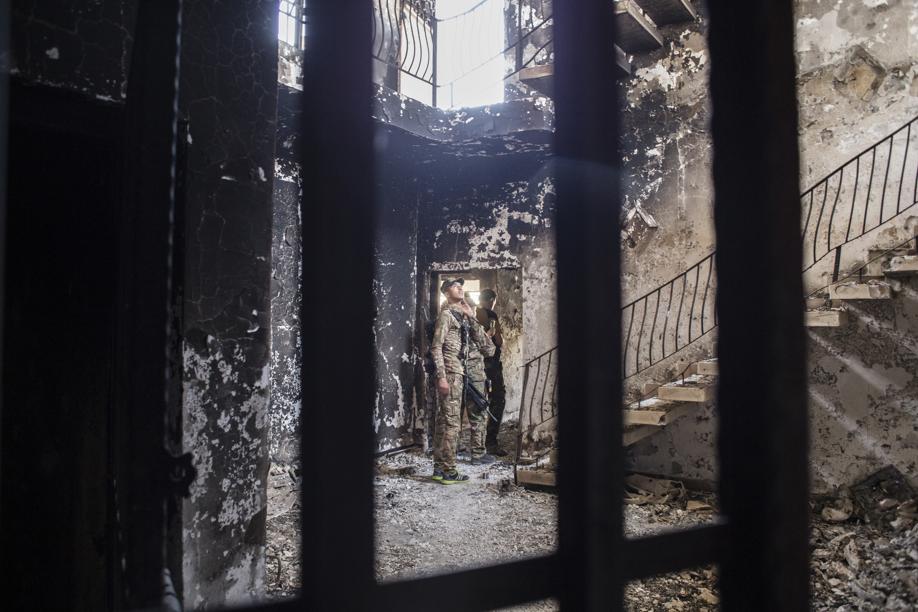
FALLUJAH, Iraq — From the outside, there’s not a lot that stands out about the three neighboring houses on this residential street in the Iraqi city of Fallujah.
One is grander than most, with two tall columns at its entrance. The others are unassuming and beige, like much of this city, which had been under the control of the Islamic State for the past 2½ years.
But behind the front doors is a makeshift prison used by the militants to mete out their archaic punishments. It provides a harrowing window into the brutal rule of law that governed here before the city was retaken, a glimpse of its regime of executions, floggings, and torture.
Home to many of the Islamic State’s leaders, Fallujah was the first city to fall into the hands of the organization and was a hub for its operations in Iraq.
The prison is just one of the remnants of their self-proclaimed caliphate that were left behind by the militants as they died or fled the city and that are now slowly being discovered, allowing Iraqi forces firsthand insight into the group’s inner workings.
As they pick through the city’s buildings since steadily recapturing the city over the last month, they are gradually unearthing bomb-making factories, documents, weapons caches, and jails like this one — many hidden in regular houses to avoid detection in airstrikes.
Colonel Haitham Ghazi, an intelligence officer for the Iraqi police’s emergency response division, also known as SWAT, indicated behind a barred door in one of the smaller buildings.
‘‘You can feel the breath of the prisoners inside,’’ he said.
The room, perhaps once a living room, was stifling, still thick with the odor of those who were incarcerated here.
It was dazzling daylight outside, but the windows were covered with sheets of metal. The little light that seeped through cast a glow over dozens of little bundles on the carpets — sheets, curtains, and scraps of clothes bound together to make pillows. There were dozens, giving an indication of the number of prisoners who were once locked up here.
The hallway outside had been torched. Iraqi security forces say that it was like that when they arrived, though pro-government forces appear to be setting some buildings on fire in Fallujah, a claim they deny.
The rooms upstairs still contained clothing and other possessions of the family that once lived here, belongings tossed across the floors and beds.
Papers found in the house showed that many people were detained after disputes that Islamic State courts had arbitrated, said Ghazi, whose forces discovered the prison. Some were imprisoned for stealing, and others for minor offenses such as smoking or violating the group’s strict dress code.
Major General Thamer Ismail, SWAT’s top commander for the area, said Iraqi forces have found a ‘‘a treasure of information’’ on the group in Fallujah. From here, they ordered car-bombing missions in Baghdad and operations as far away as Syria, he said.
His forces found another makeshift prison in Fallujah’s Nazzal neighborhood, he said, but it is smaller than this one in the recently retaken Muallimin district.
A hole in a garden wall outside that leads to the largest building allowed the jailers to move from house to house without venturing into the street, where they could have been observed from the air.
A steel sheet had been welded over the marble entrance to the main greeting room, the first sign that this is no ordinary home. A prison door with steel bars allowed access to it and another room that had been joined by a hole in a wall to make a large detention hall.
It’s the third house that appears to have been kept for the worst punishments: solitary confinement and torture. A thick black metal chain with a hook on the end hanged in the stairwell. ‘‘They’d hang them here from their legs and beat them,’’ Ghazi said.
The prison was empty when his forces arrived, Ghazi said. He does not know what happened to most of those who were incarcerated, except for some who appear to have been executed as Iraqi forces advanced.

