


LONDON — As investors sold off British stocks and traders drove the pound to its lowest level against the dollar since 1985, Britain struggled Monday to absorb the magnitude of its voters’ decision to leave the European Union, and to figure out a way forward.
Prime Minister David Cameron and the former London mayor Boris Johnson, members of the governing Conservative Party who were on opposite sides of the debate over Britain’s membership in the 28-nation bloc, both signaled that they hoped Britain could, while leaving the EU, somehow maintain access to the world’s largest common market.
But as the leaders of Germany, France, and Italy met to discuss the fallout from the British referendum, there were no signs that the EU would let Britain off the hook so easily.
The few countries that have been given access to the European free-trade zone without joining the bloc — notably, Iceland, Norway, and Switzerland — all contribute to the EU’s budget and accept its bedrock principle of free movement of workers, the very issues that angered so many of the Britons who voted to leave in Thursday’s referendum.
After meeting in Berlin, Chancellor Angela Merkel of Germany, President François Hollande of France, and Prime Minister Matteo Renzi of Italy said there would be no discussions over British withdrawal from the bloc until Britain formally invoked Article 50, the mechanism for doing so.
“I believe that Article 50 is very clear and that Great Britain needs to submit the application,’’ Merkel said, while emphasizing that it should not be “a long-drawn-out affair.’’
On Monday morning, George Osborne, the chancellor of the Exchequer, tried to calm the markets, citing Britain’s underlying economic strengths. But the markets did not seem assuaged. British and US stocks fell, as did the pound, and Standard & Poor’s downgraded Britain’s credit rating.
Cameron, who plans to resign by October, summoned his Cabinet and announced the creation of a policy unit of the “best and brightest’’ civil servants to orchestrate the country’s withdrawal from the EU.
In the first meeting of Parliament since the referendum, Cameron said he considered the referendum binding.
“The decision must be accepted and the process of implementing the decision in the best possible way must now begin,’’ he said.
About three-quarters of lawmakers had supported remaining in the EU. A senior Conservative lawmaker, Kenneth Clarke, suggested that Parliament could override the referendum — which is not, in the end, binding on the government — while a Labor legislator, David Lammy, called for a second referendum.
Cameron brushed such ideas aside, but he also made it clear that he would not be the one in charge of Britain’s exit.
Johnson, the most prominent face of the campaign to leave the EU, tried to assure Britons on Monday that their country “is part of Europe, and always will be,’’ pledging that changes “will not come in any great rush.’’
In an opinion essay in the Monday issue of The Telegraph, Johnson offered his most detailed — and conciliatory — remarks since the referendum. His description of the future seemed like the situation enjoyed by Norway, which pays into the EU’s budget while having no say over its rules.
“EU citizens living in this country will have their rights fully protected, and the same goes for British citizens living in the EU,’’ Johnson wrote. “British people will still be able to go and work in the EU, to live, to travel, to study, to buy homes, and to settle down,’’ he added.
Johnson offered no details about when Britain should invoke Article 50. Nor did he lay out a plan for how Britain could maintain free trade with the EU, without accepting the bloc’s demand for the unrestricted movement of workers.
Secretary of State John Kerry flew to London from Brussels on Monday to meet with Foreign Secretary Philip Hammond to discuss the fallout from the referendum.
In Brussels, Kerry told European leaders that he valued a “strong EU.’’ The range of issues on which the United States and Europe must cooperate included climate protection, counterterrorism, and immigration, he said.
“So I think it is absolutely essential that we stay focused on how, in this transitional period, nobody loses their head, nobody goes off half-cocked, people don’t start ginning up scatterbrained or revengeful premises, but we look for ways to maintain the strength that will serve the interests and the values that brought us together in the first place,’’ Kerry said.
In London, Hammond assured Kerry that Britain was not turning inward, while Kerry said that the “special relationship’’ between the two countries would endure.
A committee of British Conservative lawmakers met Monday and proposed a timetable to select two candidates for party leader. The party’s 125,000 members would choose between the two, with the goal of selecting a new leader — and therefore a new prime minister — by Sept. 2. A decision on the timetable is expected by Wednesday.
Unless the government collapsed in a no-confidence vote, two-thirds of Parliament would have to agree to call a new election.
With turmoil consuming both parties, that no longer seemed out of the question.
Johnson — a boisterous and often unpredictable Manhattan native and former journalist — is seen as the front-runner to replace Cameron, but he has made many enemies. The home secretary, Theresa May, who is in charge of domestic security and who advocated remaining in the EU, has emerged as perhaps the most credible alternative.
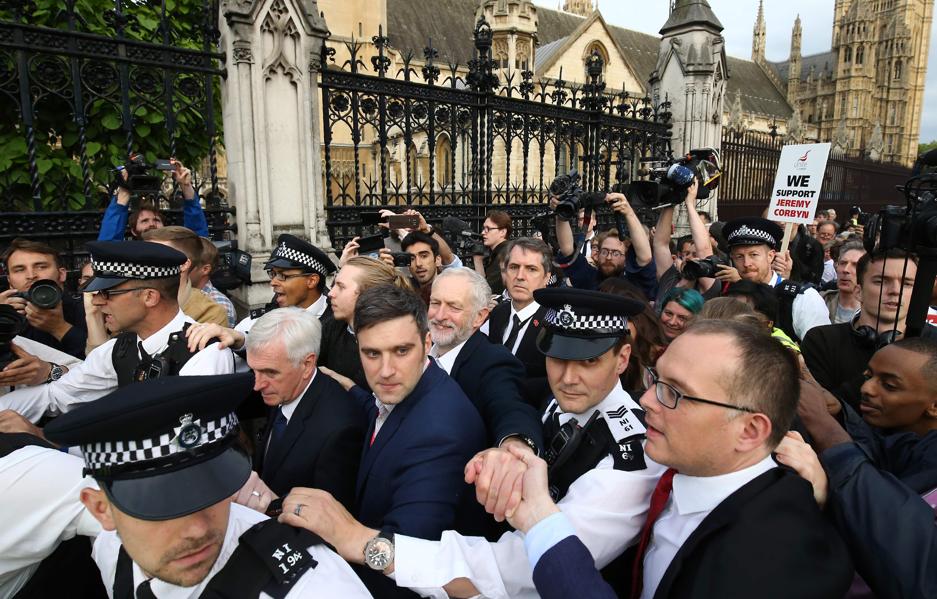
Meanwhile, the opposition Labor Party found itself in a state of civil war, with veteran lawmakers calling for the resignation of its leader, Jeremy Corbyn, and warning that the party risked losing its position as one of Britain’s two main political parties.

