


PARIS
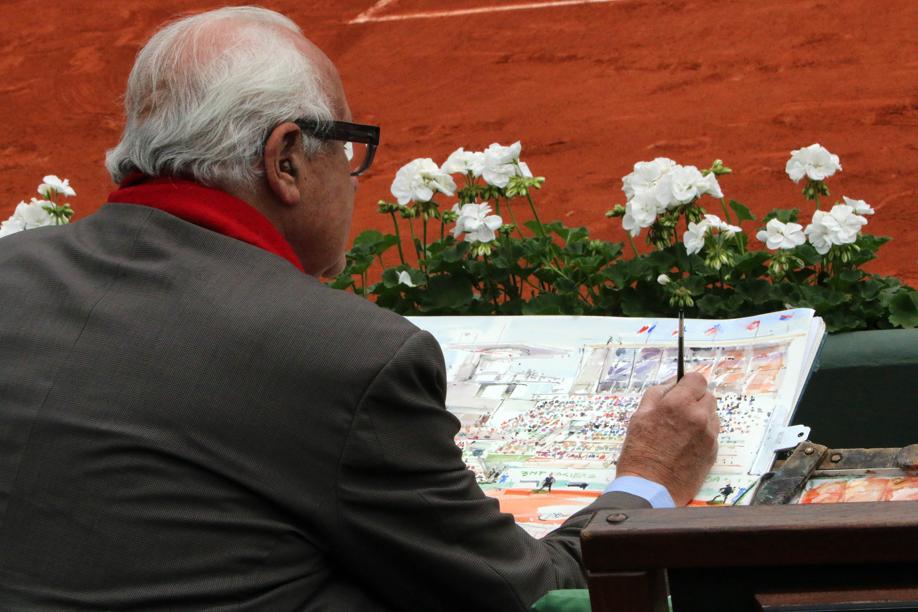
As the French Open began this weekend, interrupted by occasional rain showers, a respected Parisian watercolorist renewed his claim on a courtside box to translate tennis into vivid images of motion and color.
“I have two enemies,’’ said Joel Blanc, “the weather and jealous people.’’
Seated in box 62, Blanc is a familiar figure to French tennis fans, who covet his position only a few feet from the action. His presence over the past decade affirms France’s reputation as a cradle of artistic expression.
“I am fascinated by movement and energy,’’ he said as he fashioned images for a British television reporter three years ago.
At the time, Blanc seemed almost alone in his devotion to tennis.
But this year he has company from across the worlds of theater, literature, and television drama. In just eight months, tennis has experienced a surprising surge of artistic interest.
Two American stage plays, a historical novel by a Mexican writer, and an Australian television mystery have all used the sport as a vehicle for (mostly) serious creative expression.
In October, the La Jolla Playhouse festival staged Chekhov’s “Three Sisters’’ with several skilled actor-players performing on a lighted outdoor tennis court.
“Tennis really boils because of how much energy is contained in a smaller space,’’ said Tom Dugdale, the director. “The whole thing is even further intensified by the fact there is a net between these two opponents.’’
In February, San Diego’s Old Globe staged “The Last Match,’’ an exploration by playwright Anna Ziegler of the fears and aspirations of two players in a US Open semifinal. The play later opened in Pittsburgh’s City Theater and is reportedly making its way toward New York.
“It was a deep psychological play,’’ said Jules Boracks, a devoted San Diego theatergoer and longtime recreational player. “It was about what it was like to be older and the young upstart trying to prove himself, and it could have been in any aspect of life. Tennis was a perfect metaphor.’’
Thanks to a decision by director Gaye Taylor Upchurch, the two players swung imaginary rackets with realistic stroke and serving motions taught them by a local tennis pro she hired as a tutor.
“It was definitely a challenge figuring out how to put tennis on stage and have it still feel exciting, but not so bogged down in reality,’’ Upchurch said.
“The Last Match’’ drew acclaim for its portrayals of trash-talking players on the tour.
“It was part early Djokovic and some Serena,’’ said playwright Ziegler, citing Williams’s epic verbal attack on a US Open lineswoman several years ago.
A wildly different view of tennis came from Álvaro Enrigue, a Mexican novelist who lives in New York City. “Sudden Death,’’ which appeared in February, portrays tennis as an ancient form of dueling.
One reviewer wrote “the changing fortunes of the game — think blood sports rather than Wimbledon — thread through the entire book, but only as a spine’’ for the main action, which features a match between the Italian painter Caravaggio and the Spanish poet Francisco de Quevedo.
Why did the author, who does not play, use tennis to tell his story?
Enrigue told The New York Times: “I am an aficionado of 16th and 17th-century tennis, which is what the characters are playing — pallacorda (or ‘real tennis’), and we really don’t have a very good idea of how it was played, which gave me room to invent the rules.’’
This winter, a team of Australian TV actors played grass-court tennis set at a club in 1929 Melbourne. By most standards, the tennis was dreadful, but the murder mystery wrapped around it was delicious.
In “Miss Fisher’s Murder Mysteries,’’ actor Essie Davis plays Phryne Fisher, a glamorous private detective who flirts with dashing Police Lieutenant Jack Robinson as they solve the crime in an episode called “Game, Set, Murder.’’
The killer places a deadly spider in the tennis shoe of the victim.
As the murderer is revealed, handsome young Terence Lawson confronts the killer, Constance Barrows, his former lover and mixed-doubles partner
Barrows, a rising Aussie player, had spurned Lawson to marry a rich man who could finance her tennis career. She has just confessed to killing a woman who threatened to reveal she had borne Lawson’s child.
Passion and anger overwhelm the two players:
Lawson: “You killed Belinda, because she knew about our baby! And then you gave the baby up without even telling me!’’
Barrows: “If I told you, you’d want me to keep it. You’d want me to get married, settle down, I didn’t want any of that!’’
Lawson: “But we were in love!’’
Barrows: “I loved playing tennis with you, you used to be good.’’
Lawson: “How could tennis matter this much?’’
Barrows: “Because tennis is everything. The only thing that ever mattered. The only thing I loved. And if I hadn’t been so stupid and wound up pregnant, I could have been champion of the world!’’
As Joel Blanc’s watercolors take shape over these two weeks in Paris, tennis fans may wonder what will come next from the world of art and drama.
Perhaps “Death of a Salesman’’ staged at Wimbledon?
John Martin is a retired ABC News national correspondent.

