


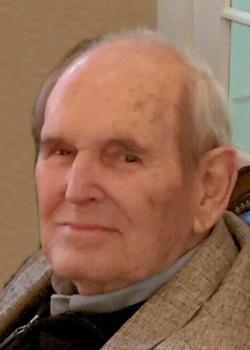
Stationed along the Elbe River in Germany in the final days of World War II, Army Lieutenant Joseph St. Onge commanded a Red Cross relief column that delivered medical supplies, food, and clothing to Allied troops who had been held prisoner.
Mr. St. Onge, who was twice awarded a Bronze Star for his actions while serving as intelligence officer, led the convoy through a protective mine field to the checkpoint.
“One gets a proud feeling for the people who, in the midst of a cruel and bloody war, can go about the business of saving lives rather than destroying them,’’ he later told a Army correspondent.
“We felt pretty helpless out there all alone,’’ he added, after the trucks disappeared into thick woods.
Mr. St. Onge, who in 2014 was made a knight of the French Legion of Honor, died of congestive heart failure July 30 in his Hanover home. He was 98 and formerly was a product manager for a Hingham-based smoke detector manufacturer.
In June 1944, his unit landed near Omaha Beach in Normandy, France. On the night of July 4, Mr. St. Onge, who spoke fluent French, helped Allied bombers target a Medieval-era church that was occupied by German snipers. The structure was destroyed and the town was liberated.
He and his wife, Eileen, returned to the same French countryside 57 years later. “Joe had kept an aerial reconnaissance photo in his pocket during the war and he used that same map to locate the hedge rows and roads that eventually led us to the site of the church,’’ she recalled.
“All that remained was a stone outline of where it stood and a sign post in the ground that praised the ‘American liberators,’ ’’ she said, adding that her husband, who found it difficult to talk about his comrades who died, spent time in silent reflection at the remains.
Having read stories about American recipients of the Legion of Honor, she forwarded to the French Consulate in Boston letters of commendation and photos Mr. St. Onge had saved.
In June 2014, before a gathering of family and friends at the clubhouse at the Spring Meadow complex where the St. Onges lived, then-Consul General Fabien Fieschi presented Mr. St. Onge with the medal for the Legion of Honor – which dates to Napoleon Bonaparte.
“We are grateful to you for your heroic actions,’’ Fieschi told Mr. St. Onge, according to an account of the ceremony in the Hanover newspaper. “In spite of constant and horrific danger, you and your fellow soldiers showed extraordinary courage and bravery throughout your service in France.’’
Mr. St. Onge kept the medal next to his favorite living room chair.
His division, the Thunderbolt, drove through Brittany, France, and fought in the Hurtgen Forest and the Battle of the Bulge before seeing additional action in the Harz Mountains in Germany.
Mr. St. Onge, whose leg was wounded by shrapnel in France, was awarded a Purple Heart. He was awarded a Bronze Star for “resolute and aggressive leadership’’ in Brittany and was awarded an Oak Leaf cluster – to denote a second Bronze Star – for his intelligence operations “on numerous occasions under fire’’ in Belgium and Germany, according to citations. His squad’s dispatches included intelligence on enemy convoys and tanks.
Nicknamed “the Saint’’ by fellow soldiers, Mr. St. Onge had family roots in the former French province of Saintonge, where his unit once fought. He remained in Europe after Germany surrendered and served as commandant of the Wurzburg displaced persons camp. He later served in the Army Reserve and National Guard, eventually retiring as a lieutenant colonel.
Years later, a friend suggested watching the 1998 movie “Saving Private Ryan,’’ which includes graphic scenes depicting the Normandy invasion and its aftermath. Mr. St. Onge declined. “I lived it,’’ he told his friend. “I don’t want to see it again.’’
Joseph A.W. St. Onge grew up in Holyoke. His parents, Ephrem St. Onge and the former Olivine Moineau, were French-Canadian and Mr. St. Onge worked for a time in his father’s trade as an apprentice tool and die maker.
In 1941, he married Anita Giroux, his classmate and high school sweetheart, and they lived in Dighton for many years. She died in 1992.
In 1998, he married Eileen Meade and moved to Hanover.
Mr. St. Onge, who played guitar in a band and also played piano and organ, found comfort in music and meditation.
“I felt that the times he would play guitar and meditate were related to his war years – a way that he could find peace,’’ his wife said.
She said he told her that while he was suffering from cold and fatigue in the Ardennes Forest during the war, he and his fellow soldiers would sit on the bodies of the frozen dead to stay out of the snow.
Mr. St. Onge, who loved to sing and also enjoyed golfing, skiing, and carpentry, was a flying instructor for gliders and small engine planes, primarily at Plymouth Airport.
“He always had a big smile on his face and he loved the challenge of teaching,’’ said Tom Somerville, a former colleague and a designated pilot examiner for the Federal Aviation Administration.
Mr. St. Onge was best man at Somerville’s wedding.
“Joe was good to the bone,’’ said Somerville’s wife, Barbara.
A private service will be held on a date to be announced for Mr. St. Onge, who in addition to his wife leaves a son, Willard of Tampa, and three grandchildren.
According Mr. St. Onge’s wishes, his wife will take his ashes to France next year. “He was proud of his service, and despite what he went through, he saw the better side of people,’’ Eileen said. “He could be the life of the party, but he also treasured his quiet time.’’
Marvin Pave can be reached at marvin.pave@rcn.com.

