


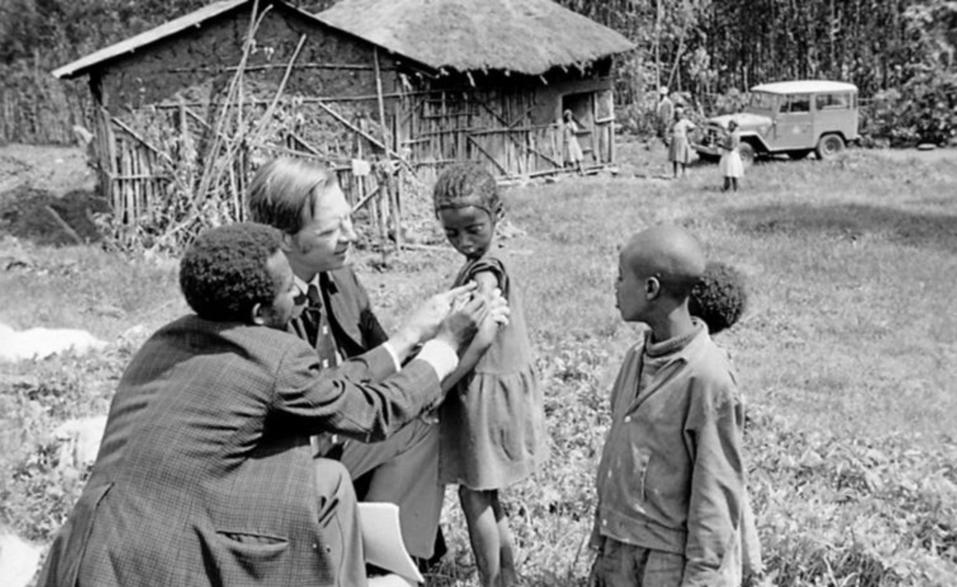
NEW YORK — Donald A. Henderson, a leader of one of humanity’s greatest public health triumphs, the eradication of smallpox, died Friday in Towson, Md. He was 87.
Dr. Henderson died in a hospice of complications of a hip fracture, including infection with antibiotic-resistant staphylococcus, a dangerous pathogen he had researched and raised alarms about, said his daughter, Leigh.
Starting in 1966, Dr. Henderson, known as D.A., led the World Health Organization’s war on the smallpox virus. He achieved success astonishingly quickly. The last known case was found in a hospital cook in Somalia in 1977.
Long after the disease was officially declared eradicated in 1980, he remained in the field as a dean of what is now the Johns Hopkins Bloomberg School of Public Health and as an adviser on bioterrorism to several presidents.
Euphoria over the smallpox victory led to calls for the elimination of measles, polio, Guinea worm, and other diseases, and Dr. Henderson was a sometimes irascible but often prescient critic of flaws in those campaigns.
The only other disease to have been banished is rinderpest, a little-known relative of measles that kills hoofed animals and once caused widespread starvation in Africa; it was eradicated in 2011.
Like any war, the one against smallpox involved thousands of foot soldiers — notably outbreak tracers and vaccinators — and more than a few generals. They came from the United States and the Soviet Union, which first called for the disease’s elimination, as well as from other nations.
But, along with Dr. William H. Foege, Dr. Henderson was considered a field marshal whose combination of vision, bluntness, tenacity, and political acumen carried the campaign to victory.
Smallpox, caused by the variola virus, was long one of the most terrifying scourges. Called the “red plague’’ or the “speckled monster,’’ it killed almost a third of its victims, often through pneumonia or brain inflammation. Many others were left blind from corneal ulcerations or severely disfigured by pockmarks.
It is thought to have emerged from a rodent virus more than 10,000 years ago, and signs of it are found in the mummy of Pharaoh Ramses V of Egypt.
It carried off many European monarchs. Because it killed 80 percent of the Native Americans who caught it, it was a major factor in the European conquest of the New World.
Three American presidents survived it: George Washington, Andrew Jackson, and Abraham Lincoln. In the 20th century, before it was extinguished, it was blamed for at least 300 million deaths.
Donald Ainslee Henderson was born in Lakewood, Ohio. He graduated from Oberlin College, got his medical degree from the University of Rochester, and did his residency at a hospital in Cooperstown, N.Y.
In 1955, he joined the Epidemic Intelligence Service, the elite disease-detective branch of the Centers for Disease Control and Prevention, and in 1960, as the chief of viral disease surveillance, he devised a campaign to eliminate smallpox and control measles in Africa. Smallpox had been eliminated in much of the West shortly after World War II, but it persisted in Brazil, Africa, and South Asia.
In 1966, he was sent to Geneva to run the World Health Organization’s campaign.
“The sense at the WHO was that this was an impossible mission, so they chose a young man who didn’t have a reputation to tarnish,’’ said Dr. Thomas V. Inglesby, director of the UPMC Center for Health Security, where Dr. Henderson was a resident scholar. “I don’t want to say as cannon fodder, but something like that.’’
WHO campaigns to end yellow fever and malaria had petered out, and the organization adopted the smallpox goal only after the Soviets and the Americans insisted, Foege said. “D.A. always said they wanted an American to blame,’’ he added.
He was given little staff or support but remaining on the CDC payroll gave him independence.
“Although outspoken, he understood the absolute importance of diplomacy, and he had the ability to recognize who could go out in the field and get things done with a minimum of supervision,’’ said Dr. J. Michael Lane, a leader of the fight.
Dr. Henderson spent much of his time visiting smallpox-stricken countries, some of which were also caught up in civil wars. He filed detailed progress reports and threatened to quit when WHO officials asked him to tone them down, Inglesby said.
When the Soviets shipped weak vaccines, Foege said, “he went to Moscow and confronted them.’’
The campaign developed a freeze-dried vaccine that could withstand tropical heat and be given either with a compressed air “injection gun’’ or by putting a drop on a forked needle and jabbing it just beneath the skin.
In 1977, success in hand, Dr. Henderson joined Johns Hopkins University. He was also in demand as an expert on bioterrorism. After the Sept. 11, 2001, attacks and the mailing of envelopes filled with anthrax, he became the chief adviser on public health preparedness to the secretary of Health and Human Services.

