


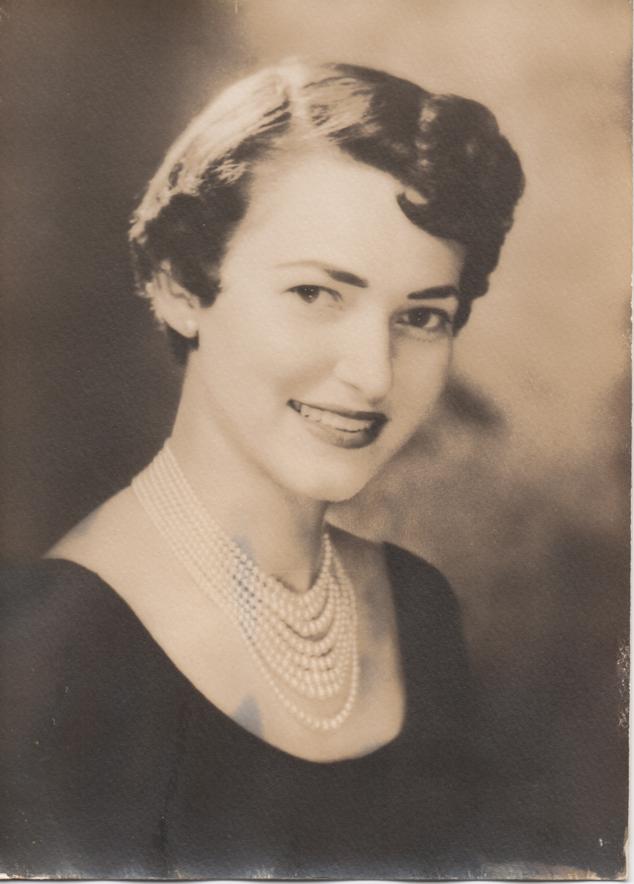
A talented writer at 19, Katherine Reese Peebles found a subject worthy of her perceptive mind when she stepped into a Wellesley College classroom in 1943 and met her new professor, novelist Vladimir Nabokov.
“Fortyish, tall and thin, shoulders hunched forward, he resembles the romantic, American conception of a real artist,’’ she wrote in a finely observed profile that year for “We,’’ a college publication. “His face is like one of those which are often ascribed to geniuses and mad scientists in mystery novels.’’
He was turning 44 and a dozen years away from publishing “Lolita,’’ the novel that made him rich and famous enough to give up teaching. She was a student who, as her “We’’ author bio noted, had “a personality vivid enough to be the subject of a character sketch herself.’’
Her piece on Nabokov, meanwhile, hinted that she and her Russian-born professor would soon fall into a flirtatious romance, if they hadn’t already. “Some of the students are rather confused by his nervousness and subtle remarks,’’ she wrote. “Others of us sit and giggle through the period. He pretends that he can’t imagine why we are laughing and looks very worried and appealing. We see the sham and giggle harder; a mutual understanding, our only obligation being to laugh at the right times.’’
Mrs. Peebles, who later in life was a college administrator and education consultant, died Feb. 7 from complications of a stroke she apparently had while sleeping. She was 93 and had stayed with her daughter in Cataumet the past few years after previously living in Waltham and Beacon Hill.
As a young mother in Weston at the beginning of the 1950s, she founded Meadowbrook Day Camp, which continues today. She formerly was an administrator in admissions at Wheelock College, in student activities at Wellesley, and in the president’s office at Bennett College in Millbrook, N.Y., and did graduate work in her 50s. At the beginning of the 1980s, she founded Valentine Vision, a nonprofit international friendship and hunger education program for schoolchildren.
Her encounters with Nabokov, however, earned her a memorable cameo in “Vera,’’ Stacy Schiff’s Pulitzer Prize-winning biography of Nabokov’s wife, which was published in 1999. At Wellesley, “I took a course in Russian, and I got sidetracked on a course on Vladimir Nabokov,’’ Mrs. Peebles quipped to Schiff.
Referring to the fictional 12-year-old Nabokov created as the title character for “Lolita,’’ Mrs. Peebles added: “He did like young girls. Just not little girls.’’
Nabokov clearly liked Mrs. Peebles, who was an unmarried student. The two “traipsed around campus, ‘stumbling and bumbling’ through the winter dark,’’ Schiff wrote in “Vera.’’ Schiff added that the relationship between Nabokov and his student “entailed a fair amount of kissing,’’ but Mrs. Peebles would never say if anything else happened, said her daughter, M’Lou of Cataumet.
In her 1943 “We’’ profile, Mrs. Peebles wrote that Nabokov’s novels were “like wine, light, sparkling, artistic,’’ and said that in conversation, he “has a habit of repeating the last phrase of sentences. Words fascinate him and he cannot bear to part with them after one utterance.’’
Mrs. Peebles, however, had no difficulty parting with Nabokov after he used one particular phrase.
In the profile, she noticed that when he wrote on the blackboard, erased, and wrote anew, “the chalk mark lingers, a mere ghost, to make the next word he writes over it look more complicated.’’
In “Vera,’’ Schiff wrote of Mrs. Peebles: “After class one day, she commented on the half-heartedness with which her professor erased the blackboard. At least one Cyrillic always shone through the next. ‘Then can you read this?’ Nabokov asked, scrawling three words on the board and just as quickly erasing them. He had written ‘I love you,’ in Russian. Peebles dropped the course, and the professor.’’
Katherine Merle Reese was born in Memphis and grew up in Paris, Tenn., as an only child. Her father, Eldridge Wiley Reese, would start a truck leasing company after moving to Greater Boston. Mrs. Peebles, who was a teenager when her mother, the former Minnie Merle Porter, died, had ancestors who fought in the Revolutionary War and for the Confederates in the Civil War.
Her family settled in Hudson, and Mrs. Peebles, who was known as Katie or Kata, learned to play piano and guitar. She attended the Dana Hall School in Wellesley and went on to major in English and study journalism at Wellesley College. “She commuted every day to and from Hudson, driven by her father,’’ said her son, Dr. Douglas Peebles of Wayland.
“She became kind of a glamor girl,’’ her daughter said. “She was very pretty and very graceful, and enjoyed being the belle of the ball.’’
Mrs. Peebles left Wellesley before graduating and in 1945 married Dr. Thomas Peebles, a pediatrician who later would help launch one of the state’s earliest health maintenance organizations. He was a pilot during World War II, and “she rode a troop train all the way from Boston to San Francisco’’ to marry him before he left for the Pacific, their daughter said.
For a Wellesley stage production, Mrs. Peebles wrote the words and music to “Navy Blues,’’ a 1943 song about her husband-to-be: “My man’s in the Navy, but I got his love to keep/My baby done left me, he’s out on the briny deep/And ’till he comes home safe, I’ll stay at home and weep.’’
After the war, Mrs. Peebles and her husband ran a laundry business they started to pay the costs of his Harvard Medical School education. Once her three children were well into school years, she returned to Wellesley to finish her bachelor’s degree in 1964, when she was 40, and later wrote that the faculty recognized her as “the first married student with children to return part time and to complete her degree after World War II had interrupted her studies.’’ She graduated from Boston University in 1975 with a master’s in education, and her marriage ended in divorce.
“Kata and I have been very close, possibly too close in some respects for freedom in our individual creative expression,’’ her former husband wrote in the mid-1970s for the 25th anniversary report of his Harvard class.
A service will be announced for Mrs. Peebles, who in addition to her daughter and son leaves another son, James of Weston, and five grandchildren.
“She really started to get more determined about feminism when Gloria Steinem and Betty Friedan came along,’’ her daughter said. “She was very well-read and was a really brilliant, powerful lady. A lot of people admired her.’’
Gregarious when hosting gatherings, Mrs. Peebles was known for chowder she made from freshly-harvested quahogs.
“People raved about her chowder. She literally would make it with beer and drink beer while making it,’’ her son Douglas said. “She loved to sing and have a good time. She loved to hear people laugh and have fun. For a girl who spent most of her early years on a poultry farm in Tennessee, I think she did pretty well.’’
Marquard can be reached at bryan.marquard@globe.com.

