


NEW YORK — Fritz Koenig hoped to see his monumental “Sphere’’ — a sculptural symbol of the promise, destruction, and resilience of the original World Trade Center — return to its intended site in Lower Manhattan.
But the effort to bring the battered artwork home, like every other element of the trade center redevelopment project, was waylaid by battles over political and physical turf.
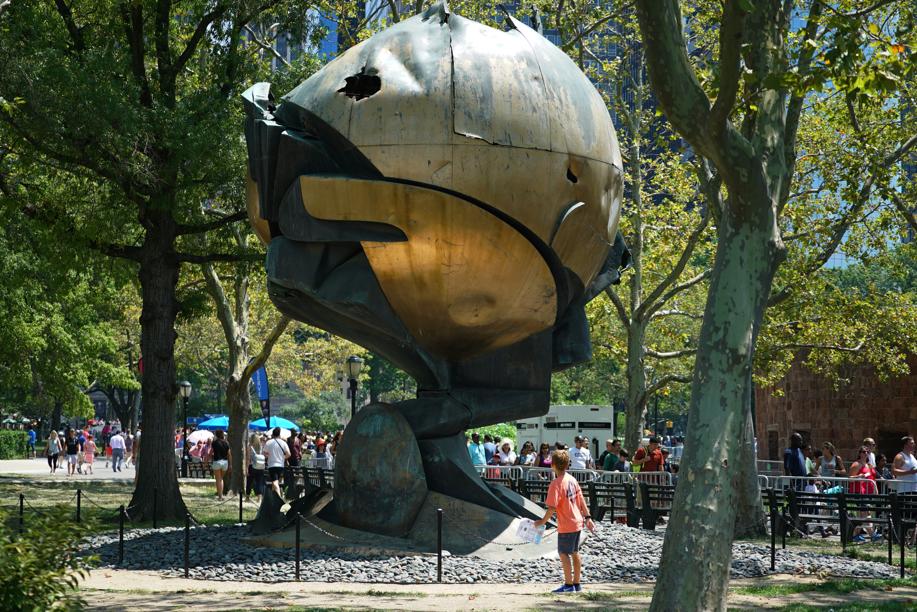
As it stands now, Mr. Koenig’s 27-foot-high bronze sculpture, still badly scarred from the terrorist attack of Sept. 11, 2001, is not scheduled to return to the trade center from a nearby park until late summer or early fall.
But when he died Feb. 22 at 92 at his home in Ganslberg, Germany, he knew at least that the fate of his “Sphere’’ finally seemed secure.
When the Port Authority of New York and New Jersey, which had commissioned the work a half-century ago, committed itself last July to reinstalling the sculpture at the World Trade Center, Mr. Koenig was said to be “electrified.’’
“He is now 92 years old but still very interested in the fate of his ‘child,’’’ Stefanje Weinmayr of the Fritz and Maria Koenig Foundation in Germany said at the time. The foundation confirmed his death last week.
Patrick J. Foye, the executive director of the Port Authority, said Mr. Koenig’s “memory will live on in the ‘Sphere’ that will soon stand in the World Trade Center’s Liberty Park.’’
“Sphere’’ was the best known of his sculptures, though Mr. Koenig produced powerful memorials, including one at the former Mauthausen concentration camp in Austria.
Born in Wurzburg, Mr. Koenig served in the German army, on the eastern front, during World War II.
From 1946 to 1952, he studied at the Academy of Fine Arts in Munich with Anton Hiller.
His first one-man show in the United States was at the Staempfli Gallery in Manhattan in 1961. “In such unusual sculptural subjects as race-horses crossing the finish line, or in a majestic modern version of a quadriga, where energy seems to explode from within the mass,’’ Stuart Preston wrote in The New York Times, “he achieves a concentration of animal power that is most impressive.’’
Six years later, Mr. Koenig was among five sculptors commissioned by the Port Authority to produce artworks for the World Trade Center, then being planned.
Minoru Yamasaki, chief architect of the trade center, was his real patron, Mr. Koenig said.
“Yamasaki kept asking me to make the sculpture bigger and bigger to complement his design, but I wanted to make something in contrast,’’ Mr. Koenig told the Times in 2001.
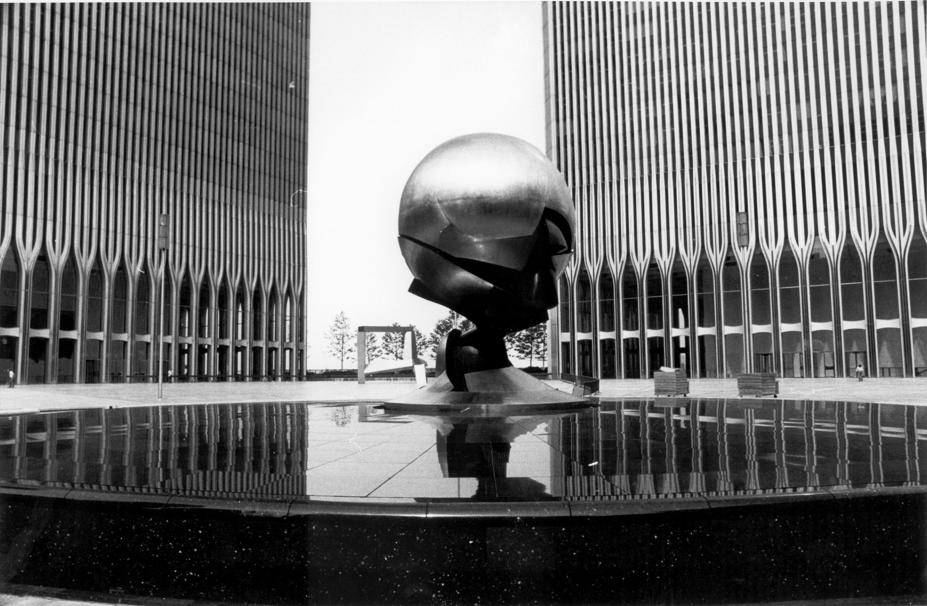
What resulted was “Sphere’’ (or “Grosse Kugelkaryatide,’’ the large spherical caryatid). Its smooth golden surface was sliced by incisions and shattered in some places by cubist eruptions.
Because it stood in a fountain in a center dedicated to world trade, the sculpture could easily have been taken for a globe. But Mr. Koenig described it as “a head, and a Cyclops’’ and “in some ways a self-portrait.’’ Some viewers saw the head as wearing a helmet.
“Laughingly, I said to Yamasaki, ‘The helmet is there because when your towers fall, I don’t want my head to be crushed by them,’’’ Mr. Koenig recalled in 2001. “I was joking, of course, but who knows why I said that?’’
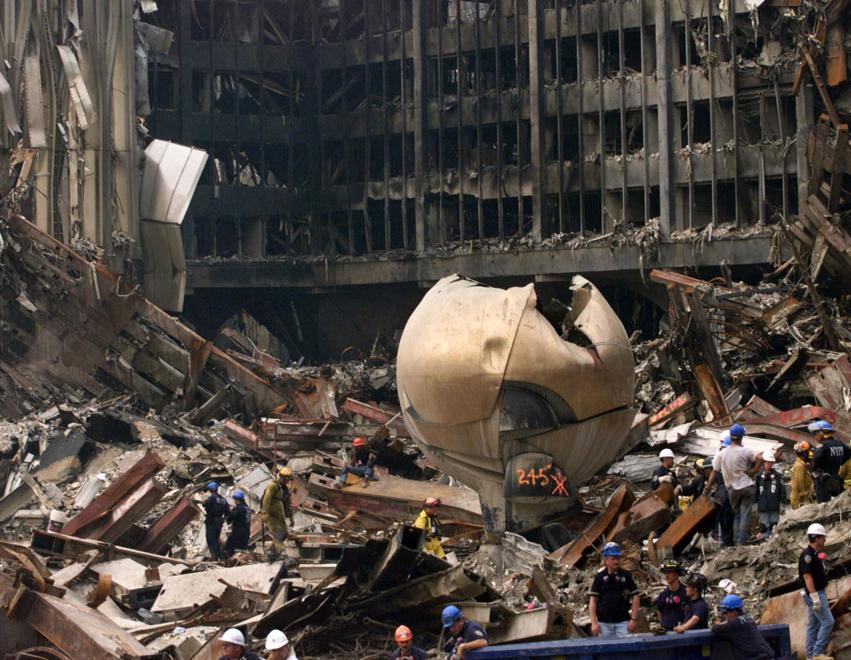
After being hit by jetliners commandeered by terrorists on Sept. 11, 2001, the twin towers collapsed around “Sphere.’’ Nearly 3,000 people were killed. Astonishingly, the sculpture emerged from the wreckage in recognizable form.
On March 11, 2002, six months later, it was made the centerpiece of the city’s mourning, rededicated as an interim memorial in the Battery, a park at the tip of Manhattan.
Ten years later, “Sphere’’ had drifted to the edge of civic consciousness, though it remained an arresting stop for visitors. The nonprofit conservancy that runs the park did not want the sculpture any longer. The National September 11 Memorial and Museum at the World Trade Center did not want the work at all. The Port Authority said it wanted to return “Sphere’’ to the site. But it would not say where or when or how.
Michael Burke, whose brother, Captain William F. Burke Jr. of the Fire Department, was killed in the 2001 attack, led a campaign to repatriate the sculpture.
“Had plain common sense and respect for history and adherence to precedent prevailed — imagine the USS Arizona memorial without the USS Arizona — the ‘Sphere’ would have been back before 2011 and Koenig may well have been there,’’ Burke said last week.
Despite that frustration, he said he was grateful that the sculpture would return. “However humble,’’ Burke said, “it is an expression of the human endeavor that triumphed over those who hate.’’
1977 — The spherical sculpture created by artist Fritz Koening was placed on a plaza between the World Trade Center buildings.
2016 — The “Sphere’’ was restored and moved to Battery City Park, near the site of the downed towers.
SEPTEMBER 2001

