


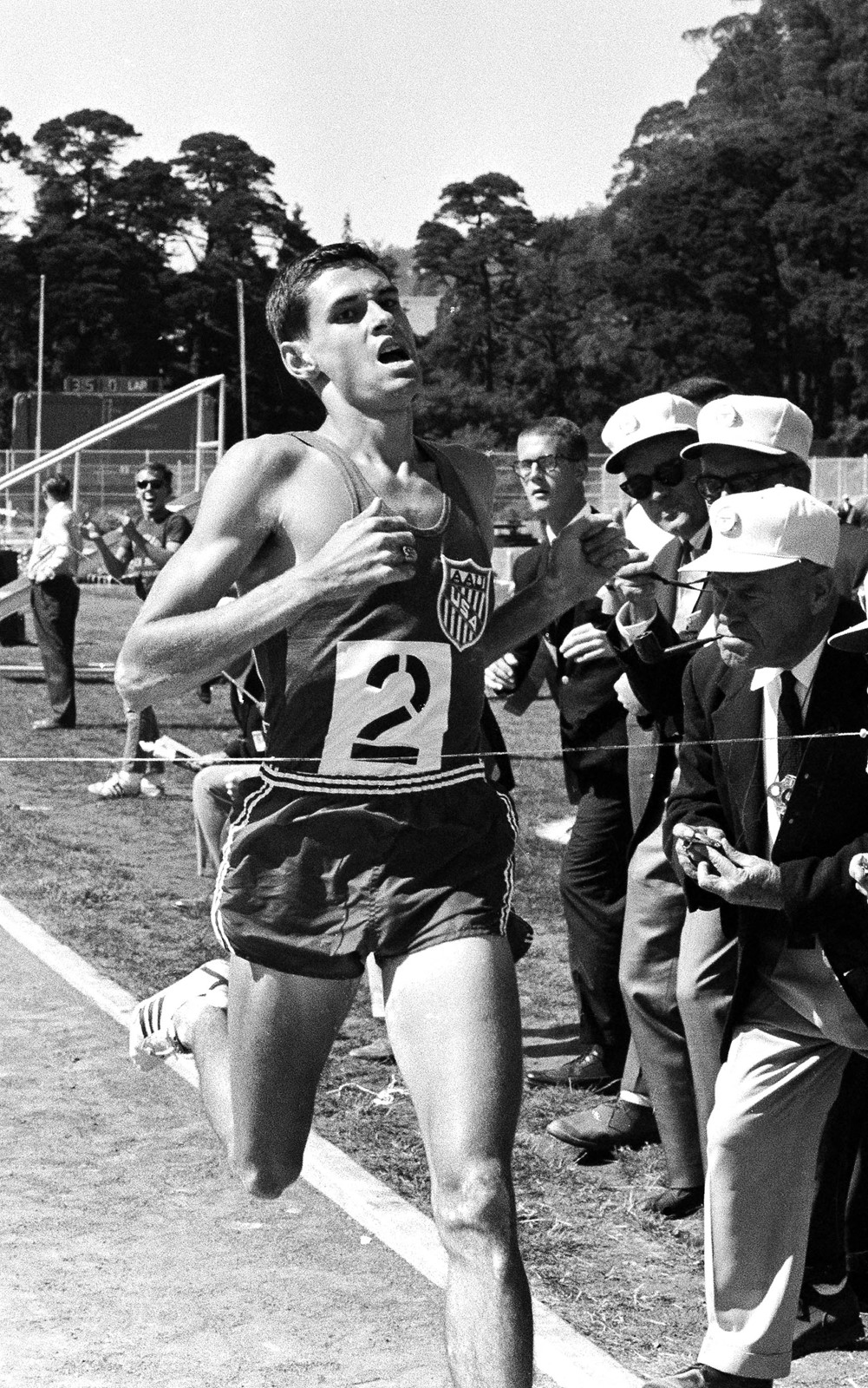


“Jim Ryun’s in the race,” Grelle said Wilborn. “So there’s a race with Ryun and then there’s the rest of us mere mortals.”
The gap between Jim Ryun, the 20-year-old University of Kansas sophomore, and the rest of the human race was never as pronounced as it was on the evening of June 23, 1967.
Leading every step of the way, from the opening gun to his devastating finish on Memorial Stadium’s crushed red brick track said to be created from the remnants of Bakersfield’s 1952 earthquake, Ryun shook the planet, lowering his world record in the mile to 3 minutes, 51.1 seconds, with a performance that promised future tremors would be felt for decades.
At a time when there were only three television networks, much of the nation watched in grainy black and white as Ryun ran in and out of the shadows of the stadium’s lights, with each step leaving previously held beliefs about human performance, the limits of the imagination in the red brick dust like the rest of the field until the 11,500 spectators in the stadium, the audience from coast to coast questioning whether they were witnessing history being made or science fiction.
When the field stepped up to the starting line at 9:15 p.m. that night only 21 Americans had ever broken 4:00 for the mile. Seven runners broke 4:00 that night, five of the world’s six fastest miles in 1967 were in Bakersfield. Yet Grelle was right — Ryun was running a totally different race.
If Ryun wasn’t from another planet he certainly seemed to be from another century. The Bakersfield race would strengthen his grip on global track and field’s most storied and revered record, a hold that would last nearly a decade, an unprecedented reign in the 20th Century.
The questions about what Ryun would run on more modern tracks in lighter shoes continue to persist into the Millennium.
Sub 3:50?
3:47? 3:45? 3:43?
What is clear to those who chased him through the shadows, through history on a night undiminished by more than a half-century or fading memories is Ryun’s unmatched brilliance.
“That was the greatest mile ever run,” said Marty Liquori, later a three-time NCAA champion.
The distant echoes of the last outdoor mile world record set on American soil can be heard in the build-up to Saturday’s Prefontaine Classic at Hayward Field and the promised assault on Hicham El Guerrouj’s world record of 3:43.13 by Olympic 1,500 champion Jakob Ingebrigtsen of Norway, Josh Kerr, of Great Britain and Scotland, the World 1,500 champion, and Yared Nuguse of the United States, all of them chasing a time some of Ryun’s rivals believe he was capable of running nearly 60 years ago.
“You can’t set a figure,” Grelle, who died in 2020, said of Ryun’s potential after the Bakersfield race. “There is no limit.”
The Ingebrigtsen-Kerr showdown has also served as a reminder of an era when track and field was an American major sport, a constant on network TV Saturday afternoons and the cover of Sports Illustrated, Ryun making seven such appearances.
“In his era he was unbelievable,” Ron Warhurst, the longtime Michigan coach who now trains American rising star Hobbs Kessler, said of Ryun. “He was just unbelievable.”
Ryun was the most unlikely of sports heroes. Skinny, frail and awkward, he struggled in Little League growing up in Wichita. He found no more success in basketball or football.
“As a child I couldn’t make the junior high track and field team,” Ryun said. “In fact, I remember going to bed many times during the junior high days saying a prayer, ‘Dear God, my life isn’t much at this point in time but I would really like my life to amount to something and if it could show up in sports I would appreciate that.’”
As a sophomore, he turned out for cross country and was discovered and encouraged by East High coach Bob Timmons,who had served in the Marines in World War II and won seven state swimming titles before turning to track.
Timmons believed teenage athletes could handle large training volumes and produce world-class performances.
“Coach Timmons was a gift from God to me,” Ryun said. “I was one of those kids who couldn’t make a team and in two years I was under 4 minutes (in the mile).”
On June 4, 1964, Ryun, then a 17-year-old East High junior, became the first prep runner to break four minutes, running 3:59.0 to place eighth in a world-class field at the Compton Invitational. That summer, he appeared on the cover of Sports Illustrated for the first time and then made the U.S. Olympic team in the 1,500 meters. Ryun, slowed by illness, was eliminated in the semifinals at the Olympic Games in Tokyo.
A year later Ryan beat New Zealand’s Peter Snell, the Olympic 1,500- and 800-meter champion, at the 1965 AAU Championships in San Diego in arguably the greatest single achievement ever by an American high school athlete, holding off Snell and Grelle in a dramatic homestretch at Balboa Stadium, finishing in 3:55.3 to set a new American record and a national high school mark that would stand for 36 years.
“That was when I knew for the first time I would someday have the world record,” he told reporters afterward.
He would get his chance 13 months later in Berkeley.
When the Soviets pulled out of the meet, citing the Vietnam War, the Poles following suit, Ryun asked Cal coach Sam Bell, the meet director, to switch the 1,500 meter run to the mile. Bell laughed. He had already made the change anticipating a world-record attempt.
“I can sell more tickets if I announce to the public that you’re going for the world record,” Bell told Ryun. But Ryun asked to keep his plans out of the newspapers. Bell reluctantly agreed.
Even so, 15,000 showed up on a 75 degree afternoon. While Ryun was hesitant to let the media in on his plans he still felt he needed help chasing the world record of 3:53.8 set by France’s Michel Jazy in June 1965.
He enlisted Oregon haf-miler Wade Bell, Oklahoma State’s Tom Von Ruden and Texas’ Richard Romo.
“Jim said, ‘I want to make an attempt on the world record tomorrow and I’d like to know if you guys would help set me up,‘” Bell recalled.
Ryun would finish in 3:51.3, knocking 2.5 seconds off Jazy’s global standard.
“I believe we all hit our marks perfectly,” Bell said.
“I would reflect on Berkeley, Rich Romo, Tom Von Ruden, and Wade Bell, I would have liked to see their name on the world record certificate because they all sacrificed their race to help achieve what happened,” Ryun said. “They all did a great job. To me that was a huge breakthrough.”
Just 19, still eight months away from his first outdoor varsity race at Kansas, Ryun was perhaps the most famous athlete in the world outside of Pele and Muhammad Ali. He received rock star like attention, mobbed by fans and the media everywhere he went.
“In those days everybody just wanted to talk to Jim Ryun,” Liquori said.
Including a coed named Anne from his home state who approached him with her siblings after the Berkeley race.
“This young attractive girl from Kansas State University came to ask for my autograph,” Ryun recalled chuckling. “I told her well catch me later.
“Well, later came on a blind date and we’ve been happily married for over 50 years. So to me, that was another highlight of that Berkeley race.”
Unlike Berkeley there would be no teamwork chasing the world record with spots on the line for a U.S. vs. British Commonwealth meet the next month in Los Angeles and a U.S. national team European tour later that summer.
Besides Ryun and Grelle, the 1967 AAU final field in Bakersfield included Tim Danielson, who as a Chula Vista High senior in 1966 became the second prep runner under 4:00, Liquori, a senior at Essex Catholic High in New Jersey and Bowerman’s latest two prodigies at Oregon — Wilborn, an exceptionally gifted if inconsistent runner who had a history of being too hard on himself, and Divine.
Even before his pre-race chat with Grelle, Wilborn had no illusions about beating Ryun.
“He was unbeatable at his peak,” Wilborn said. “I don’t care if all the best people were in the race. If it started out slow he would beat them. If it started out fast he would beat them. If they waited to the last 100 to kick he would beat them. If you took off with 300 to go he would beat them. He was literally unbeatable at this peak.”
While Ryun today said Bakersfield “wasn’t a planned world record race,” but that night he told reporters, “I realized that I wouldn’t set any records (running with the pack) because no one was going to knock himself setting a record pace. So I decided to push myself.”
He only told Grelle of his plan.
“Fine,” Grelle said with a laugh. “See you later. I sure won’t be trying to keep up with you.”
No one did as Ryun opened a gap on the field from the gun.
“We might be en route to what we expected all along that he can run under 3:50 for the mile,” Jim Beatty, the first man to break 4:00 indoors, announced on ABC’s Wide World of Sports broadcast of the race.
But by the time Ryun completed the first lap in 59.2 the pack was on his heels. They stayed there as Ryun led through the half-mile in 1:59.“I had no plan of leading the whole way,” Ryun said. “It was a shock to me, finally after the first half mile I realized no one was going to help with the race, so I relaxed a little bit and got even faster. So it was one of those moments in time where I look back and thank God for the fact that it went so well but it was a huge surprise to me.”
Ryun surged, opening a wide lead immediately.
“Jim just took off,” Divine said. “It was Jim Ryun and the rest of us.”
His third lap was 58.6.
“All by himself, runs against time,” ABC’s Jim McKay, sharing broadcast duties with Beatty, said as Ryun charged down the final backstretch.
“He’s got a shot at the 3:50 mile,” Beatty said.
At first, the TV screen flashed Ryun’s time at 3:50.9. The official time was actually 3:51.1. Ryun had covered the final quarter-mile in 53.5.
“I didn’t really feel anything until after the race,” Ryun said. “That’s why I was very surprised at the time. I went by the three-quarter mark in 2:58 which then was a good pace and then I relaxed a little more and ran even faster. I think it was 53 seconds on the last 440. If I had known I was that close to the world record I would have tried to accelerate a litte more. It was so unbelievably easy that night that when I finished I know I commented to other people I could have kept going at another lap or two at that pace. It just felt really comfortable and easy.”
Grelle held off Wilborn for second 3:56.1 to 3:56.2.
No high school runner broke 4:00 in the mile until Alan Webb of South Lakes High in Reston, Virginia ran 3:59.86 indoors in January 2001 in New York and then lowered Ryun’s national high school record with a 3:53.43 performance at the Prefontaine Classic.
Webb’s record sparked a debate on whether his performance was actually superior to Ryun’s prep time given the advances in track surfaces, shoes and training. It renewed a larger debate on what Ryun’s Bakersfield record and his other top performances would translate to in 21st century conditions.
Bell said Ryun would run between a second and a second and a half faster on today’s tracks.
“That was the greatest mile ever run,” Liquori said repeating himself. “And I’ll give you some reasons. A minor reason, he ran 4:07 the night before (in the heats).
“It was crushed brick track. Thirty years later in Gainesville (Florida)” Liquori’s home since the 1970s “I met a guy from Bakersfield. I mentioned the track. He said, ‘You know how we got the crushed brick? After the earthquake we didn’t know what to do with the bricks.
“It was a good dirt track, I can definitely say that that dirt track is a second a lap slower than the tracks today. And the reason I know that is that I ran a lot of laps around a dirt track on a Wednesday and on a synthetic track on a Saturday and I know how much difference it made.
“Give him four seconds faster because it’s a dirt track. Give him another second because the pace was erratic. He ran a (53) second last quarter. Even pace would have run at least a second faster. If he had a pace-setter he would have run at least a second faster. ... I think it was the greatest mile performance ever.”
Ryun is hesitant to join the discussion about it how it compares to modern runners.
“I’ve never done a really good job on speculating. Let me say this, and Marty would probably remember this, anybody running that race would remember this. The inside lane by the time we ran that mile it was really torn up and soft. The California tracks were usually really fast. But by the time we got to it, it was like sawdust. So the fact that it was that fast, in fact if you look at the film, you’ll see me wandering around on the inside lane trying to find good footing. And I would find it almost stepping on the curve. Of course that was a little dangerous for me because of a balance issue.
“Maybe a second a lap, I don’t know. That’s very difficult to address. It was one of those nights where you were on top of the world and you thank God for all the help you had. That is where I was.”
 PREVIOUS ARTICLE

