


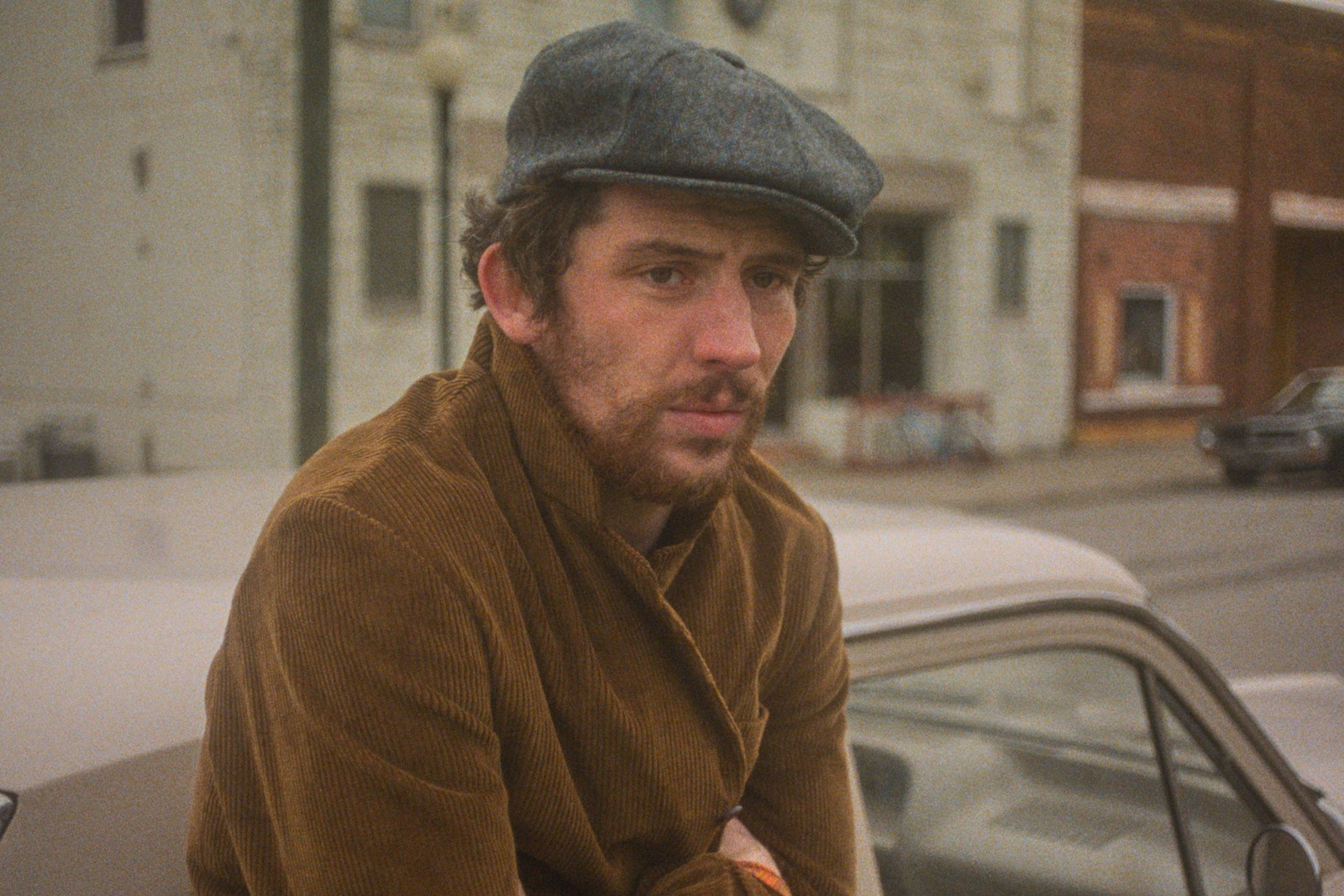


Not long after Kelly Reichardt’s “The Mastermind” opens, a couple of comically blundering thieves rob a small Massachusetts museum. This burglary seems too clumsy and its stakes too modest to call the job a heist. The burglars fumble and snap at each other, the shriveled legs of the pantyhose pulled over their heads flapping. Almost despite themselves, the thieves finish the job, but one nearly gets stuck in the museum before they finally make their getaway in a station wagon.
It’s 1970, and the guy who organized the robbery, James Blaine Mooney, aka J.B., is going through interesting times, partly self-inflicted. Played by the agreeably ubiquitous British actor Josh O’Connor, J.B. doesn’t seem like a typical ringleader of a criminal enterprise, at least on screen. He’s on the scrawny side, with a patchy beard and droopy affect. He wears clothes that look like someone else bought them for him and lives in a nondescript suburban house with his wife, Terri (Alana Haim), and two sons whom he barely seems to notice. J.B. often seems like a kid himself, whether he’s eating dinner at the home of his parents (Bill Camp and Hope Davis) or lying to his mother about why he needs to borrow money.
J.B. planned the museum job, but the movie’s title turns out to have a distinct ironic tang; the guy hardly comes off as the master of anything, himself most of all. That’s evident throughout his arranging of the robbery, its humorously amateurish execution and its more complicated aftermath, which takes up much of the story. In some classic heist films, the focus is on everything that it takes to pull off the job: the goals and logistics, the co-conspirators you can trust, the ones you definitely shouldn’t. Here, the robbery is more of a beginning in a low-key funny and sharp look at a character — as well as a larger world — in thrall to narcissistic self-interest.
“The Mastermind” is about a guy going through some things — most conspicuously, a crime that soon upends what seems like an ordinary, even humdrum life. From all appearances, it is a life that would probably settle into disappointment (cue the divorce, boozy ennui, the usual). It isn’t immediately clear why he robs the museum, pinching a clutch of canvases by Arthur Dove, an early American abstract painter.
Maybe he is, but J.B. also lives in the world, even if he doesn’t pay much attention to it. In an early scene, he lies on the floor playing checkers with one of his sons as the other boy roams about with a paper airplane. J.B. seems just like another one of the kids, an impression that’s reinforced by the image of his own father stretched out on a couch watching the news on television. As Reichardt cuts from among the characters, you hear voices on the TV talking about a trial and anti-war campus protests. There are “tremendous feelings of powerlessness, cynicism, apathy on the part of large numbers of people,” a voice rich in emotion says as Reichardt holds on a close-up of J.B. right before he’s called to dinner.
Once the museum robbery makes the news, J.B. is soon squeezed between oppositional forces, and things go rapidly south for him. A couple of police officers show up at his and Terri’s house, having been tipped off by one of his co-conspirators, and then a carful of mobsters stir up even more dangerous (and amusing) trouble. As J.B. anxiously navigates these complications, his home life takes a hit. Terri doesn’t say much from the start, yet while her relatively few words and averted gaze can speak volumes, her silence is initially disappointing simply because Haim (a musician and star of “Licorice Pizza”) is a vividly real, distinctive presence. It’s only later that it becomes clear that Terri isn’t just a supporting character in the movie but also in J.B.’s life.
 PREVIOUS ARTICLE
