


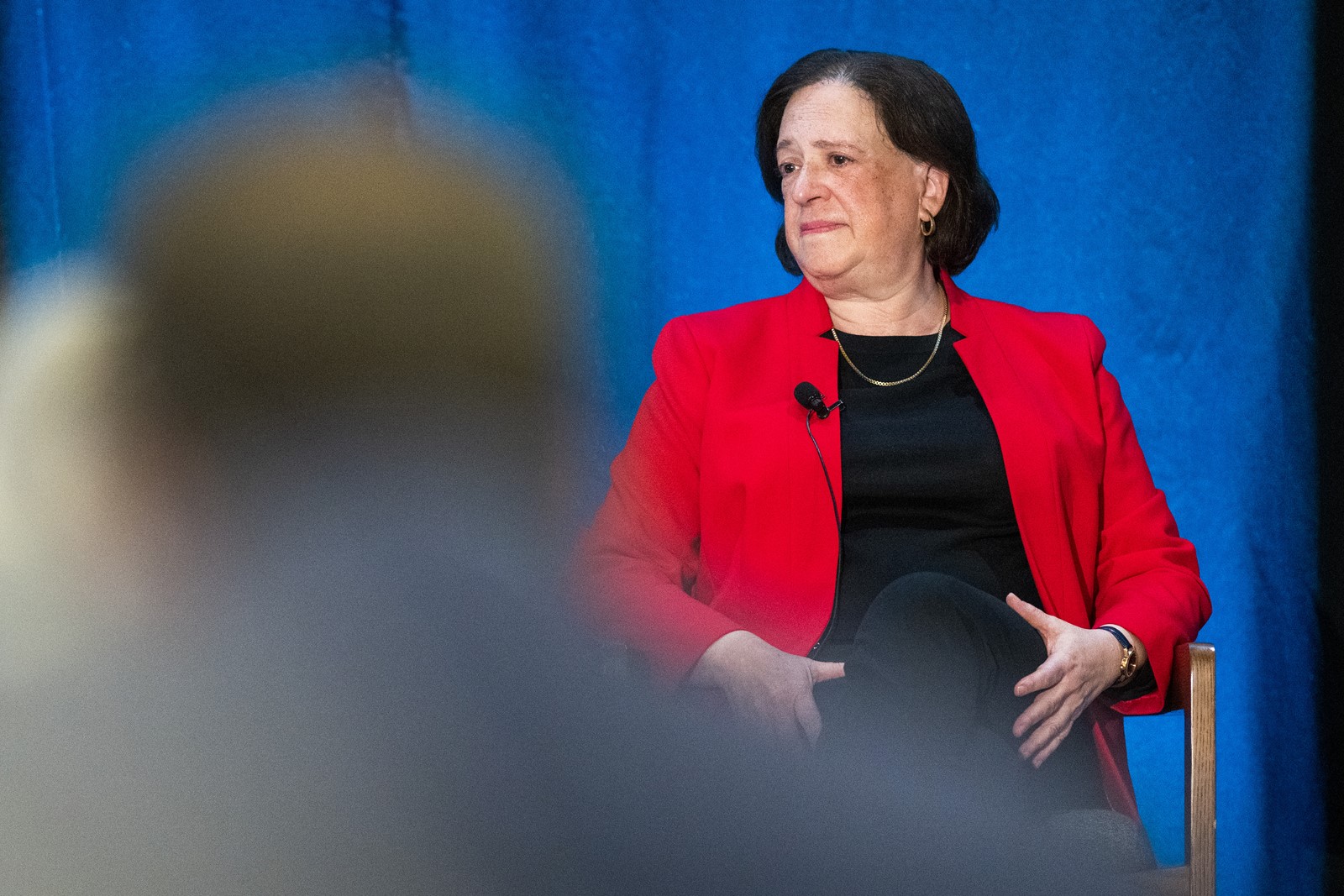


MONTEREY — Justice Elena Kagan said Thursday that the Supreme Court was shortchanging the public and lower court judges by failing to explain its reasoning in rulings on cases that come before the court on an emergency basis, including challenges to the Trump administration’s efforts to transform the federal government.
“I think as we have done more and more on this emergency docket, there becomes a real responsibility that I think we didn’t recognize when we first started down this road, to explain things better,” Kagan said. “I think that we should hold ourselves, sort of on both sides, to a standard of explaining why we’re doing what we’re doing.”
Even two or three pages of explanation, she said, would be helpful — “to just sort of say, Here’s the basic issue, the basic problem that we see. Go fix it.”
Her comments came during an appearance in Monterey, at an annual meeting of federal judges and lawyers from the 9th Circuit.
Speaking in conversation with a federal judge and a lawyer, Kagan focused on the emergency docket and her concerns that the justices’ failure to provide the court’s reasoning in cases could make it difficult for lower court judges to understand how to apply the decisions and for the public to understand the court’s reasoning.
In recent months, the Supreme Court has been bombarded with emergency applications, many of them focused on Trump administration policies, including efforts to downsize the federal government and to remove temporary immigration protections for hundreds of thousands of people, as well as President Donald Trump’s decisions to remove heads of government agencies.
Many of these applications have challenged temporary orders issued by lower court judges, and challenges to those orders have zoomed up to the justices on the emergency docket.
“I think we should be cautious about acting on the emergency docket,” Kagan said. “Sometimes we have to, but I think we should be cautious.”
Decisions on that docket, known by critics as the shadow docket, are typically not fully briefed and argued before the court. Often, emergency docket decisions do not provide any description of the court’s reasoning, leaving lower court judges to decipher the meaning.
According to a tally by Stephen I. Vladeck, a law professor at Georgetown and the author of a book about the court’s emergency work called “The Shadow Docket,” the court has granted emergency relief to the Trump administration seven times without any explanation at all in recent months.
Kagan explained that, unlike with standard cases, the justices do not typically meet in person and discuss how to rule on emergency applications.
She said that they fashioned their approach as they began to see an increasing number of emergency applications, but she said it was time for the court to begin providing more of an explanation because “the orders themselves don’t tell anybody anything about why we’ve done what we’ve done.”
 PREVIOUS ARTICLE

