


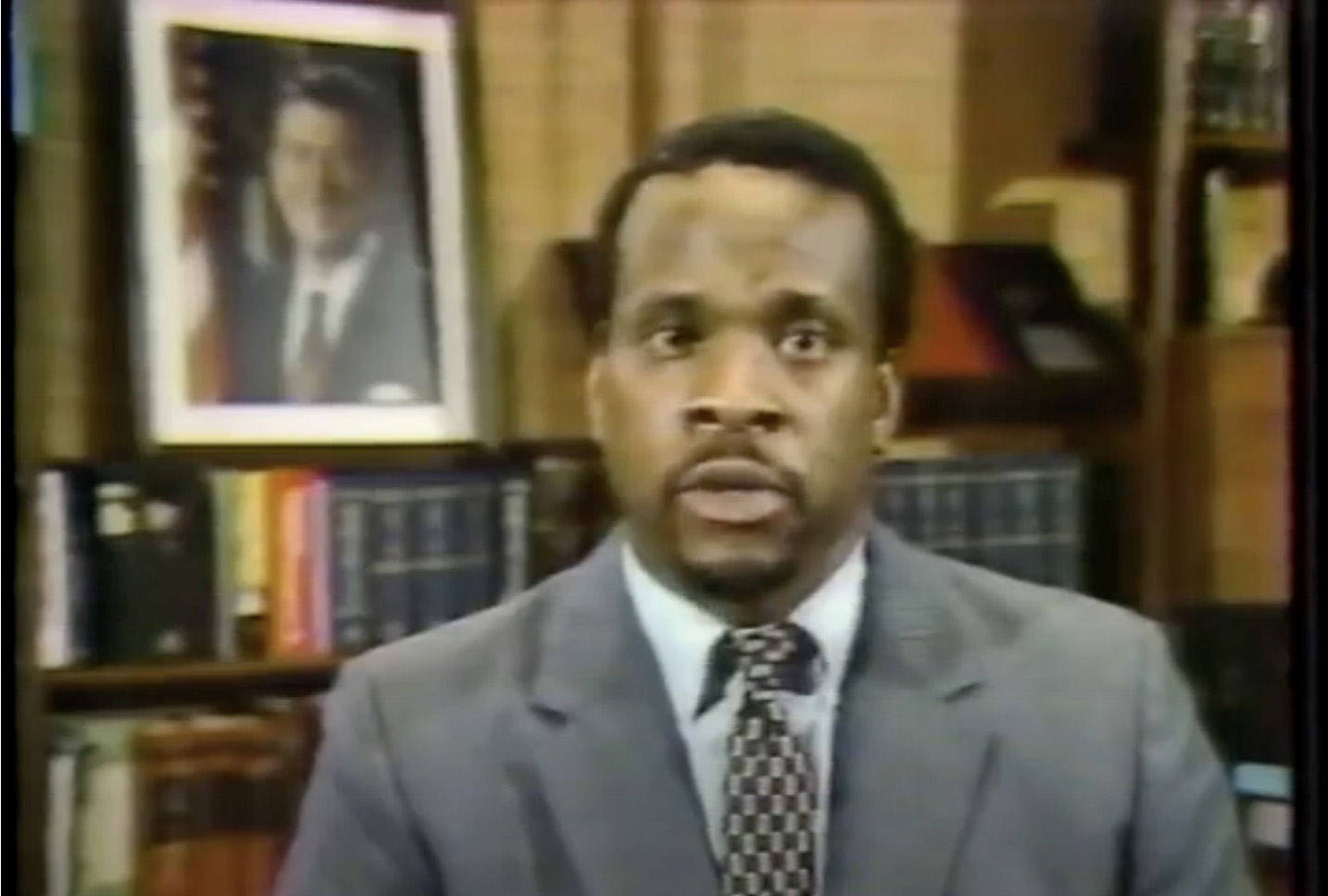


On Oct. 15, 1991, Clarence Thomas secured his seat on the Supreme Court, a narrow victory after a bruising confirmation fight that left him isolated and disillusioned.
Within months, the new justice enjoyed a far warmer acceptance to a second exclusive club: the Horatio Alger Association of Distinguished Americans, named for the Gilded Age author whose rags-to-riches novels represented an aspirational version of Thomas’ own bootstraps origin story.
If Thomas’ life had unfolded as he had envisioned, his Horatio Alger induction might have been a celebration of his triumphs as a prosperous lawyer instead of a judge. But as he tells it, after graduating from Yale Law School, he was turned down by many top law firms, rejections he attributes to a perception that he was a token beneficiary of affirmative action.
When he joined the Horatio Alger Association, Thomas entered a world whose defining ethos of meritocratic success — that anyone can achieve the American dream with hard work, pluck and a little luck — was the embodiment of his own life philosophy, and a foundation of his jurisprudence. As he argued from the bench in his concurrence to the recent decision striking down affirmative action, the court should be “focusing on individuals as individuals,” rather than on the view that Americans are “all inexorably trapped in a fundamentally racist society.”
At Horatio Alger, he moved into the inner circle, a cluster of extraordinarily wealthy, largely conservative members who lionized him and all that he had achieved. Though he has never held an official leadership position, in some ways he has become the association’s leading light. He has granted it unusual access to the Supreme Court, where every year he presides over the group’s signature event: a ceremony in the courtroom at which he places Horatio Alger medals around the necks of new lifetime members.
At the same time, Thomas has served as the group’s best messenger, meeting with and mentoring the recipients of millions of dollars a year in Horatio Alger college scholarships, many of whom come from backgrounds that mirror his own.
“The Horatio Alger Association has been a home to Virginia and me,” Thomas said, referring to his wife. The organization, he added, “has allowed me to see my dreams come true.”
Over the years, his Horatio Alger friends have welcomed him at their vacation retreats, arranged VIP access to sporting events and invited him to their lavish parties. In 2004, he joined celebrities at a 70th birthday bash in Montana for industrialist Dennis Washington. Several Horatio Alger friends also helped finance the marketing of a hagiographic documentary about the justice in the wake of an HBO film that had resurfaced Anita Hill’s sexual harassment allegations against him during his confirmation.
Prominent among his Horatio Alger friends has been David Sokol, the onetime heir apparent to Warren Buffett at Berkshire Hathaway. Sokol describes the justice and his wife as “close personal friends,” and in 2015, the Sokols hosted the Thomases for a visit to their sprawling Montana ranch. The Sokols also have hosted the Thomases at their waterfront mansion in Florida.
In recent months, Thomas has faced scrutiny over new revelations by ProPublica of his relationship to Harlan Crow, a Texas billionaire, whose largesse over more than two decades has included vacations on a super-yacht, private school tuition for the great-nephew the justice was raising and the purchase of his mother’s Savannah, Georgia, home. None of this was reported by the justice, and the revelations have renewed calls for tighter Supreme Court ethics rules.
But a look at his tenure at the Horatio Alger Association, based on more than two dozen interviews and a review of public filings and internal documents, shows that Thomas has received benefits — many of them previously unreported — from a broader cohort of wealthy and powerful friends. They have included major donors to conservative causes with broad policy and political interests and much at stake in Supreme Court decisions, even if they were not directly involved in the cases.
Thomas declined to respond to detailed questions from The New York Times.
At the Horatio Alger Association, the justice’s circle has also included Washington and Wayne Huizenga, the entrepreneur who built the Blockbuster Video empire and owned the Miami Dolphins. (Huizenga died in 2018.) In 2001, Huizenga’s foundation joined Crow in helping underwrite the restoration and dedication of a library wing in Savannah in the justice’s honor.
The Clarence Thomas origin story begins in a dirt-floor shack in Pin Point, a tiny community founded by formerly enslaved people outside Savannah.
When he is 20, it continues at the College of the Holy Cross in Worcester, Massachusetts, where he is one of a small group of young Black men who integrate the school. There, in 1971, his senior year, he receives a letter from Yale Law School. He worries that the thin envelope means a rejection. But one of the nation’s most elite law schools wants him.
“My heart raced and my spirits lifted,” Thomas wrote in his autobiography.
At Yale, he was one of only 12 Black students in his law school class, admitted the year the law school introduced an affirmative action plan. His White classmates viewed him as a token, he felt — a belief in the corrosive effects of affirmative action that was only deepened by his failure to win the law firm job he had dreamed of.
“I’d graduated from one of America’s top law schools, but racial preference had robbed my achievement of its true value,” he later wrote.
By 1979, he had ended up in Washington, first as a legislative aide to Sen. John Danforth of Missouri and then later as the Reagan administration’s chair of the Equal Employment Opportunity Commission, the agency charged with enforcing federal anti-discrimination laws.
In the 1980s, Thomas appeared in a public service announcement for the agency that featured the Dallas Cowboys, his favorite football team. He struck up a friendship with the team’s owner, Jerry Jones, and began to taste the good life that he still hoped would somehow become his own.
Over the years, he flew in Jones’ private jet. Jones gave him a Super Bowl ring. He attended the Cowboys’ training camp, and when the team played in Washington, he sat in the owner’s box. (Jones later became a member of the Horatio Alger Association.)
Soon after Thomas joined the court, Armstrong Williams, a close friend from Thomas’ earliest days in Washington who is now a conservative commentator, came to his chambers with a plan to restore his spirits.
Williams was not a member of the Horatio Alger Association, but he knew one. He pitched a skeptical Thomas on the idea of joining as a chance to mentor a generation of promising Black students and “to be around a community of people that could help him heal.”
The Horatio Alger Association was founded in 1947, according to its website, “to dispel the mounting belief among our nation’s youth that the American dream was no longer attainable.” To that end, the group has awarded more than $245 million in college scholarships to roughly 35,000 students.
In a statement, a Horatio Alger spokesperson noted that “the association is not privy to the relationships that individual members have with one another.” Of Thomas she wrote, “We are grateful to him for the many hours he has spent speaking directly with scholars, providing them with mentorship and advice and welcoming them to the Supreme Court during our annual conference, affording them the opportunity to experience one of the most important institutions in the country.”
Thomas spends hours meeting privately with scholarship recipients and hosts a ceremony at the Supreme Court. In the courtroom, he conducts the organization’s foundational rite, the induction of roughly 10 new members.
The association has used access to the court ceremony and related events in the annual gathering to raise money for scholarships and other programming, according to fundraising records reviewed by the Times.
The court discourages using its facilities, or the justices, to help raise money. In 2014, a court official emailed Horatio Alger staff members a reminder that photographs of the courtroom ceremony were “for internal use only by the association” and “may not be used for any promotional or fundraising purpose.”
 PREVIOUS ARTICLE

