




The beginning of what could be a long “conversation” about Woodland and Yolo County’s homeless and what community service groups can do to make a difference has begun.
Although state and local governments have been working actively for at least the last decade to offer services and housing for those who live on the streets, Saturday’s gathering of nearly 100 people is quite possibly the first time a civic group has gotten involved.
Held in the Performing Arts Center at Woodland Community College, the event was titled “An Unhoused Conversation” and featured a series of local representatives from Fourth & Hope, All Leaders Must Serve, and the college’s “Student Basic Needs” service who discussed how they are helping those in need.
Brad Miller of Woodland Luna Vista Rotary Club told the audience that Rotary Clubs across Northern California have been holding conversations on the unhoused over the last 15 months.
“We determined that the time for action is now,” he said. “Our goals include education and expanding the conversation and bringing more awareness to our houseless neighbors, challenging assumptions and busting some myths along the way.”
Woodland College President Lizette Navarette, who served as moderator, said the “conversation” fit in with one of the “key purposes” at the college which is to end poverty.
“That may sound unobtainable, audacious or a far-fetched dream,” she said. “But I truly believe that it is part of our role …. to uplift entire communities and socio-economic opportunities. I can’t think of a better part of a conversation to be part of than one that thinks about the empathy, the work ahead and the actions needed to support our unhoused neighbors.”
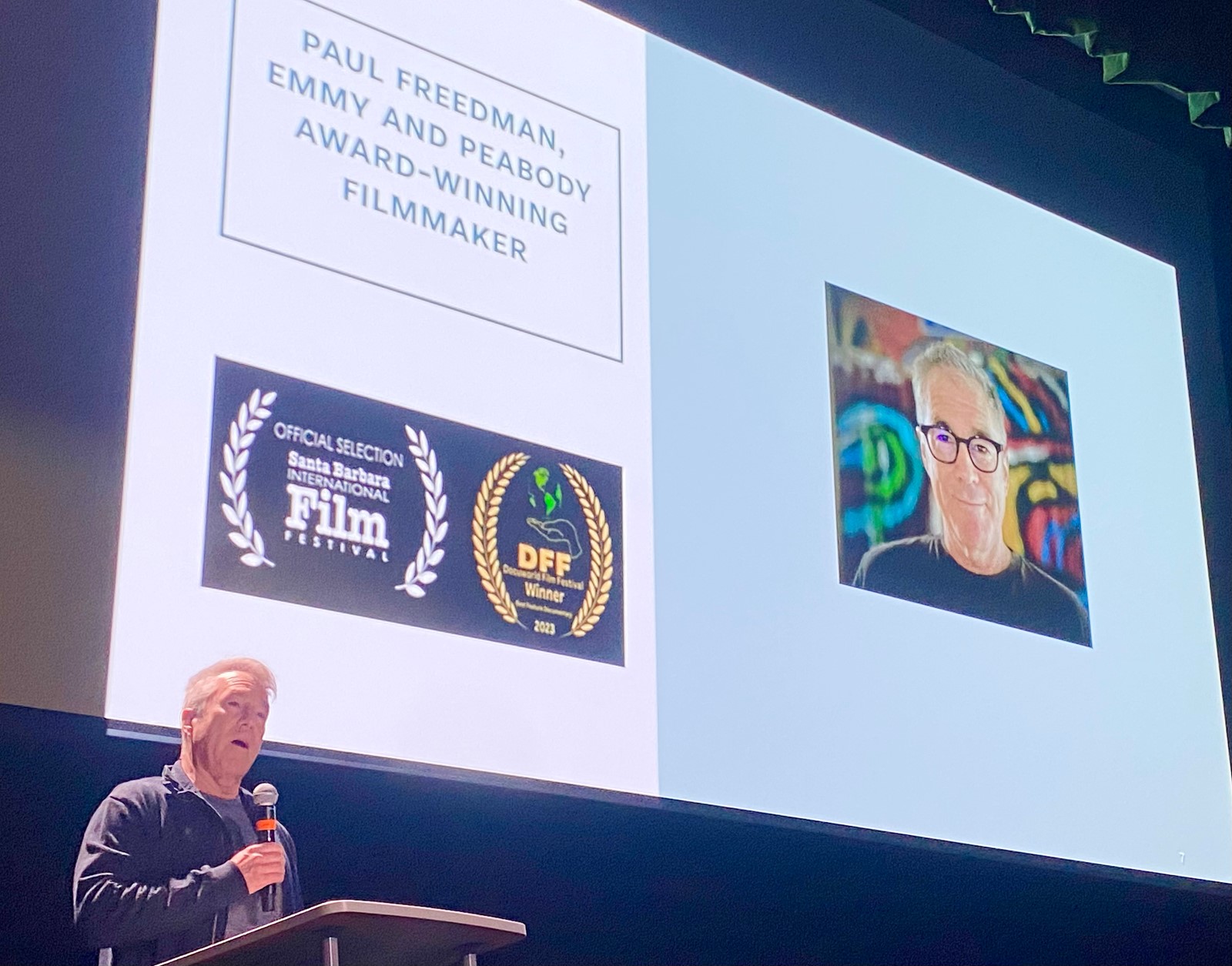
Navarette introduced documentary filmmaker Paul Freedman, who has won Emmys and Peabody awards for his work overseas and in America, documenting the plight of the impoverished, the terrorist attacks of Hamas against Israel and the antisemitism that occurred in America as a result, and those suffering Post Traumatic Stress Disorder.
Freedman, who is from Los Angles, said that in his film “you will see what you perhaps haven’t seen before when you drive past a homeless encampment. I’m guilty of this because for years I would drive by an encampment and see shadowy figures. I wouldn’t see anybody.
“But after spending almost five years working on Skid Row,” he continued, he now sees “people: youthful, resilient, often troubled — much like the folks in my neighborhood.
“I want you to take a long look at this film. It offers a glimpse of hope … Let’s see if we can find humanity in ourselves to see if it’s commensurate with what I’m demonstrating in the film.”
In the opening scenes of the documentary, Freedman interviews people of the Los Angeles Community Action Network, which has been helping the poor and unhoused for 25 years. The group originated the name “The Dirty Divide” to signify the stark disparity between the East and West sides of Main Street in downtown Los Angeles.
West of Main Street has an affluent white population while the eastern side has Skid Row, law enforcement, lack of housing and “banishment” for a long-standing Hispanic community. It’s estimated that Skid Row has a population of between 13,000 and 15,000 people.
People living on Skid Row, it was reported, are “brilliant and resilient” who are “recovering not just from substance abuse and alcoholism but recovering from economic devastation, PTSD, recovering from trauma. Skid Row also holds the dirty secrets of industrialization, the dirty secrets of the real life impacts of the war on drugs … and the dirty secrets of structural racism. It’s also the tapestry of meanness, political meanness.”
Skid Row has been condemned by the United Nations with officials conducting a human rights investigation saying the way people are “being forced to live in the most affluent county of the world is a disgrace. The grade on that is a failure. There is no doubt about that.”
Freedman said most of the residents of Skid Row are Black. African-Americans make up 8% of LA’s population, but are 40% of the city’s unhoused.
“In failing to see how America’s systemic oppression of people of color factors into houselessness, I’ve only seen half the picture,” he said in the film. “I only saw poverty. Spend any time down here and you’ll see that race and racism plays a significant roll in who is and who isn’t housed in the city.”
While Woodland and Yolo County are not as bad as Skid Row, there are hundreds of people living on the streets or in shelters, with the numbers continuing to grow.
According to the most recent information, taken during January 2024 as part of the 2024 Point-In-Time Count, there were 942 people and families experiencing homelessness, a 26.3% increase of 196 people compared to 2022.
“This rise reflects ongoing challenges in addressing homelessness within the community, particularly in the face of transitions from COVID-related housing programs,” according to a county statement following the survey. “Unsheltered homelessness saw a significant increase, with 255 more individuals living outside in 2024, while sheltered homelessness saw a decrease of 59 individuals.”
The report also noted that homeless populations saw increases in rural and unincorporated areas, while Davis experienced reductions and West Sacramento maintained stable numbers.
Woodland saw the most notable increase, going from 267 to 416 individuals experiencing homelessness between 2022 and 2024. More recent estimates put that number at closer to 500 today.
PIT counts are conducted every two years. The previous count was originally supposed to be completed in January 2021 but was delayed until February 2022 due to the COVID-19 pandemic.
The 2022 report showed that Yolo County had a total of 746 individuals experiencing homelessness. This equated to a 13.9% increase in the homeless population from 2019 to 2022.
Miller has previously said “while Skid Row is an example of the homeless condition on a massive scale, it’s representative of those impacted even in much smaller communities.”
“We wanted a program, sponsored by local Rotary clubs, that included community solutions to the unhoused and those in need, but also to those at risk,” he stated.
“The goal of bringing a wide and diverse audience to an ‘Unhoused Conversation,’ is to extend knowledge and awareness, while inviting a continuation of the conversation beyond the event, to support an even greater impact to improving the lives of those in need,” Miller noted.
Woodland’s three Rotary Clubs are all members of District No. 5160, which has 2,700 members.
 PREVIOUS ARTICLE
