


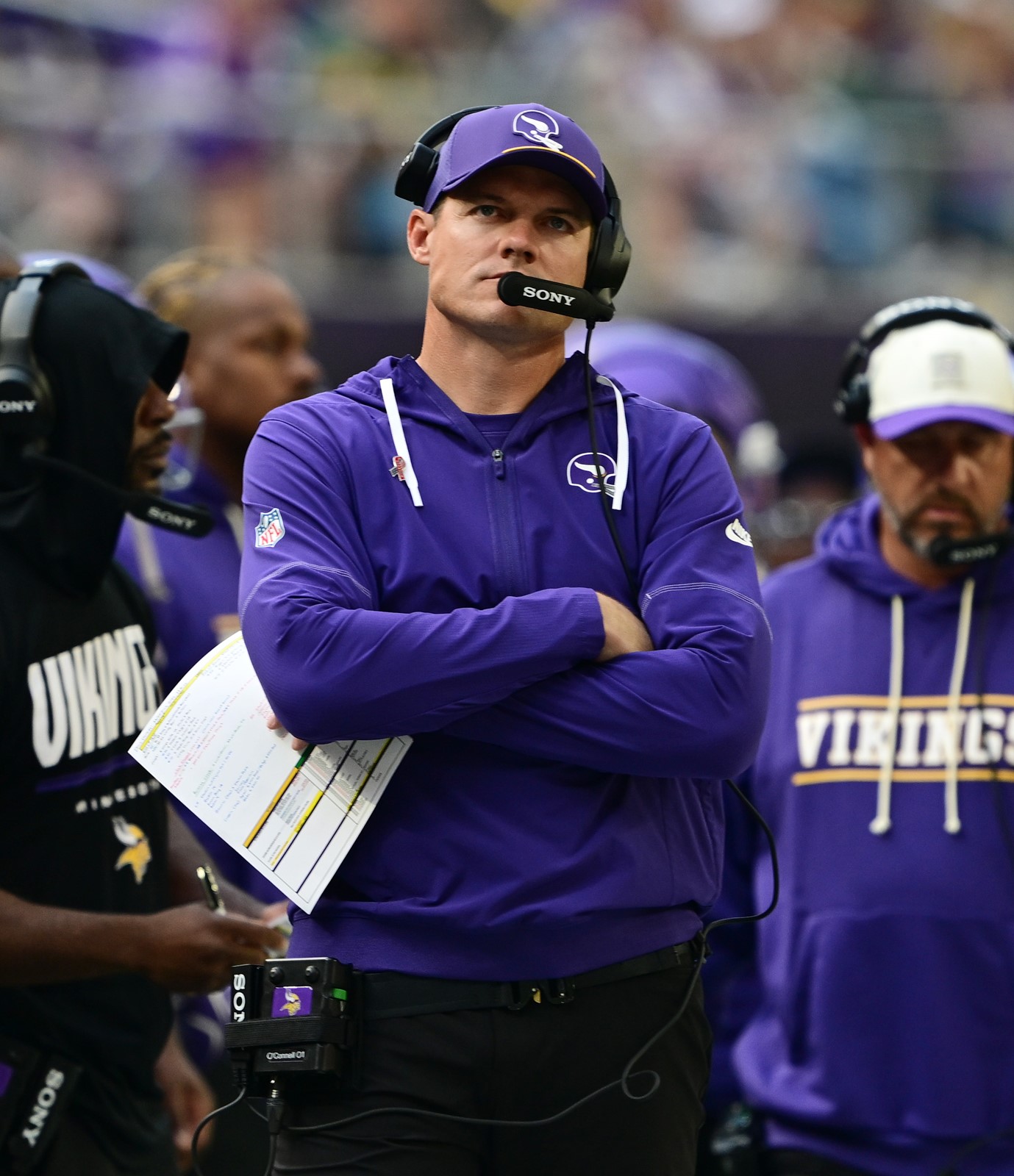
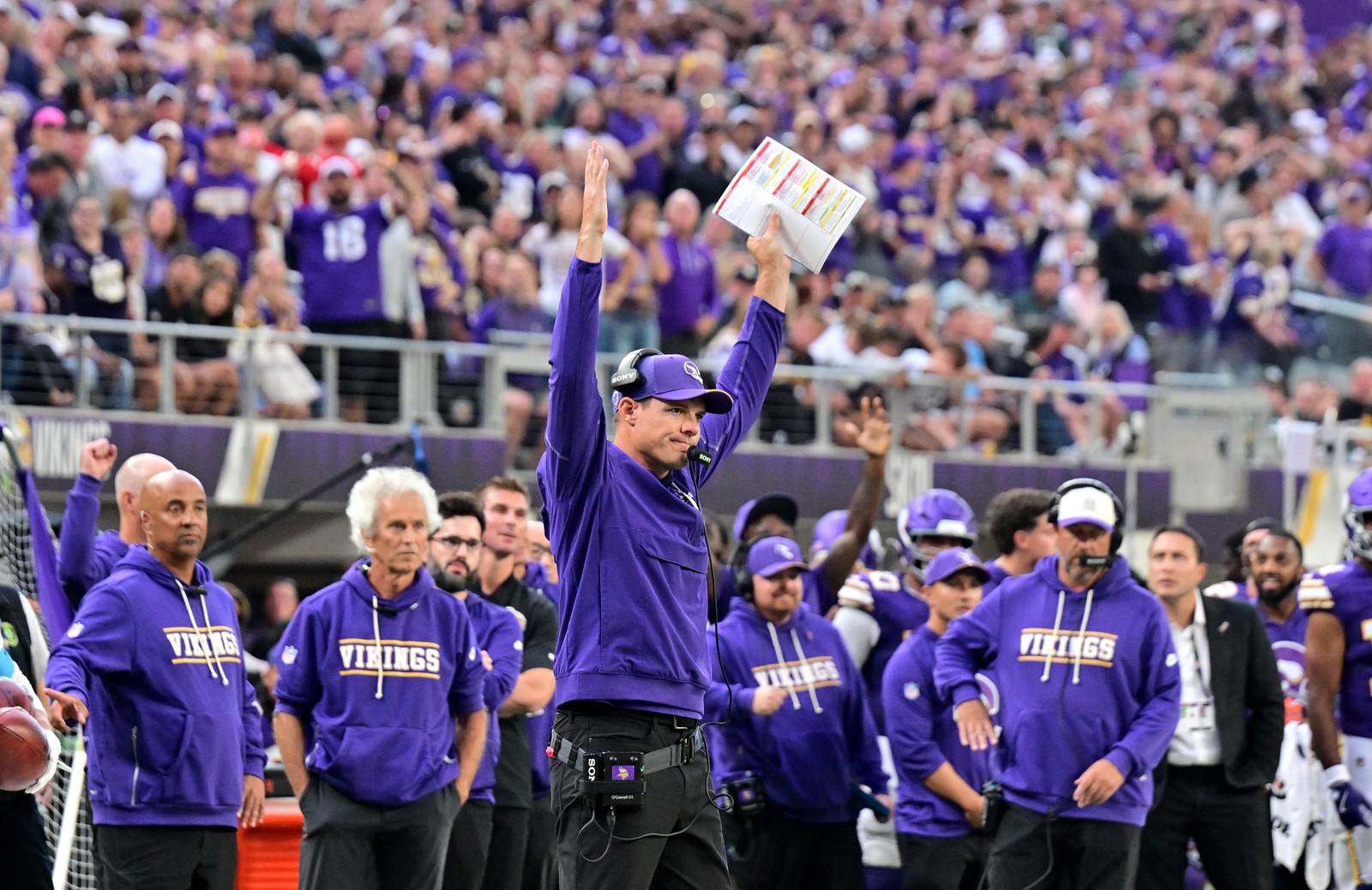


A reflective coach Kevin O’Connell stood at the podium last Sunday at U.S. Bank Stadium shortly after the Vikings celebrated a rather stunning 39-22 win over the Packers.
After a win in which Minnesota tallied just 239 yards of total offense due in part to O’Connell’s unusually conservative play calling, he briefly confronted some of his own shortcomings from the past.
“In some of the adversity I don’t think I’ve coached very well,” O’Connell said. “Just trying to maybe worry about the stat sheet or trying to maybe worry about what it’s going to look like when we pick up the newspaper.”It was as close as he has come to admitting there might have been times earlier his career that he was at least partially driven by the numbers. Validation comes with trotting out a high powered offense.
Rams head coach Sean McVay, 49ers head coach Kyle Shanahan and Bears head coach Ben Johnson are universally revered for their offensive success. The latter is particularly relevant with the Vikings traveling to play the Bears this Sunday at Soldier Field.
As he’s gained more experience, however, O’Connell has come to an important realization. Though he will continue to be guided by some of the analytics, such as explosive play rate and expected points added, he won’t be defined by them.
“You learn that none of those other things matter,” O’Connell said. “Because winning is the only thing that matters.”
That mindset was most recently display as O’Connell did his part to make sure the Vikings stayed in the fight against the Packers.
After starting quarterback Kyler Murray suffered a concussion and had to be replaced by backup quarterback Carson Wentz, O’Connell leaned heavily on the running game, sticking with it despite the fact that the Vikings were trailing the Packers for most of the game. He handed the ball off to Aaron Jones and Jordan Mason a total of 22 times while tied or trailing with a handful of designed quarterback runs sprinkled in between.
It was a commitment to the running game not often seen with O’Connell calling the shots from the sideline.
“That doesn’t always mean it’s going to equal explosive run after explosive run,” O’Connell said. “You’ve got to know that as a play caller.”
In a past life, O’Connell might’ve abandoned the running game in short order, relying on the passing game to get the Vikings back into it. Not only did he remain committed to the running game this time around, O’Connell made halftime adjustments tailored to using it even more.
There seemed to be an understanding that the game plan the Vikings had in place with Murray at the helm was going to have to change with Wentz at the helm.
Data from Sharp Football Analysis highlighted how the Vikings were able to malleable. They lined up in shotgun on 58% of drop backs in the first half and only 28% of drop backs in the second half. They also opted for more heavier packages on offense with a steady dose of 21 personnel (2 running backs, 1 tight end) and 22 personnel (2 running backs, 2 tight ends) throughout the game.
In fact, the Vikings were in 21 personnel or 22 personnel roughly 40% of the time. Only the 49ers and Dolphins used 21 personnel at a higher rate. Only the Giants used 22 personnel at a higher rate.
The use of heavier packages from the Vikings manifested in the passing game taking a backseat to the running game.
There was some ineffectiveness in the early stages due to missed assignments, but O’Connell still continued to pound the rock. That conviction paid off down the stretch when Mason got loose for an important 28-yard gain to help put the Vikings in scoring position.
“I’ve got to do a better job early on making sure we’re cleaner there,” O’Connell said. “I thought we adjusted and got some things downhill and then then we were able to stick with it long enough to have a wide zone pop there late for a good hit.”
His players appreciated the commitment to the running game. It was representative of a mentality that the Vikings talked about throughout the spring and summer with hopes that it would show up in the fall and winter.
“We’re going to stick with it,” Jones said. “We’re going to wear these guys down. We’re not shying away from it. We’re going to be physical.”
It helped that the Vikings were aided by a defense forcing multiple turnovers that put the offense in prime scoring position.
That said, O’Connell deserves credit for putting his trust in defensive coordinator Brian Flores and not trying to do it all by himself. It’s almost as if he realized in real time that if the offense simply didn’t lose the game, the defense was going to be capable of winning the game.
“There are principles of playing complementary football,” O’Connell said. “Especially now with Flo and what he’s been able to build.”
It’s been a welcomed sight for Flores for no other reason than he enjoys that play style.
“There’s nobody that likes to see us run the ball more than me,” Flores said. “I love it when we’re running it and imposing our will on the opposing group.”
The philosophical shift that was on display in Week 1 can traced back to the end of last season when the Vikings got shutout in a loss to the Seahawks.
Never mind that Max Brosmer was making the first start of his career on the road in arguably the hardest place to play in the NFL. He was asked to drop back to pass on 18 of the 26 offensive plays before halftime.
It resulted in the Vikings digging themselves into a 13-0 deficit from which they never recovered. That stretch of consistent drop backs included Brosmer throwing an interception to linebacker Ernest Jones IV that was returned for a touchdown.
It’s not a coincidence that O’Connell looked himself in the mirror after he threw undrafted rookie quarterback Max Brosmer directly into the fire.
After that game the Vikings seemingly started to sacrifice style for substance, leaning on the running game much more than the passing game while grinding out wins over the Commanders, Cowboys, Giants, Lions and Packers to close the campaign. Not once in that span did the Vikings pass more than than ran.
The Vikings completely altered their identity since that shutout loss to the Seahawks. Only the Ravens ran the ball at a higher rate.
That provided a blueprint that O’Connell has continued to follow. The hiring of assistant head coach Frank Smith ahead of this season indicated there was going to be an intentionality in integrating the running game into the offense’s DNA.
The fruits of that labor have already started to show up for the Vikings. The most promising thing? They believe the running game is just scratching the surface.
“We aren’t satisfied,” left tackle Christian Darrisaw said. “There a lot of things that we can do better to make it look better than it did. We got to see a few glimpses of what it can be if we apply what we’ve been doing. I trust this group and I know a lot more things are going to pop off.”
As for the the Vikings staying in the fight with the Packers long enough to unleash an avalanche, O’Connell tried to explain exactly how it happened, emphasizing an element that he’s prided himself on since arriving in Minnesota.
“It’s having the right kind of guys, first of all,” O’Connell said. “I know sometimes people take shots at culture. What is it? That’s what it is.”
That might be true.
It’s fair to suggest that the Vikings might not have won that game without the culture they have in place. It’s also fair to suggest that the Vikings might not have won that game had the man who’s worked so hard to cultivate it not proven he can change.
“We all as offensive coaches would love to put up 500 yards,” offensive coordinator Wes Phillips said. “It’s ultimately about what we need to do to win the football game. It really is about how all the phases complement each other. I think Kevin is more aware of that than anybody.”
That’s not to say O’Connell is going to go completely old school with his play calling. A review of the film from the Vikings win over the over the Packers showed missed opportunities down the field that would’ve gone for big gains.
The ability to push the ball down the field is always going to be a big part of the offense.
It’s just going to be a balance that O’Connell seemingly understands now more than ever.
“The expectation is to go out and do whatever we think is best to win a football game,” O’Connell said. “I think that’s where we have to look at things through the lens that it could be different every week.”
 PREVIOUS ARTICLE
