


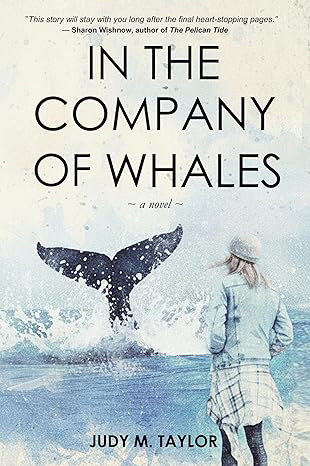
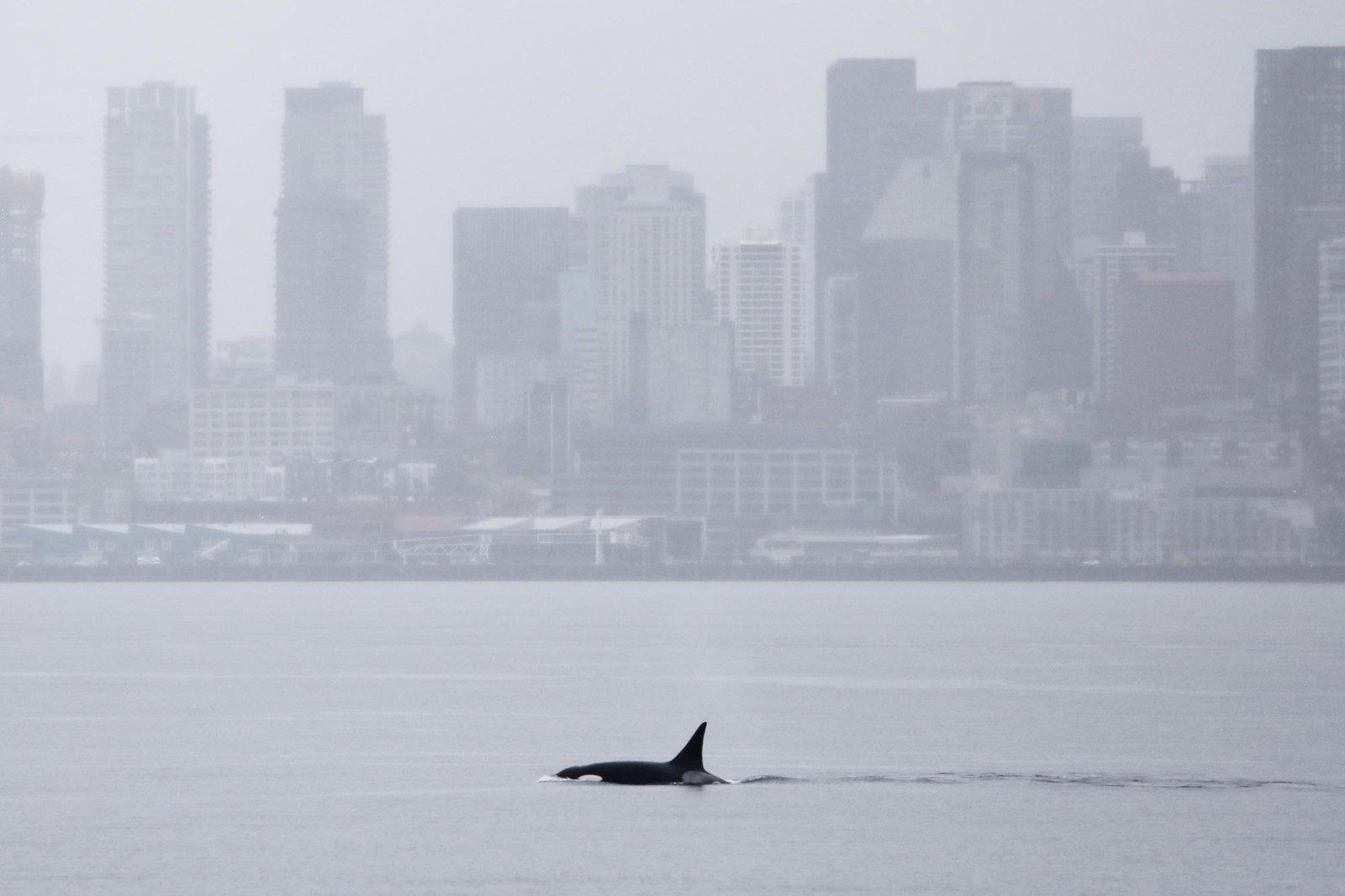



Judy Taylor was mesmerized when she saw live orca whales for the first time.
“My reaction was a gasp,” she recalls. “I’d seen pictures of whales but when I saw them splashing out of the water, it knocked my socks off. Their coloring is so striking — pristine white and black backs. That’s the feeling I wrote into my book.”
Taylor talked about her debut novel, “In the Company of Whales,” from her home in Minneapolis’s Longfellow neighborhood just miles from where she grew up. This week she’ll launch her story about a small town dealing with a trapped pod of whales and the lonely Goth waitress whose life is changed by the sea giants.
How did Taylor, a former teacher from landlocked Minnesota, fall so in love with whales?
“In 1997 I was living in Washington State and a pod of 19 orcas was spotted in Dyes Inlet near the Kitsap Peninsula where they hadn’t been seen for 40 years,” she said. “I was driving my kids to school when I heard on the radio about orcas in the inlet. I went there a lot, captivated by watching them put their fins and tails out of the water.” (The whales left a month later and nobody knew why.)
Taylor’s short time with the whales in their annual migration inspired her to write a short story. “I felt I had more to tell but I didn’t have the slightest idea how to write a novel and I put off writing far too long,” she admits. Still, her encounter with the orcas stayed with her.
Family and writing
Taylor, who grew up with four siblings, attended Jefferson Junior High and the old West High School, graduating from the University of Wisconsin.
Her father, Romeyn Taylor, taught Chinese history at the University of Minnesota from 1980 to retirement in 1994, specializing in the Ming dynasty. Judy’s mother, Irene, was an English teacher and writer who had 11 published short stories.
“I always felt like a writer and I dipped in and out of it all my life,” Judy says about veering into teaching. “I did a lot of writing with my students, encouraging them to participate in National Novel Writing Month, a great program. Some kids said it was their favorite year.”
Taylor, who has two children, moved around the country during her first marriage because of her husband’s career. She says that when her marriage ended, one of her first thoughts amidst the turmoil was “I have time now to be a writer and I can go home to Minnesota.”
Taylor wasn’t sure she wanted another major relationship in her life, but then she was introduced to her husband, Curt Leland, a Michigander who loves Minnesota. She’s thrilled that several of her siblings who were scattered around the country have returned and live within miles of one another.
Writing the whales
Finally settled into her “hidey hole” in the basement of her home, Taylor began writing her novel, combining her real-life experience seeing whales with an imagined visit of a pod of orcas who slip into an inlet, much to the delight of small town residents and tourists whose boats crowd the whales.
“I wanted to shine a light on the environment, working-class struggles and the value of community,” she says.
In her story, whale-watchers boost the town’s economy but Nathan, a researcher for the (real-life) Center for Whale Research, is worried about the orcas that are eating salmon as they swim in the inlet. They won’t leave and they are running out of food.
Nathan needs a volunteer to help in his boat as he monitors the whales. He gives the job to Carla, a former punk rocker and waitress at the local coffee shop who is living paycheck-to-paycheck and pushes people away, a cold woman dressed in thrift store clothing. Carla knows nothing about whales but she is captivated by the family as she learns how to distinguish between them by the shapes of their fins.
For the first time in her life, Carla has a mission. She learns everything she can about orcas, finally figuring out why the whales are afraid to leave the inlet. Battling bureaucrats who won’t listen to her, she finally finds sympathetic men who help her and Nathan. Can they implement the complicated plan to save the orcas before it’s too late?
Taylor says it was the character of Carla that brought the story to life for her, inspired by a real-life encounter.
“In some of my travels I was often at a small airport with a restaurant,” she recalls. “There was a woman server who was very funny, very outgoing, with kind of a grumpy exterior. Something about her kept stewing in my head. A cranky character with a good heart underneath. Once I got to know Carla, she developed in my imagination.”
As the story progresses and Carla falls more in love with the whales, she confronts her past with her drug-addicted mother and finds unexpected strength to save the whales.
It’s not surprising Taylor is now an advocate for orcas, sometimes called “killer whales,” a description she says is incorrect.
“This is the biggest misconception about orcas, leading people to give the wrong impression — that they are like sharks,” she says. “Orcas are curious about people but they have no interest in eating us.” She acknowledges part of this wrong interpretation stems from news accounts of orcas in theme parks attacking their trainers.
“Orcas don’t thrive in captivity,” Taylor explains. “They have never killed a human being in the wild. One of the big problems with keeping them alone in tanks is that they have a family structure. They are very social animals. They need and depend on one another.”
Taylor is a supporter of the Center for Whale Research, where scientists were responsible for the first counting of the Southern Resident orcas, monitoring their births, deaths and general health. Find information on the center at whaleresearch.com.
She will launch “In the Company of Whales” with a free reading at 4 p.m. on Tuesday at Chatterbox Pub, 2229 E. 35th St., Mpls.
Taylor contacted the Orca Conservancy, dedicated to protecting orcas, and the Whale Museum in Friday Harbor, Wash., informing them she is having a reading and will be at the Book Fair for Adults in July at the State Fairgrounds.
“They sent brochures, stickers, all kinds of stuff that will be on my tables,” she says happily, inviting everyone to learn more about whales.
 PREVIOUS ARTICLE
