


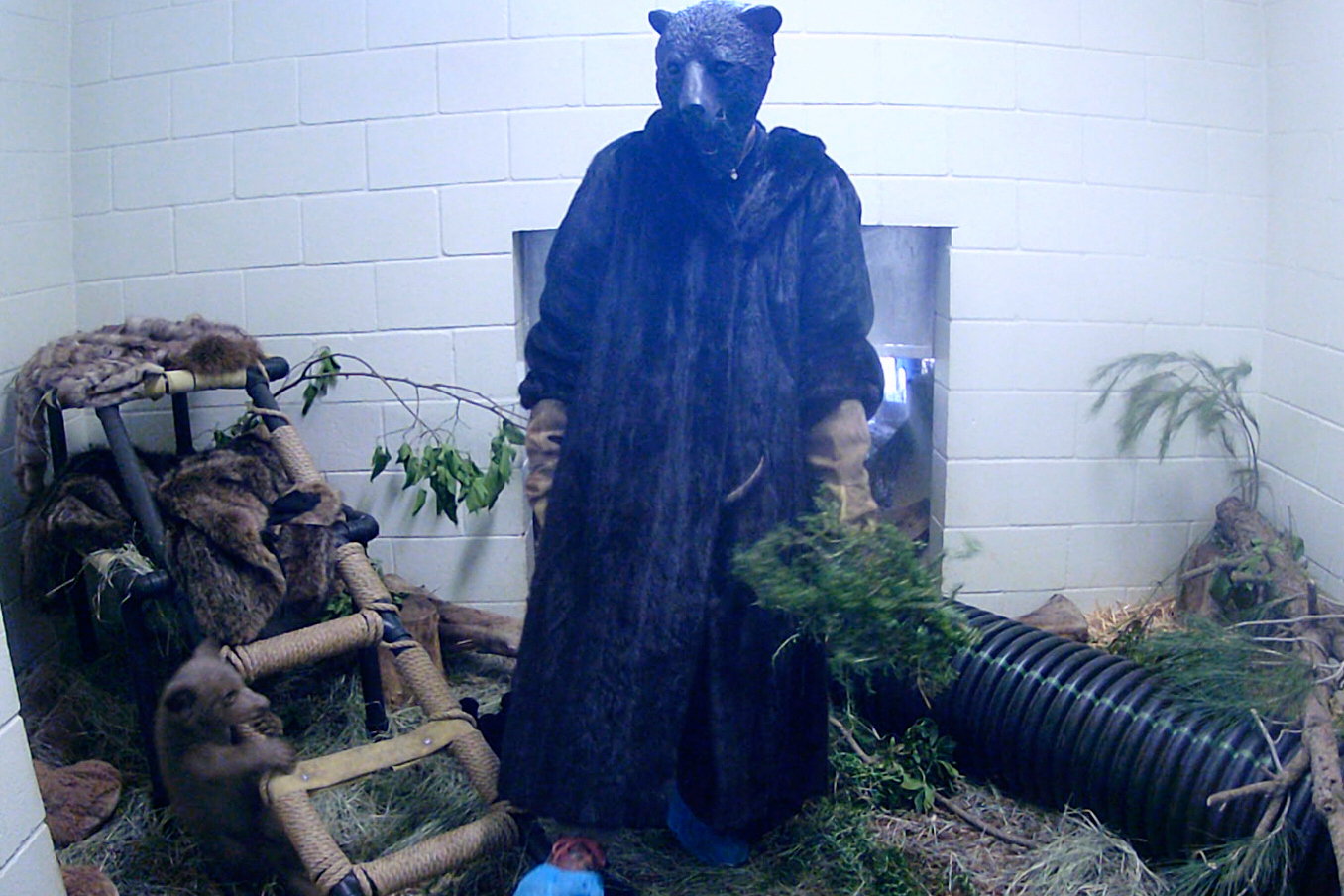


Autumn Welch dons a fur coat, leather gloves and a bear mask for work these days, then enters an enclosure to feed and fawn over a 12-pound black bear cub who she hopes will consider her family.
The orphaned cub was about two months old when he was found April 12 in Southern California’s Los Padres National Forest — weak, underweight and alone. Since then, the baby bear has been cared for by Welch’s team with the San Diego Humane Society in sessions that mimic familial behaviors. The hope is to eventually return the cub to the wild.
The bear costume is meant to stop the rescued cub from bonding with humans. The fur coats are stored in bins with hay scented by black bears. The team went through a few masks before finding one that fit properly.
“Mama” is a giant stuffed teddy bear propped up in the corner of a pen at the humane society’s 13-acre (5-hectare) Ramona Wildlife Center near San Diego. That’s where the cub turns when he’s spooked or just wants to snuggle up for a nap, said Welch, the wildlife operations manager.
“He’s probably really missing his real mom,” she said.
When the costumed caregivers enter, the cub treats them like siblings. He rambunctiously plays with them and happily accepts grass and fresh wildflowers to munch.
A milestone was met recently when the youngster learned to dig through soil for worms and insects, “which he caught on to pretty quick,” Welch said. Other food is placed in tree branches for him to find on his own. Team members took heart when they recently found the cub snoozing on a tree branch, a common behavior for bears in the wild.
“He’s very thoughtful. He’s constantly taking in his environment,” Welch said.
The California Department of Fish and Wildlife tried to reunite the cub with his mother after campers found him. They returned the youngster to the wild overnight, but took him in when she didn’t appear. The emaciated 3-pound (1.3-kg) baby bear was then transported to the Ramona wildlife center.
The cub has quadrupled in size since then.
Biologists hope they can return him to the wilderness next year, provided he can learn to find food, seek shelter and avoid people.
The cub is the fourth to enter rehab care in California in the past five years. He could be paired with a buddy if another one turns up, because that would reduce the risk of them imprinting on humans.
 PREVIOUS ARTICLE
