




An unusually early and light wine grape harvest is moving quickly across California’s North Coast, but the smaller crop is arriving as growers and wineries wrestle with weak grape demand, higher operating and regulatory costs and renewed uncertainty over farm labor expenses.
Sauvignon Blanc is largely harvested in Napa and Sonoma counties, Pinot Noir is nearing completion and Chardonnay is coming in, while Cabernet Sauvignon picking has begun unusually early in warmer parts of Napa Valley, according to Christian Klier, North Coast grape broker for Turrentine Brokerage.
Light crop, uneven demand
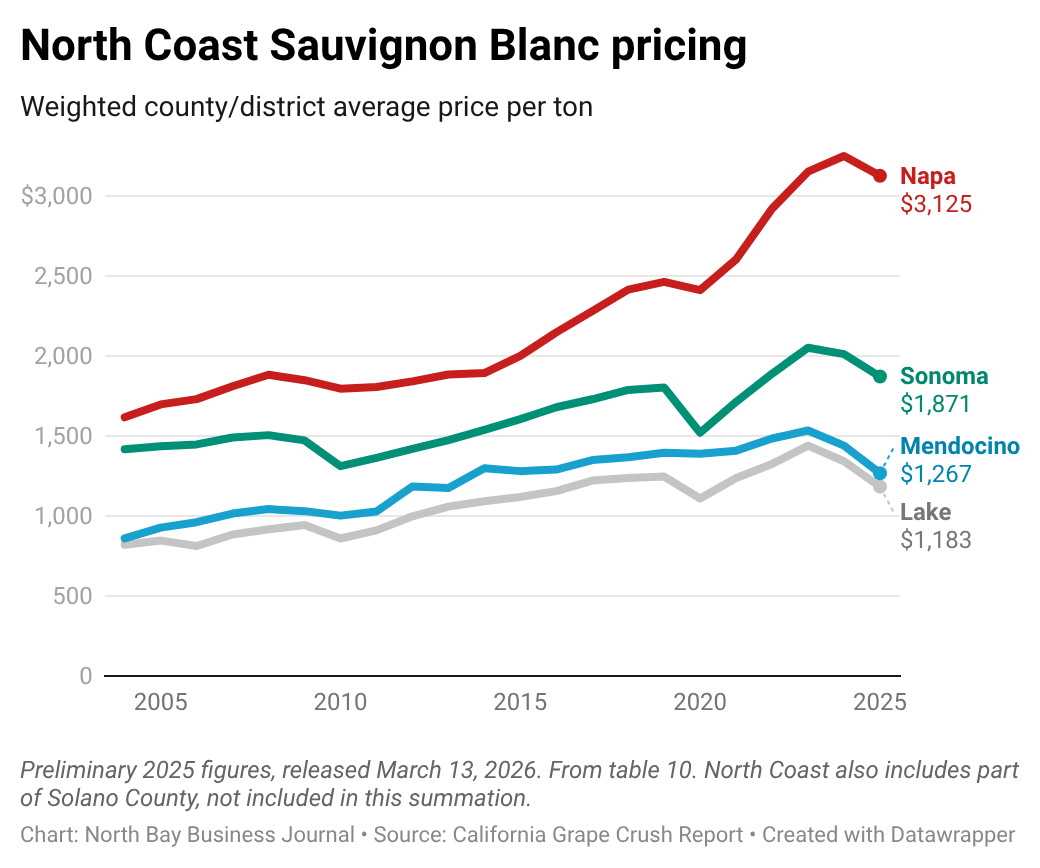
The season’s strongest spot has been Sauvignon Blanc. Klier said consumer sales volume for the varietal has increased 1.5%, helping spur a late rush by wineries for Napa fruit after months of weak interest. Competition pushed some Napa Sauvignon Blanc prices nearly $1,000 a ton above last year’s district weighted-average price per ton for the variety ($3,125) before buyers moved into Sonoma County and largely cleared available supplies there at around the 2025 district average ($1,871).
But the rebound has not spread evenly. Sauvignon Blanc remains available in Lake and Mendocino counties, where Klier said some fruit may go unharvested, while interest in most other varietals there is extremely limited.
Pinot Noir also has been unusually light, particularly in Sonoma County. Klier said some Russian River Valley vineyards that normally produce 3 to 5 tons an acre are yielding only 1 to 1.5 tons.
But smoke from the Woodside Fire in late July and early August added another complication, with some lots in the appellation rejected by wineries. But that did not produce a broad scramble for replacement fruit, Klier said. Meanwhile, Chardonnay picked tonnage appears to be running below average but heavier than Pinot Noir and Sauvignon Blanc.
Cabernet Sauvignon also appears lighter than normal across Napa, Sonoma, Lake and Mendocino counties. Klier attributed that to poor weather during bloom and fruit set, resulting in “shatter” (incomplete ripening of each berry in a cluster). Other factors he cited are the physiological effects on the vines from last year’s heavy crop and growers’ reducing what they spend on their vineyards after several years of low grape prices and, for some, fruit that went unsold.
“A lot of dynamics happening right now, and a lot of worry and a lot of concern on both sides of the fence, the growers and the wineries,” Klier said.
Growers cut costs to match the market
Ernie Ilsley, president of the Napa County Farm Bureau and owner of Ilsley Vineyard Management, said his company has finished picking its roughly 20 acres of Sauvignon Blanc and is about 20% through its red-grape harvest. It has been picking hillside Cabernet and has harvested most of the Merlot and Malbec it manages.
Ilsley said the lighter crop has prompted some wineries to return to the market to fill shortfalls, although others may be content to make less wine this year. His company manages about 250 acres, primarily in the Stags Leap and Yountville appellations, and supplies labor on several hundred more.
Still, weaker grape values are forcing growers to recalibrate what they can spend.
“Pricing for grapes has dropped dramatically, so the farming costs need to adjust with that,” Ilsley said.
His company has reduced costs such as cutting back on fertilizer after the Iran conflict’s crimp on shipments sent prices soaring. The firm also has worked with clients on their vineyard budgets and mothballed several properties, keeping them viable but not farming them to produce fruit this year. Its H-2A workforce has been cut to 15 workers from 30, and its domestic workforce (18 year-round and over 50 seasonal employees at harvest) also is smaller.
H-2A ruling adds uncertainty
As is common in many businesses, labor is Ilsley’s largest expense, with workers’ compensation the biggest insurance component. That cost now carries additional uncertainty after an Aug. 26 federal court ruling over wages in the H-2A temporary agricultural worker program.
U.S. District Judge Kirk Sherriff in Fresno ruled the Department of Labor’s October 2025 interim final rule for calculating the H-2A adverse effect wage rate was unlawful and ordered the agency to develop a new wage-setting methodology.
Sherriff found the department had not adequately justified the changes or its decision to bypass normal notice-and-comment procedures, according to the Fresno Bee and Reuters. The rule used a lower wage tier for many workers and allowed an adjustment tied to employer-provided housing.
The lawsuit was brought by the United Farm Workers, the UFW Foundation and 18 individual farmworkers, according to the Fresno Bee. The union argued the rule could cut wages by $3—$7 an hour for some workers.
“This decision recognizes the important and essential work of the men and women who put food on our tables and that farmworkers should get paid fairly,” UFW President Teresa Romero told the newspaper.
The ruling, however, did not immediately eliminate the existing rates.
In a Sept. 2 notice, the Labor Department’s Office of Foreign Labor Certification said the current adverse effect wage rates will remain in effect until the agency publishes new rates under a replacement methodology. The department emphasized that employers are not currently obligated to pay back wages.
But the agency warned that employers using H-2A workers from Sept. 2 until new rates are issued may later have to make wage-adjustment payments to qualifying H-2A workers and U.S. farmworkers in corresponding employment if their hourly wages fall below the new rates.
“The period potentially subject to such an adjustment would run from the issuance of this notice … and end when the Department issues new AEWRs under a new methodology,” the Labor Department said.
The department also told employers to maintain identifying and contact information for H-2A and corresponding U.S. workers who could later qualify for payments.
For Ilsley, the court fight adds to several years of swings in H-2A costs. He said changes in the program lowered the rate growers paid in 2026, but the latest ruling suggests costs could rise again. His company starts domestic workers at $21.50 an hour, while H-2A workers are under a separate wage structure and receive free housing and transportation as required by law.
Regulatory costs compound pressure
The labor uncertainty comes on top of a regulatory burden documented this year in two Cal Poly San Luis Obispo case studies supported by the Napa County Farm Bureau.
A March study of Napa vineyards estimated annual regulatory compliance costs of $1,744.87 an acre for a 1,000-acre operation and $1,131.10 an acre for a 200-acre grower — about 8.1% to 12.5% of total production costs, the Journal reported. Labor-related regulations accounted for most of those expenses.
A later study of an anonymous Napa winery producing 8,500 cases found almost $204,000 in annual regulatory compliance costs, equal to $23.65 a case and 17.5% of production costs, the Journal reported. The total included production compliance and direct-to-consumer sales requirements.
Those costs are colliding with a harvest in which a smaller crop has not necessarily translated into stronger demand.
Klier said some growers have cut fertilizer and other vineyard spending because they lack contracts or failed to sell fruit last year. Some wineries, meanwhile, are operating with sharply reduced harvest crews and intake schedules, making it harder to process fruit as picking accelerates.
Light rain on Wednesday and Thursday briefly slowed the harvest and gave wineries time to catch up.
“It’s a lot of working with growers to match the farming cost with the price of fruit. Control our costs, farm at a lower per-acre basis,” Ilsley said.
Jeff Quackenbush joined North Bay Business Journal in May 1999. Reach him at jeff@nbbj.news or 707-521-4256.
 PREVIOUS ARTICLE
