




WARSAW, Poland >> For months leading into the American elections last fall, the prospect of a second Trump presidency deepened uncertainty among Ukrainians over how enduring America’s support would prove in a war threatening their national survival.
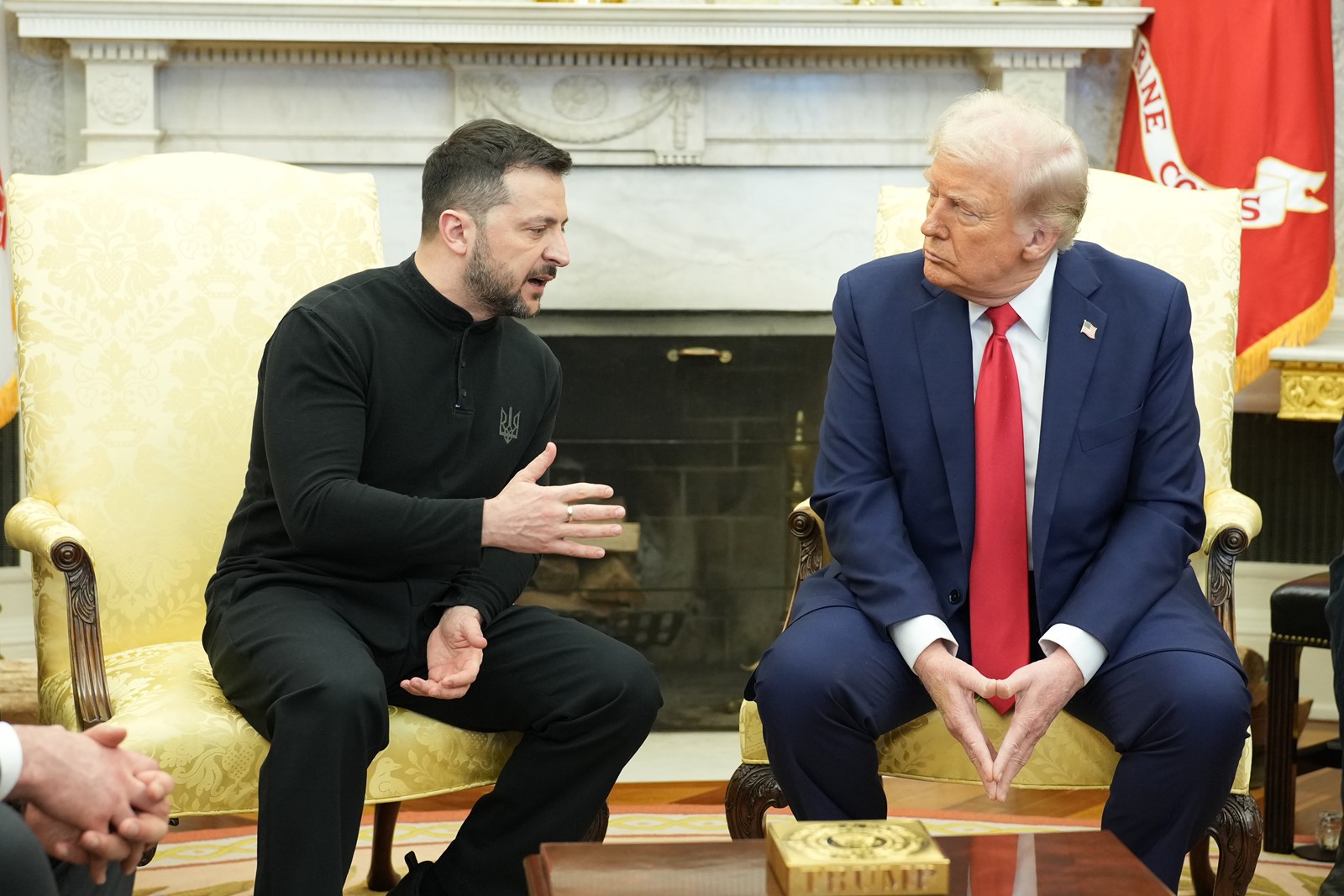
After President Volodymyr Zelenskyy’s disastrous meeting with President Donald Trump in the White House on Friday, many Ukrainians were moving toward a conclusion that seemed perfectly clear: Trump has chosen a side, and it is not Ukraine’s.
In one jaw-dropping meeting, the once-unthinkable fear that Ukraine would be forced to engage in a long war against a stronger opponent without U.S. support appeared to move exponentially closer to reality.
“For Ukraine, it is clarifying, though not in a great way,” Phillips O’Brien, an international relations professor at the University of St. Andrews in Scotland, said in an interview. “Ukraine can now only count on European states for the support it needs to fight.”
The German president, Frank-Walter Steinmeier, said Saturday that Europe must stand with Ukraine and prevent the country “from having to accept subjugation.”
“The scene at the White House yesterday took my breath away,” he told the German press agency onboard a plane. “I would never have believed that we would ever have to defend Ukraine from the United States.”
An immediate result was that Ukrainians, including opposition politicians, were generally supportive of Zelenskyy on Saturday for not bending to Trump despite tremendous pressure.
Maryna Schomak, a civilian whose son’s cancer diagnosis has been complicated by the destruction of Ukraine’s largest children’s cancer hospital by a Russian missile strike, said that Zelenskyy had conducted himself with dignity.
“They gathered with one goal: to pressure us and undermine our authority on the global political stage,” she said of Trump and his team.
Zelenskyy signaled Saturday that he had not completely given up hope of repairing the relationship with Trump. Posting on social media, he went out of his way to thank the United States, perhaps trying to address Trump’s complaint Friday that he was ungrateful.
“I’m thankful to President Trump, Congress for their bipartisan support and American people,” he wrote. “Ukrainians have always appreciated this support, especially during these three years of full-scale invasion.”
At the same time, Zelenskyy began laying the groundwork for moving ahead with the European countries that have stood by Ukraine’s side. Ukraine announced plans Saturday for a joint weapons venture with France that would be financed by the interest earned from frozen Russian assets.
Later in the day, Zelenskyy met with Prime Minister Keir Starmer of Britain, who has been a supporter of the Ukrainian president in the face of Trump’s harsh rebukes.
In a stark contrast to Friday’s meeting in Washington, the visit to 10 Downing St. began with a warm handshake and a short embrace. It included a promise from Starmer to the Ukrainian president that “you have full backing across the United Kingdom, and we stand with you and Ukraine for as long as it takes.”
Today, Zelenskyy will attend a summit of European leaders hosted by Starmer.
While much of the focus was on the shocking tone and theatrics of the dressing-down delivered by the American president to a putative ally, O’Brien said that Trump’s comments suggested that the root of the public rupture ran deeper.
“He was trying to pressure Zelenskyy into agreeing to a ceasefire along Putin’s lines, and Zelenskyy refused,” O’Brien said, referring to President Vladimir Putin of Russia. “Trump comes out and says that explicitly at the end.”
Trump had shouted at the Ukrainian leader, “You’re buried there,” and said, “Your people are dying. You’re running low on soldiers.”
As Zelenskyy tried to defend himself, Trump talked over him.
“No, listen,” he continued. “And then you tell us, ‘I don’t want a ceasefire. I don’t want a ceasefire.’ ”
The exchange, O’Brien said, reflects Trump’s belief that “Ukraine should shut up and take Trump’s and Putin’s terms.”
The real affront that prompted the spectacle, many Ukrainians and analysts believe, is that Zelenskyy pushed back against some of Trump’s terms.
Along the front lines, some soldiers said that the realization was sinking in that Trump would probably not help Ukraine. “Trump chose his side in this war,” said Pvt. Serhiy Hnezdilov in a telephone interview from the front Saturday.
Hnezdilov said he supported Zelenskyy’s stance, adding that he thought the attempt to humiliate the Ukrainian leader was probably the goal of the invitation to the White House.
“The scandal we witnessed was essentially the only purpose of that meeting,” the private said. “It looked utterly absurd, considering that we, Ukrainians, have always regarded America as an example of democracy and, most importantly, of values.”
Ukrainians may have been naive, he added.
Still, many Ukrainians were shaken by the public falling-out in Washington, and Zelenskyy sought to reassure his war-weary nation Saturday.
“People in Ukraine need to know they are not alone, that their interests are represented in every country and every corner of the world,” he said in a statement.
Leaders across Europe took to social media to voice support of Ukraine, and Zelenskyy offered his personal thanks for every statement while reposting them.
But Zelenskyy did acknowledge that losing U.S. military support would be a devastating blow.
Zelenskyy received a public signal of support from the speaker of the Ukrainian parliament, Ruslan Stefanchuk, who would assume the presidency if Zelenskyy resigned. “Full support for the President of Ukraine!” Stefanchuk wrote in a social media post.
Opposition figures also backed Zelenskyy.
“Though I do not fully agree with President Zelenskyy’s policies, I must say that I am genuinely grateful to him for withstanding this pressure,” Natalia Pipa, a member of parliament for the Holos party, said in an interview.
“Trump behaved disgustingly and condescendingly,” she added.
The path ahead for Ukraine, politicians and analysts said, was to try to repair relations with the United States, where defense contractors are one constituency with an interest in continuing America’s support, while trying to shore up European backing. Zelenskyy will also be trying to get a role in the negotiations for a peace settlement, though Trump seems intent on dealing directly with Putin.
But the anger directed at Zelenskyy in the Oval Office came against a tense backdrop in which Trump has increasingly aligned himself with the Kremlin in words and actions.
Since Trump picked up the phone Feb. 12 for a 90-minute chat with Putin, he has called Zelenskyy “a dictator”; falsely accused Ukraine of starting the war; and pressed the Ukrainian leader to accede to his administration’s demands, posting that he “better move fast or he is not going to have a country left.”
Recently, the State Department terminated an initiative that has invested hundreds of millions of dollars to help restore Ukraine’s energy grid after attacks by the Russian military.
While pressuring Ukraine, Trump has said that he would “love” to see Russia back in the Group of 7 — a gathering of the world’s wealthiest large democracies — and that “it was a mistake to throw them out.”
He offered Putin generous concessions on NATO and Ukrainian territory even before the talks started and repeated the Kremlin’s calls for elections in Ukraine.
The White House has also cut funding for pro-democracy programs as part of its efforts to dismantle the U.S. Agency for International Development, a move celebrated by the Kremlin.
Having endured years of loss and suffering, Ukrainians would like nothing more than to see an end to the war, but not if the price is their freedom, Zelenskyy has been insisting.
Natalka Sosnytska, a program coordinator at the Behind Blue Eyes project, a Ukrainian organization that helps children with war trauma, echoed that sentiment. “Of course, we want peace, but only after our victory,” she said. “By standing his ground, Zelenskyy preserved our dignity as a nation.”
 PREVIOUS ARTICLE
