


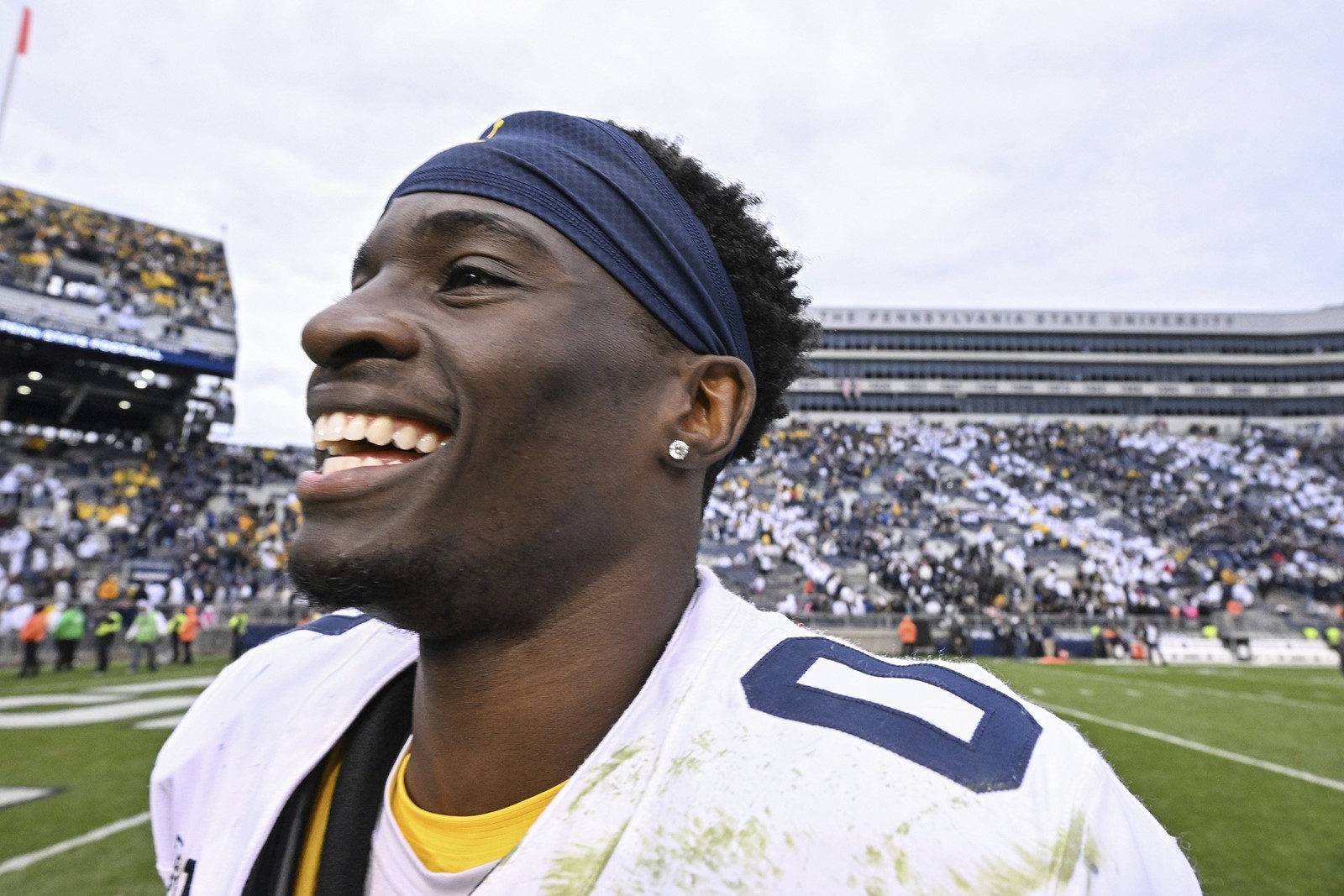
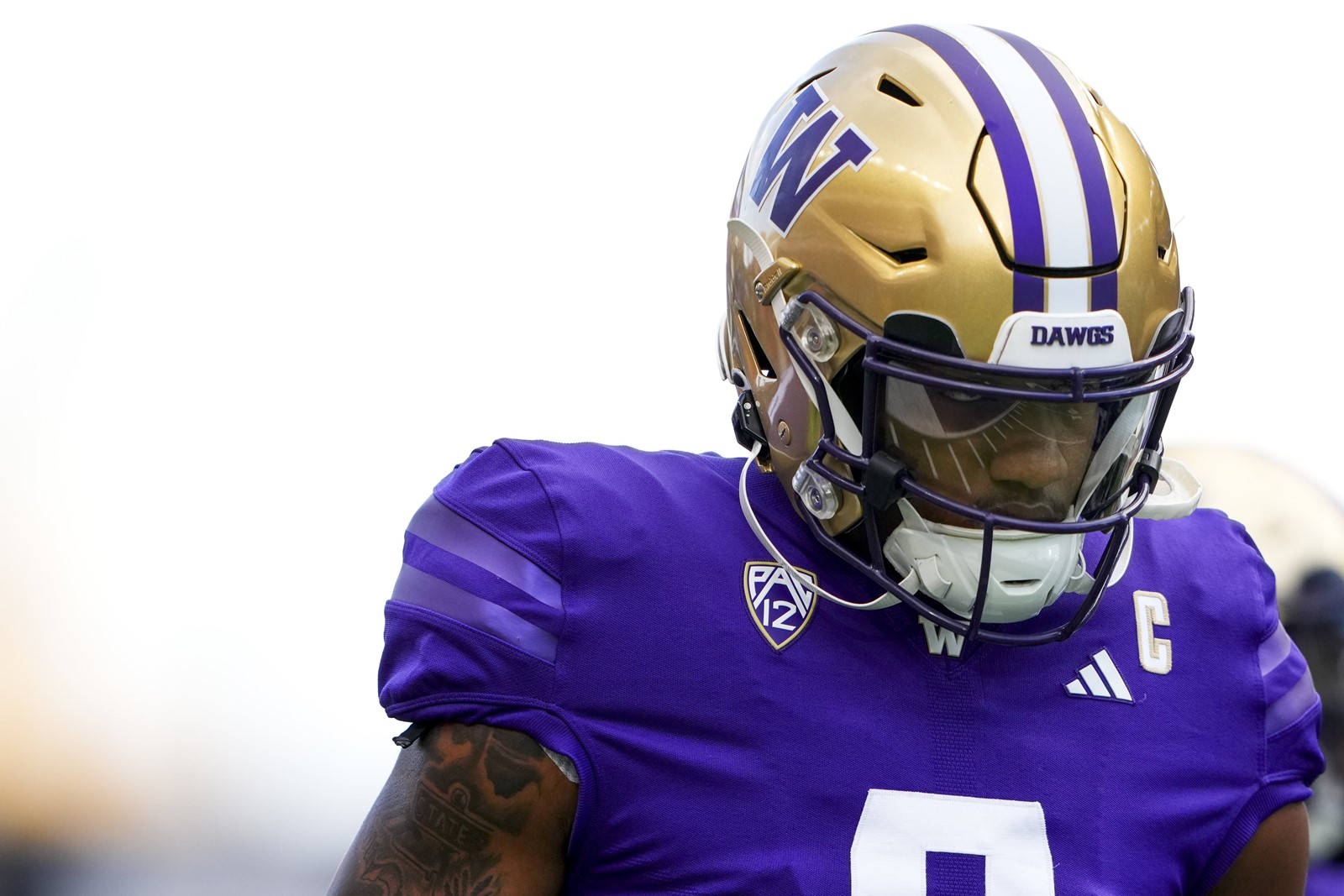
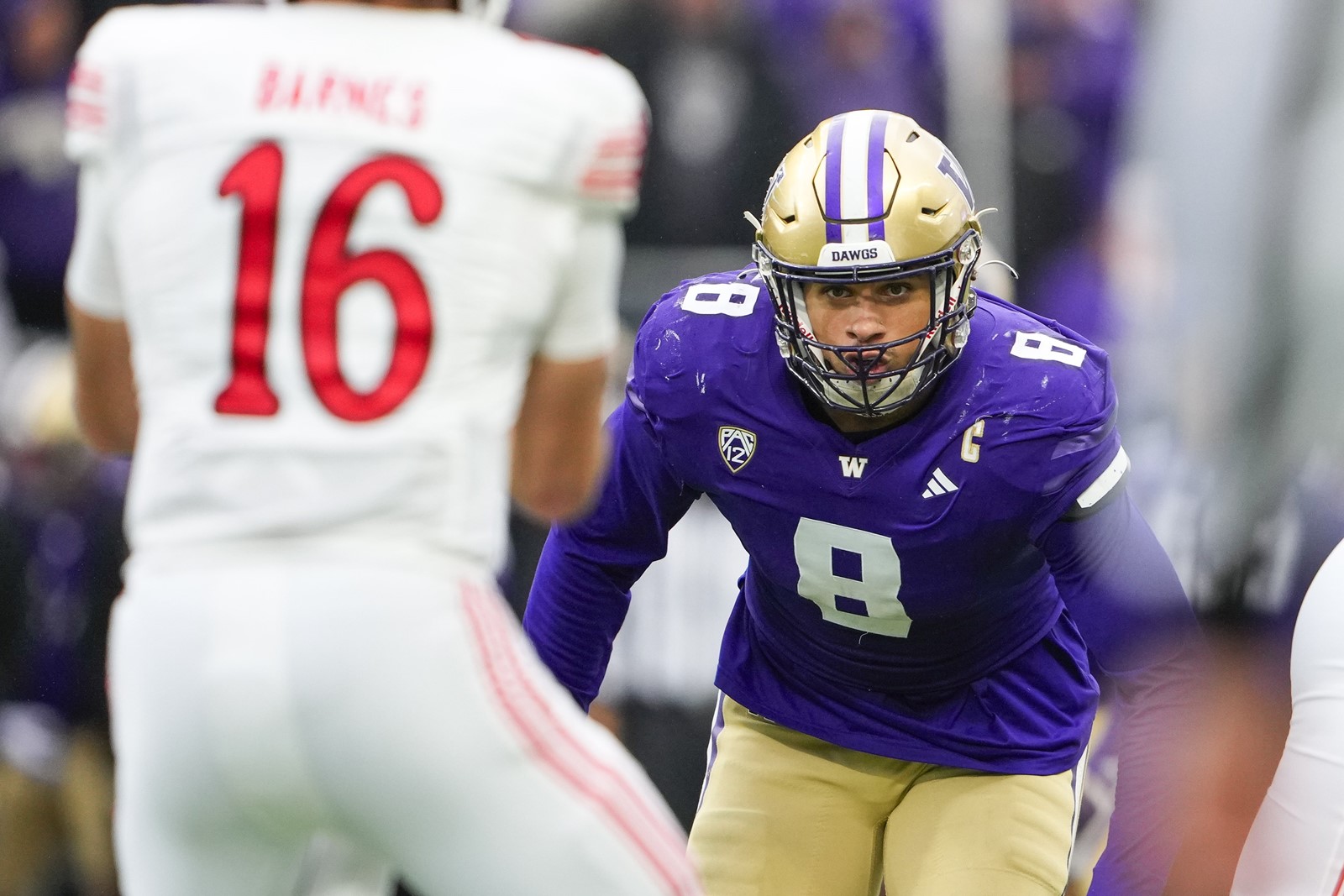
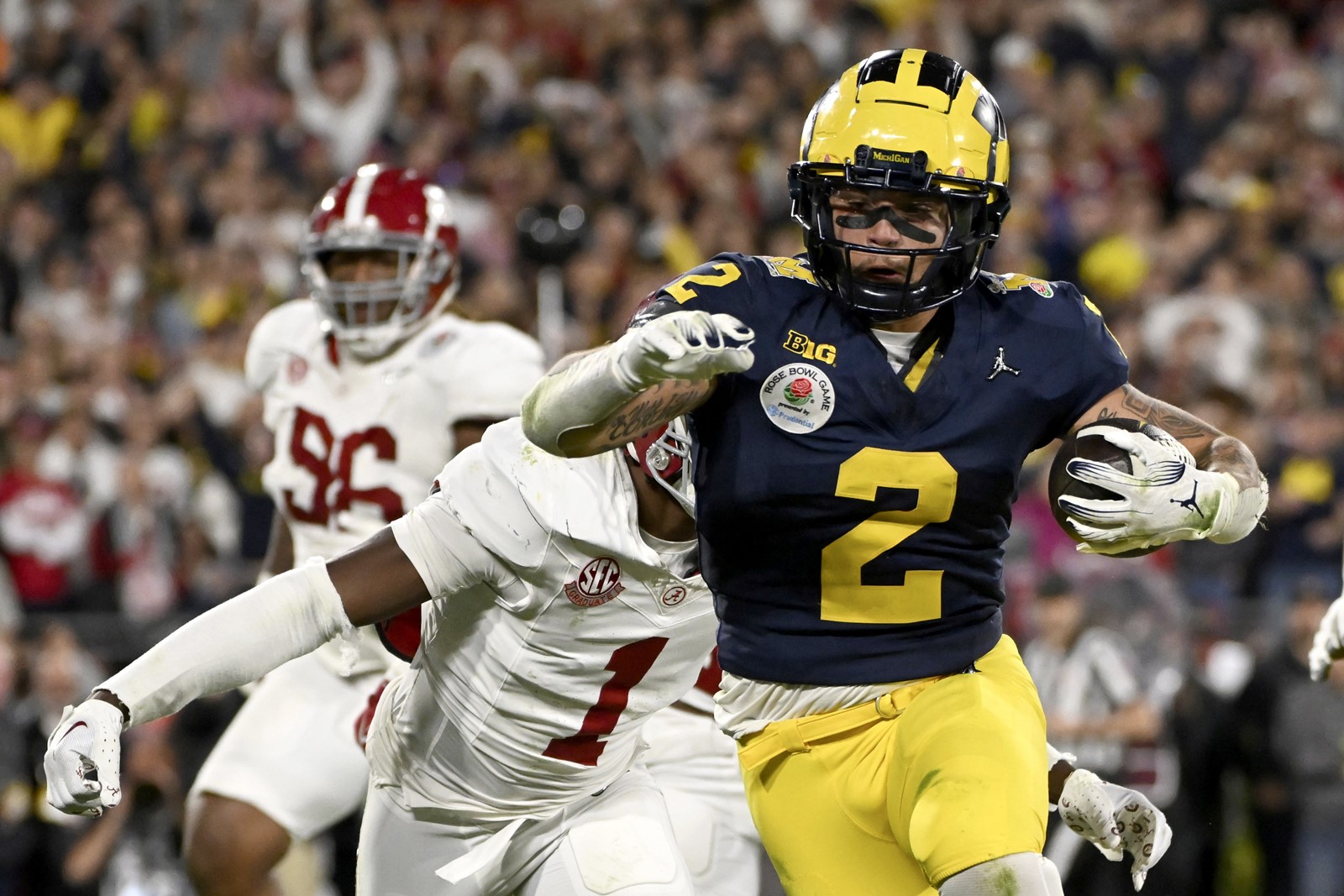


The College Football Playoff national championship game between No. 1 Michigan and No. 2 Washington is a contrast in styles and a matchup of strength versus strength when Michael Penix Jr. faces the Wolverines’ defense. “You get a schematic, professional-style matchup and to me you get the Baltimore Ravens versus the Kansas City Chiefs,” said Fox analyst Brock Huard, who has called games for both teams this season. “The Huskies in purple masquerade as the Chiefs and the guys in blue masquerade as the Baltimore Ravens.”
When Washington has the ball ...
Getting pressure on Penix is difficult. Washington’s offensive line won the Joe Moore Award as the best group in the country and tackles Troy Fautanu and Roger Rosengarten provide excellent edge protection.
When teams do pressure Penix, he is often unfazed. In the Sugar Bowl, Texas didn’t sack him once in 38 pass attempts and while it might have looked like the Longhorns got almost no push, they actually registered 16 pressures, according to Pro Football Focus. When pressured Penix was incredible, completing 60% of his passes at 10 yards per attempt.
“Can Michigan strike up enough interior pressure and edge pressure to actually get to Penix, not just make him uncomfortable? And then can the safeties and cornerbacks find those layers of wide receivers and force Penix to make the impossible throw ... and not give (the Huskies) any gimmes,” college football data analyst Parker Fleming said on The AP Top 25 College Football Podcast.
Texas got most if its pressure from the interior with powerful tackles T’Vondre Sweat and Byron Murphy II. Michigan is deeper up front and better off the edges. Defensive coordinator Jesse Minter gave Alabama fits in the Rose Bowl by making it difficult to identify what was coming from where. Minter succeeded Mike Macdonald, who left Michigan and coach Jim Harbaugh to work for Ravens coach John Harbaugh.
Huard, who played quarterback at Washington, said Michigan’s defense will test Penix and Huskies offensive coordinator Ryan Grubb as problem-solvers.
“It’s an NFL-type defense, which is a matchup mindset, which is change the picture pre- and post-snap, which is make it very difficult on the quarterback to read and react,” Huard said.
Washington’s veteran offensive line has allowed only 11 sacks for a team that throws it as much as any in the country. And while the Huskies’ deep passing game can be spectacular, Penix and Co. are good all over the field. If there is a play to be made, the Huskies usually make it.
Penix targeted receivers Rome Odunze, Ja’Lynn Polk, Jalen McMillen and Germie Bernard 20 times against Texas and completed 19 passes for 411 yards.
Michigan’s secondary plays an aggressive style, led by star cornerback Will Johnson and versatile nickel back Mike Sainristil. The Wolverines don’t concede anything. They want to force opponents to make difficult completions. No team is better at making the difficult look easy than Washington.
Here’s the wildcard: Michigan has the third-best pass defense in the country by opponent efficiency rating (101.52) and has allowed seven touchdown passes, fewest in the nation.
But the Wolverines have faced only two offenses ranked in the top 20 in pass efficiency (Alabama and Ohio State).
“Michigan is elite defensively, but they’ve gotten to feast on horrific, horrific offenses in the Big Ten,” Huard said. “So from a stress test, Michigan has not seen anything the likes of Washington’s offense.”
Meanwhile, Washington has faced only one top-30 pass defense: Oregon, twice. Penix completed 64% for 8.2 yards per attempt with five touchdowns and two interceptions.
When Michigan has the ball ...
Strength vs. weakness.
Michigan runs the ball a lot and efficiently, and can do it in critical situations.
Washington’s run defense isn’t good (86th in the country at 4.40 yards per carry allowed), but Penix and the offense are so effective that opponents often can’t or don’t stick with it.
Texas’ running backs averaged 6.8 yards per carry in the Sugar Bowl against Washington, but had only 18 carries as the Longhorns seemed to get impatient early and then were scrambling to come from behind late.
Michigan is committed to the run with Blake Corum, who leads the nation with 26 touchdowns. Even in a game they trailed for much of the second half against Alabama, the Wolverines had 30 runs and J.J. McCarthy threw 27 passes.
Washington’s defense, outside of edge rusher Bralen Trice, who had two sacks in a ferocious performance against Texas, doesn’t have much high-end, NFL-type talent. The Huskies do have a knack for getting big stops late in games — which helps explain how they have won each of their last 10 games by 10 points or fewer.
Michigan and Washington have thrived off dictating the way their games are played. Michigan makes its opponents try to out-grind them. Washington makes its opponents try to keep pace.
“I really don’t expect there to be many wasted possessions,” Fleming said, “and we might get this really weird mismatch with these long plodding rushing drives and scoring and Washington coming out and scoring in four or five plays.”
By the numbers
Team comparison
Category Mich. Wash.
Points per game 36.0 37.6
Total points 504 527
Total TDs 65 68
Total first downs 281 328
1st downs by rush 111 95
1st downs by pass 154 205
1st downs by penalty 16 28
3rd down pct. 44.8 46.5
4th down pct. 80.9 70.6
Net passing yards 3065 4900
Comp./att. 250/342 349/523
Passing TDs 24 37
Interceptions 5 10
Sacks-yards lost 19-151 11-74
Net rushing yards 2233 1730
Rushing attempts 525 391
Average per rush 4.3 4.4
Rushing TDs 36 28
Total offensive plays 886 925
Total yards 5298 6630
Yards per game 378.4 473.6
Penalties-yards 40-367 107-999
Fumbles-lost 12-3 17-8
Time of possession 32:26 30:07
CFP Title Game Margin of Victory
Michigan by 1 to 6 Points +350
Washington by 1 to 6 Points +425
Michigan by 7 to 12 Points +475
Michigan by 13 to 18 Points +600
Washington by 7 to 12 Points +800
Michigan by 19 to 24 Points +900
Washington by 13 to 18 Points +1200
Michigan by 25 to 30 Points +1400
Washington by 19 to 24 Points +2000
Michigan by 31 to 36 Points +2000
Washington by 25 to 30 Points +3300
Michigan by 37 to 42 Points +3300
Michigan by 43 Points or More +4000
Washington by 31 to 36 Points +5000
Washington by 37 to 42 Points +8000
Washington by 43 Points or More +10000
PAC-12 IN BOWLS
LA Bowl, Inglewood, Calif.
UCLA 35, Boise State 22
Independence Bowl, Shreveport, La.
Texas Tech 34, California 14
Las Vegas Bowl, Las Vegas
Northwestern 14, Utah 7
Holiday Bowl, San Diego, Calif.
Southern Cal 42, #15 Louisville 28
Alamo Bowl, San Antonio, Texas
#14 Arizona 38, #12 Oklahoma 24
Sun Bowl, El Paso, Texas
#16 Notre Dame 40, #19 Oregon State 8
Fiesta Bowl, Glendale, Ariz.
#8 Oregon 45, #23 Liberty 6
Sugar Bowl, New Orleans (CFP Semi)
#2 Washington 37, #3 Texas 31
BIG TEN IN BOWLS
Quick Lane Bowl, Detroit
Minnesota 30, Bowling Green 24
Las Vegas Bowl, Las Vegas
Northwestern 14, Utah 7
Pinstripe Bowl, New York City
Rutgers 31, Miami 24
Cotton Bowl, Arlington, Texas
#9 Missouri 14, #7 Ohio State 3
Peach Bowl, Atlanta
#11 Mississippi 38, #10 Penn State 25
Music City Bowl, Nashville, Tenn.
Maryland 31, Auburn 13
ReliaQuest Bowl, Tampa, Fla.
#13 LSU 35, Wisconsin 31
Citrus Bowl, Orlando, Fla.
#21 Tennessee 35, #17 Iowa 0
Rose Bowl, Pasadena, Calif. (CFP Semi)
#1 Michigan 27, #4 Alabama 20, OT
 PREVIOUS ARTICLE
