


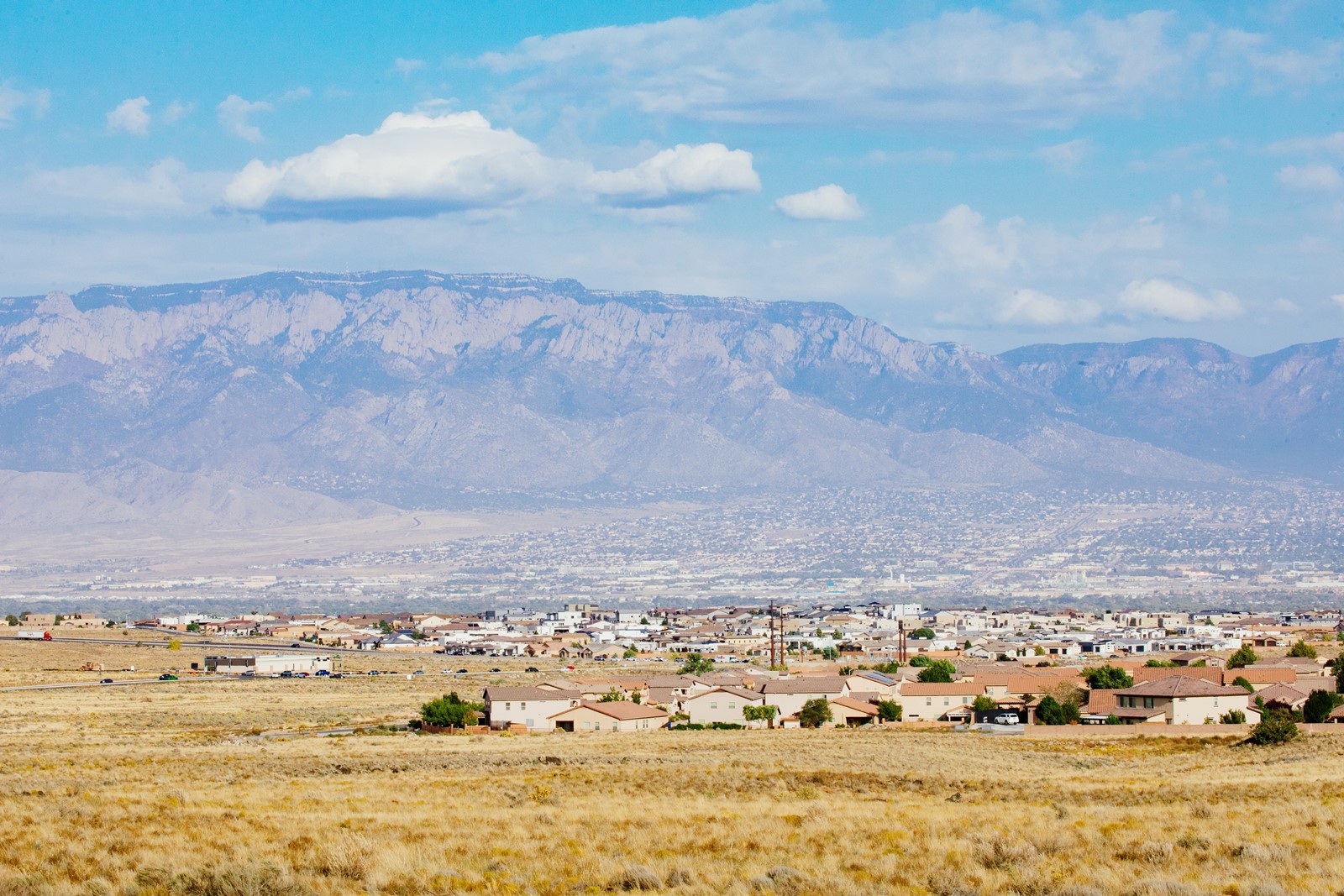




ALBUQUERQUE>> Something about the New Mexico desert seems to invite big thoughts. The sky is immense and the sun feels close. Deep time is on constant display in ribbons of exposed granite and piles of volcanic black basalt. As the home of Roswell, it is a mecca for UFO conspiracy theorists, but at thousands of feet above sea level, it is also a little thin on oxygen.
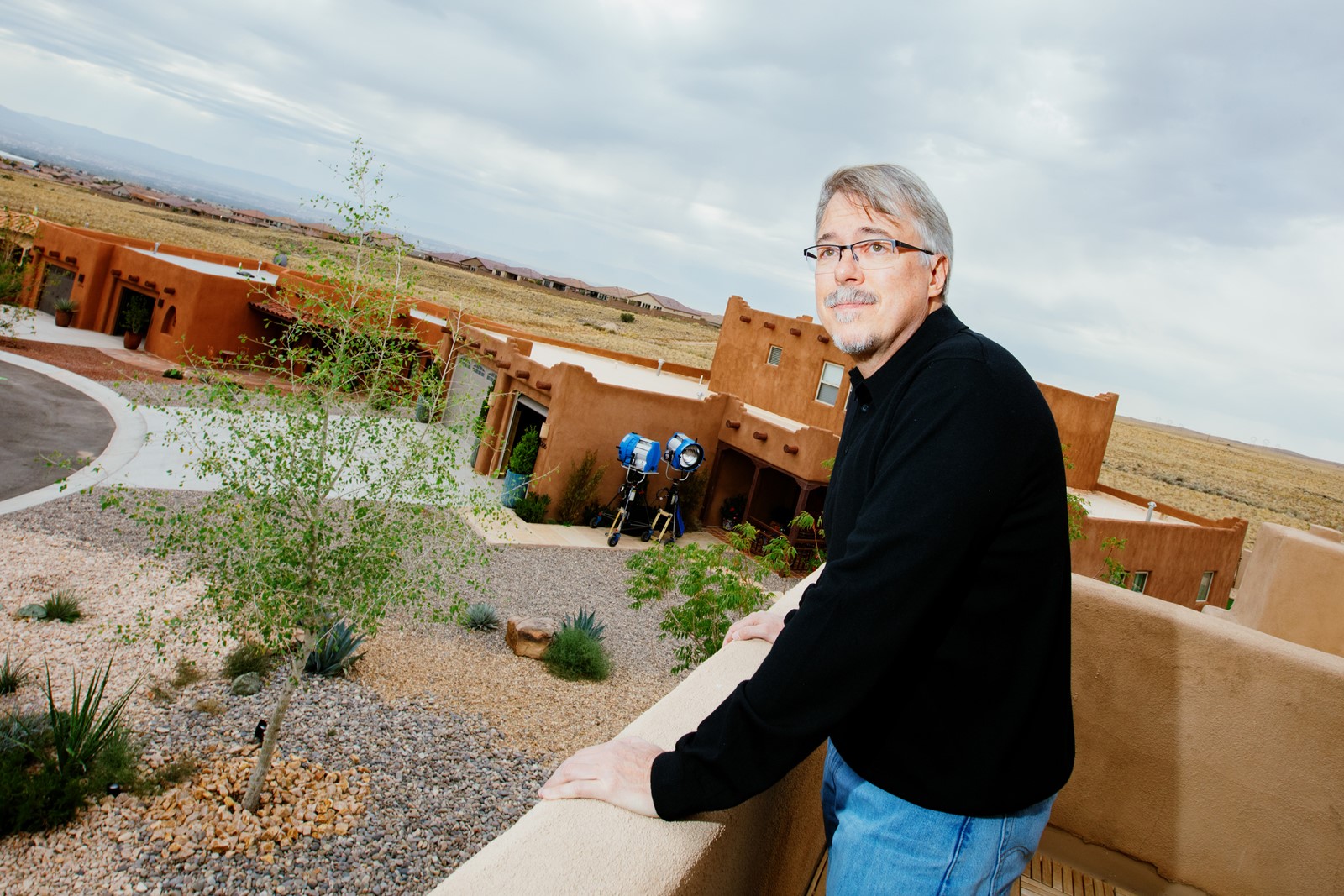
Whatever that something is seems to work for Vince Gilligan, whose new television series for Apple TV, “Pluribus,” is set in Albuquerque, effectively his artistic home since “Breaking Bad” debuted in 2008. As the stage production there wound to a close in October 2024, Gilligan stepped onto a balcony and looked across the city to the Sandia Mountains — named after watermelon by Spanish explorers, he explained in his affable Virginia lilt, because of the way they glow red at sunset.
“Have you guys seen the comet?” he asked with the gee-whiz enthusiasm of a boy with a backyard telescope. Over the previous several nights, Comet Tsuchinshan-ATLAS had been visible for what may have been the first time in 80,000 years. “You’ve got to look away from it a little to see the tail,” he said, “but it’s for real.”
The new show, Gilligan’s first to debut in a decade, is in many ways as big as modern TV gets: high-budget, high-concept, a deep character study that combines science fiction, philosophy and sociopolitical allegory.
To help convey a sense of the show’s ambition, Gilligan had taken me and a photographer up the West Mesa escarpment, at the northwest edge of town where the roads turned into sand. There, we toured a suburban cul-de-sac that can’t be found on any map, an elaborate exterior set complete with seven houses and a tiny park. Though most of the rooms lacked drywall or interior finishing, all of the houses had been built to code out of real wood, stone and brick on a formerly bare patch of rented land, at the end of an unpaved road.
At the far end of the cul-de-sac stood the home of the lead character, Carol, a successful author and chronic malcontent played by Rhea Seehorn. One day, Carol finds, for reasons hard to describe because of Apple’s extensive spoiler list, that almost everyone on Earth but her is happy. All conflict has vanished, self-loathing too. A mysterious signal from outer space has created a kind of utopia, fulfilling the wishes of countless dreamers since the dawn of humanity. This makes Carol, suddenly and literally, the unhappiest person on Earth.
And yet she prefers that to the alternative.
“I think about ‘Brave New World,’” Seehorn said later at a soundstage in downtown Albuquerque. “I think about even ‘Fahrenheit 451’ and Neil Postman’s essays in his book ‘Amusing Ourselves to Death,’ when he talks about the real threat is that we would come to love our oppressors instead of revolting — that everybody was just happy.”The word pluribus means “many,” but Gilligan looks increasingly like one of the last of the TV auteurs standing. If ever there were a moment to take a big swing, this may be it, and “Pluribus,” which debuts Nov. 7, bears all the markings of one. It is sprawling, meticulous and deeply personal, the vision of a man who has had many of his own wishes fulfilled but, by his own admission, struggled to find fulfillment.
“I’ve never been a particularly happy person,” he said, comparing happiness to a butterfly, an elusive thing. “It’s like chasing your own shadow, you know, and never catching it. And then you think about it for enough decades, like I have, and then you think to yourself, Why is it that important?”
The city of Alburquerque has played a significant role in Gilligan’s success since it welcomed him to town for “Breaking Bad.” Gilligan chose the city then on the recommendation of Sony Pictures Television, with which he has had an overall production deal for over 15 years; New Mexico offered a significant tax break, making it cheaper than Southern California, where he had intended to set the series.
“A rebate got us here,” he said, “but what kept us here is the landscape, the natural beauty, the skies, the clouds, that Western vibe.”
There was also the crew, he said, many of whom have stayed with him for nearly two decades. These days, Gilligan and his wife live nearly full time in New Mexico.
The benefits, and the affection, seem mutual. Since 2007, nearly everything in the “Breaking Bad” universe — including the feature film “El Camino” and the six-season prequel series “Better Call Saul” — has been filmed in New Mexico. According to a 2022 social media post from the city’s mayor, Tim Keller, the franchise had by then made a local economic impact of over $385 million and employed more than 200 Burqueños each episode.
A bronze statue of the “Breaking Bad” characters Walt and Jesse greet visitors to the Albuquerque Convention Center. RV tours pass a “Breaking Bad” store on their way through Old Town.
Viewers may find the impulse to search for allegorical meaning in “Pluribus” irresistible — who hasn’t felt surrounded by mindless clones at times? As Gilligan readily acknowledges, the series makes deliberate homage to “Invasion of the Body Snatchers,” a 1956 film that was widely interpreted as a comment on the Red Scare. The 1978 remake was no less charged, read commonly as a critique of consumerist society after the collapse of hippie-era idealism.
No one involved with “Pluribus” would draw direct parallels with current events or cop to any covert political messaging. “Working on ‘The X-Files’ for seven years cured me of conspiracy theories,” Gilligan said, laughing. But there were possible clues. A fake lending library on the cul-de-sac set, for example, included a copy of “How Democracies Die” and the writings of 18th-century philosopher David Hume.
The “Body Snatchers” link is almost immediately apparent in the first episode. But then it is quickly turned on its head. The stakes are understood early.
“The twist on this one is that there is no twist,” as Gilligan put it. The question soon becomes not whether the protagonist will fulfill some great desire — she can have anything she wants — but whether her misery, as an expression of her free will, is worth defending.
“You can spend hours dissecting it and talking about it, and we did that on set,” said Karolina Wydra, who plays a kind of representative for the billions of happy people. “It was so fun to have these conversations,” she added, “breaking down humanity and what’s good about it, what’s not? Would we be willing to sacrifice our individuality?”
The heart of “Pluribus” is a person who is told she should be happy but fights hard to have the freedom not to be. It didn’t seem like a coincidence that Gilligan had come up with the idea soon after his TV-genius status had been cemented.
“Breaking Bad” had stuck the landing, and he was preparing to hand full showrunning duties on “Saul,” another critical favorite, to its other creator, Peter Gould. Success was his by any measure.
But what was he supposed to do? Be happy and retire? “I spend a lot of my life thinking about happiness — I always have,” Gilligan said. And he had come to a kind of conclusion.
“This general level of unhappiness and this dissatisfaction that I’ve learned to live with — it took me years, decades, but I finally realized this — is what gets me up in the morning,” he said. “It’s what gets me to achieve.”
 PREVIOUS ARTICLE
