


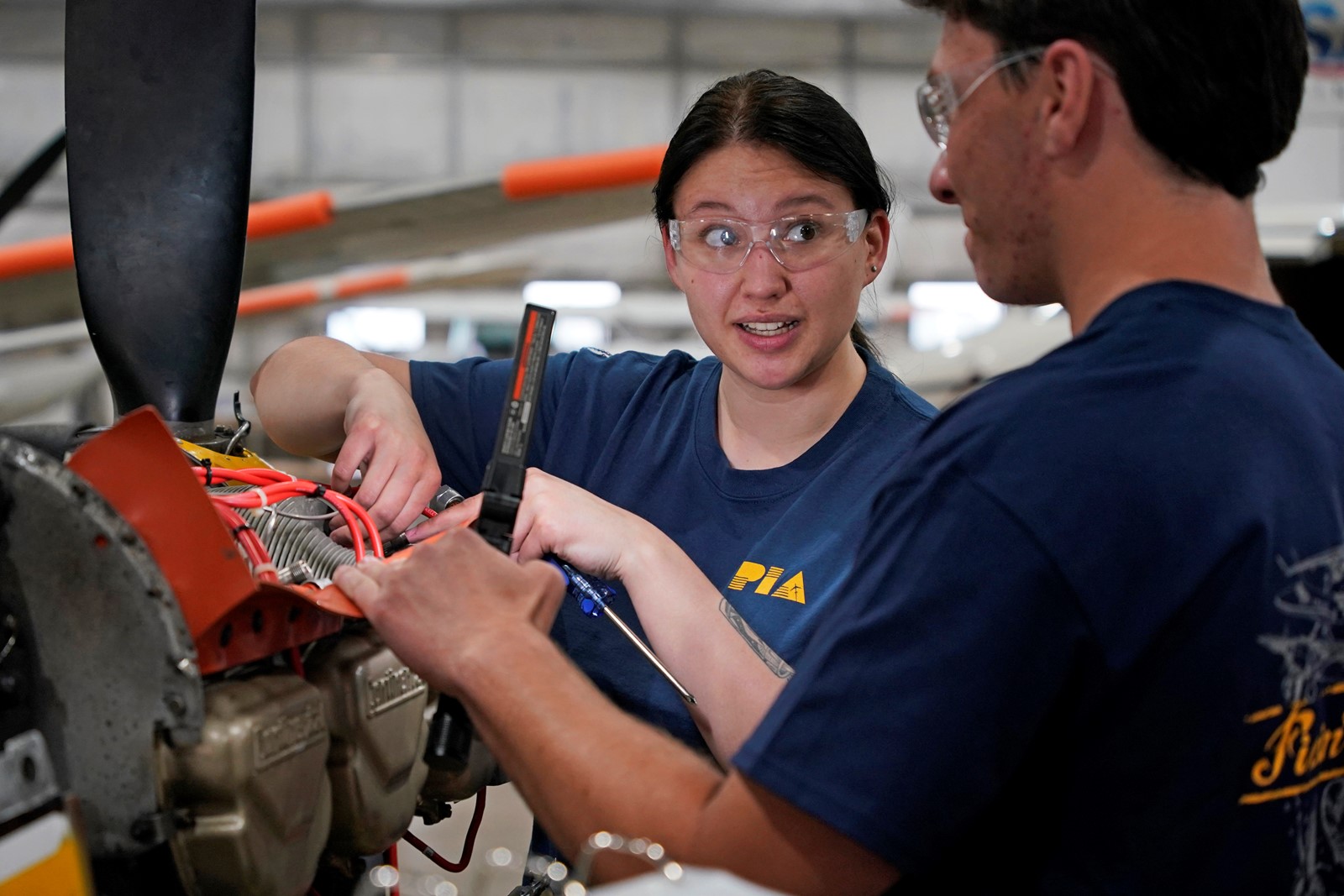


WASHINGTON >> Kwasi Bandoh, a senior recruiter for an airline, stood before a group of aviation mechanic students at their graduation ceremony last month and congratulated them for all having jobs.
As some of the students began nudging each other, Bandoh realized that perhaps not every one of them had already been hired.
“Who doesn’t have a job?” Bandoh demanded, surveying the 15 graduates before him at the Pittsburgh Institute of Aeronautics’ training facility in Hagerstown, Maryland. “Who doesn’t? Because I have a job for you.”
The crowd of about 70 friends and relatives, gathered in a hangar where the students had been trained, laughed appreciatively. Fourteen of the 15 graduates did have jobs, and the only one who didn’t had an interview lined up for the next day.
As happy as the moment was for the graduates, it epitomized the struggles of recruiters like Bandoh, who are desperately seeking mechanics for the airlines, plane manufacturers and repair shops that need them. Most of their existing mechanics are aging, and demand for travel is growing.
Across the U.S. economy, other industries, too, face the same formidable challenge: Replenishing a workforce diminished by a surge of retirements that began during the pandemic and has continued since. It’s a growing problem in such fields as construction, manufacturing, nursing and some professional industries like accounting.
Since 2019, the proportion of retirees in the U.S. population has risen from 18% to nearly 20%, according to research by the Federal Reserve Bank of New York — equivalent to about 3.5 million fewer workers. And the trend seems sure to accelerate: The percentage of workers who are 55 or older is nearly 24%, up from only about 15% two decades ago.
The surge of retirements, along with a slowdown in immigration that began during the pandemic, are the primary factors behind the labor shortages that continue to bedevil some employers.
The aging workforce also helps explain the confounding nature of the economy right now. Even as the Federal Reserve has relentlessly pumped up interest rates to fight high inflation, hiring has remained surprisingly robust. Regardless of where interest rates are, many employers simply need to replace people who have left.
Companies that must fill jobs tend to raise pay to attract and keep workers — a trend that can fuel inflation as those same employers typically raise their prices to cover their higher labor costs. That dynamic is complicating the Fed’s efforts to tame inflation.
In the airline industry, more than one-third of mechanics are between 55 and 64, according to government data. Fewer than one in 10 are under 30.
“Everybody’s getting ready to retire, and not enough people are coming in to take the jobs,” said Mike Myers, a maintenance manager for Piedmont Airlines, in Hagerstown, a regional feeder for American Airlines.
The new graduates of the Pittsburgh Institute of Aeronautics have been awed by how much they’re in demand. One of them, Will Gower, said he weighed multiple job offers at nearly twice the $15-an-hour wage he had earned at the retail job he held while in school.
In the past year, the air travel industry has hired roughly 45,000 people, enlarging its workforce by 9%, to more than a half-million. That’s triple the pace of the U.S. economy’s overall hiring.
In the construction industry, the proportion of workers ages 55 and older doubled from 2003 to 2020, to nearly one-quarter, according to the government.
Anirban Basu, chief economist for the Associated Builders and Contractors trade group, said that in addition to aging, industries like aviation maintenance and construction share another challenge: Fewer young people want to take jobs in what are often perceived as less-secure, blue-collar work.
When the now-retiring baby boomers began working, Basu said, “there was the notion that being a blue-collar tradesperson was a solid and secure path to prosperity.” But as factories shut down across the country, “the notion increasingly became that for one to become part of the American middle class, one would likely need to have more formal education, namely, a bachelor’s degree.”
The result, he said, is an economy short of factory workers, backhoe operators, welders, electricians and other skilled trade workers.
If there’s one trend that might ease, if not solve, the problem it’s that Americans below retirement age have been re-entering the job market, likely drawn by steady hiring and higher pay levels. The proportion of these adults who either have a job or are looking for one now exceeds pre-pandemic levels.
Yet for now, an aging workforce remains a problem even for some white-collar jobs, particularly accounting. About three-quarters of accountants are “nearing 60” and approaching retirement, according to the Association of International Certified Professional Accountants.
 PREVIOUS ARTICLE
