


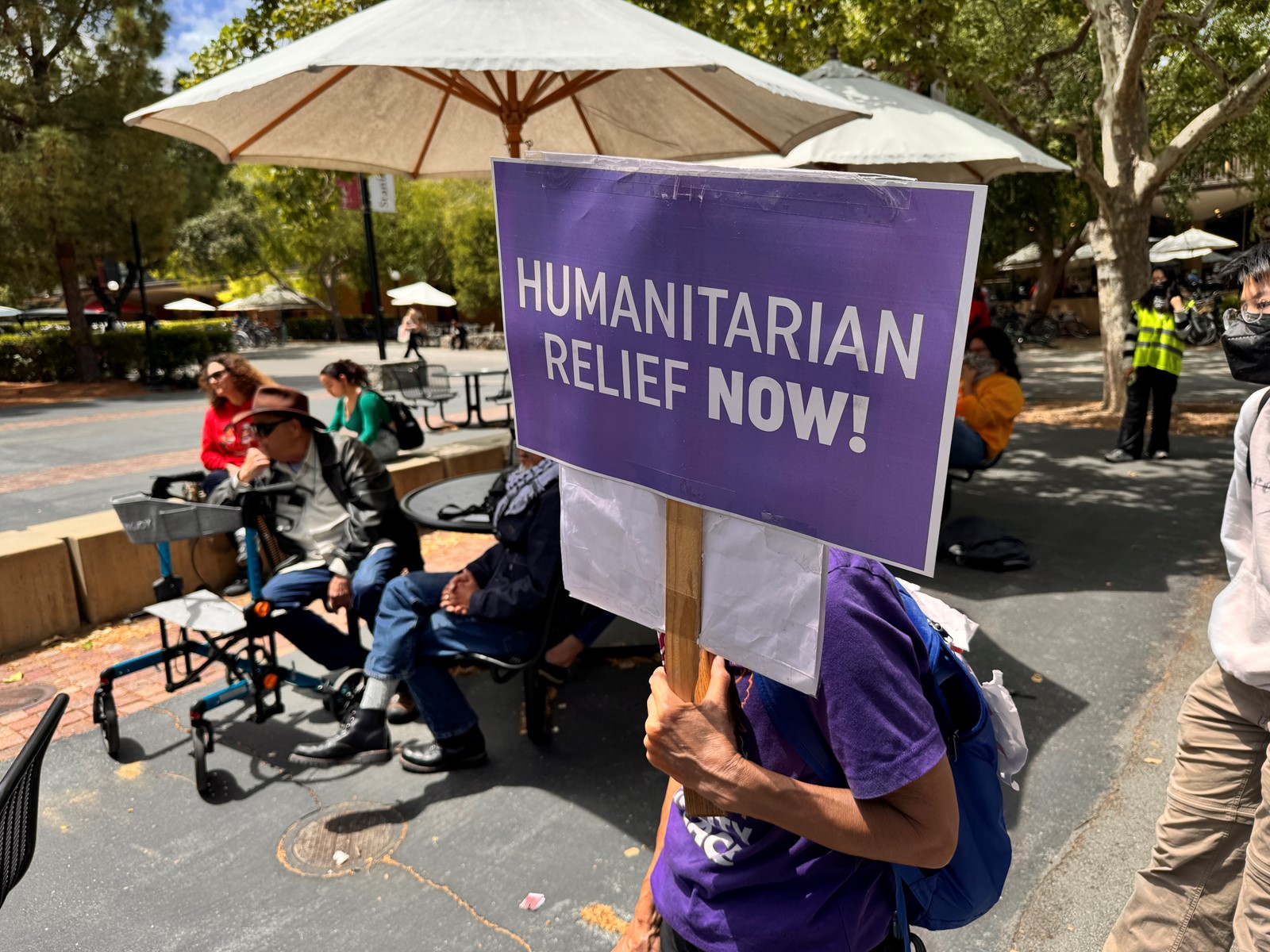


Stanford University students and faculty launched a hunger strike Monday, joining a broader statewide movement calling for universities to divest from companies with ties to Israel in protest of the ongoing war in Gaza.
At least 12 students and three faculty members are participating in the hunger strike, which also calls for local authorities to drop criminal charges against student protesters, for the university to repeal recent free speech restrictions, and for President Jonathan Levin to sign a national academic freedom statement.
The protest began with a peaceful assembly at White Plaza, the campus’ designated free speech zone. Security personnel and sheriff’s deputies observed from a distance but did not intervene. Activists said they will maintain a physical presence there from 6 to 8 p.m. daily to advocate for their demands.
“We’ve continuously called for divestment and the university has not responded,” said Yousef Helal, an electrical engineering graduate student participating in the strike. “We continue to witness the genocide in Gaza, and it’s our duty to stand up.”
The action follows a string of pro-Palestinian demonstrations at Stanford.
On June 5, 2024, 13 people — including a student journalist — were arrested during a sit-in at the university’s administrative offices. Santa Clara County District Attorney Jeff Rosen later filed felony charges against 12 students, citing property damage between $360,000 and $1 million. Under California law, damage exceeding $400 qualifies as felony vandalism.
“Dissent is American. Vandalism is criminal. Speech is protected by the First Amendment. Vandalism is prosecuted under the penal code,” Rosen said last month when announcing the charges.
Helal pushed back on the amount cited and the characterization of those who took part.
“These students were fulfilling a moral obligation,” Helal said. “Stanford exaggerated the costs. They should not be punished for standing up for what’s right.”
Students arrested in June 2024 also faced administrative sanctions, including suspensions, delayed degree conferrals and required community service.
Stanford has faced criticism from multiple sides over its handling of the protests. A university subcommittee found widespread anti-Israel and antisemitic bias on campus, while another concluded that Islamophobia and prejudice against Muslim, Arab, and Palestinian students were also prevalent.
According to Stanford Students for Justice in Palestine, students have experienced continued repression for their activism, including what they describe as selectively enforced overnight camping bans and ID or face-covering checks during campus events.
Foreign students at other campuses have also faced legal jeopardy. Elif Öztürk, a Tufts University student detained over her participation in pro-Palestinian protests, was released earlier this month but still faces deportation.
Stanford senior Arwa Faruk, a human biology major, said the university’s response stems from fear.
“I think the administration only wields that power when they feel threatened,” she said. “It means our actions are having an effect.”
Faruk also criticized the university’s free speech policies, which she said are overly restrictive.
“It’s ironic they’re called ‘free speech policies’ when you’re only allowed to raise your voice above 40 decibels or hold a sign between noon and 1 p.m. on weekdays,” she said.
Stanford’s website confirms that White Plaza has restrictions, including limited hours, bans on camping and rules against blocking fire lanes or pedestrian paths.
Pro-Palestine encampments occurred in two waves: from October 2023 to February 2024, when protesters voluntarily dismantled tents, and again in April through June 2024, when university security cleared the encampment and made arrests.
“We’re complying with those rules now,” Faruk said.
 PREVIOUS ARTICLE

