


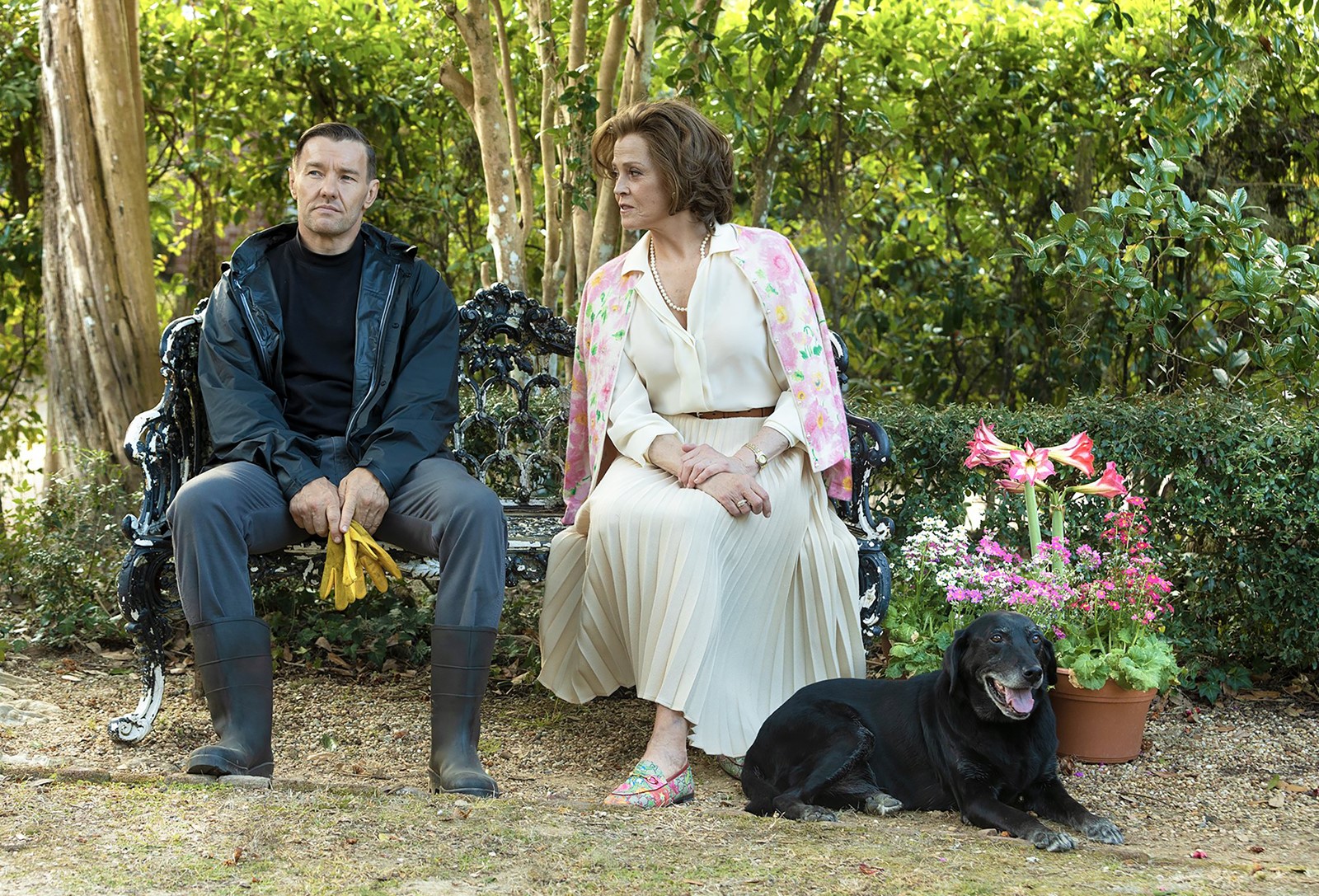


Part of the kick of “Master Gardener” is that writer-director Paul Schrader manages to pull off this improbable movie. It shouldn’t work and, even after seeing it twice, I don’t think that it entirely does, which only makes it more fascinating and strengthens its power. There’s much to admire about the movie’s tense dreaminess, its pulpy undertow and severe elegance, as well as the astonishing, awkward sincerity with which Schrader hurtles headlong at questions of love, hate, race and redemption in an unforgiving world.
As has been the case in many of Schrader’s stories, this one centers on a man who’s of this world and apart. That character — “God’s lonely man,” as he’s called in “Taxi Driver,” which Schrader wrote — has appeared repeatedly in his filmography. That lonely man is here again, risen once more in “Master Gardener,” but now named Narvel Roth and played like a clenched fist by Joel Edgerton. Stoic, driven and watchful, Narvel works as the chief horticulturist for Gracewood Gardens, a cultivated wonderland someplace in the American South with fastidiously organized plantings and a shuddering chill in the air.
“Master Gardener” is the third installment in what Schrader has described as an accidental trilogy that began with his 2018 drama “First Reformed,” about a minister (Ethan Hawke) having a crisis in faith, and which continued three years later with “The Card Counter,” about a gambler (Oscar Isaac) with a brutal military past. In all three movies, a solitary, soul-weary man in crisis — who’s invariably seen alone in a room writing in a journal he shares in voice-over — undergoes a kind of transfiguration. Each man meets a woman who greatly moves him, and each also experiences purgative violence (oblique and disturbingly literal), and through both, each achieves grace or something like it.
Narvel doesn’t at first seem in crisis. The garden he tends is owned by Norma Haverhill, a vain, imperious doyenne played with terrifying hauteur by Sigourney Weaver. Everyone in Norma’s employ calls her Mrs. Haverhill, which with her eerie mansion — a plantation house — brings to mind a more put-together Southern Miss Havisham. The name Norma, on the other hand, seems an obvious cineaste nod to Norma Desmond, another wealthy woman rattling around inside the mausoleum that she’s made of her life. Unlike Desmond’s garden, though, Norma’s has not gone to seed, to borrow Schrader’s controlling metaphor, partly because Narvel is nothing if not an obliging worker.
Norma’s and Narvel’s ordered lives are disturbed by the arrival of her biracial grandniece, Maya (Quintessa Swindell), who’s come to apprentice at the garden. Maya has a troubled backstory, as beautiful young women sometimes do in movies, a history that Norma relates to Narvel with the detached cool of one discussing inconvenient weather. Norma seems generally more emotionally invested in her garden, which she discourses on while strolling about in pearls and a cream-colored skirt and blouse, a flower-patterned sweater draped over her shoulders. The sweater’s splashes of pink echo the richer-hued rose sweater that Maya wears in a childhood photo.
There are more splashes of pink in the shirt Maya is wearing when she arrives at Gracewood, which creates a sense of continuity between her and Norma that lingers, complicating the triangle that develops as things begin to fall apart, as they must. Schrader can surprise you, but violence is one of his signatures and a sense of unease settles into the story almost as soon as Maya arrives, a disturbance that Schrader stokes with references to past trauma, spooky flashbacks, prowling camerawork and a distinctly fashy haircut. Soon, Narvel and Maya are shoulder to shoulder, a wildly complicated union that frays their ties with Norma and also pushes the movie to its breaking point.
Despite their different stories and characters, the movies in Schrader’s latest trilogy are tonally, thematically and visually similar, more like chapters in the same book than distinct volumes. (In the past, he has referred to “Taxi Driver” and two movies that he directed, “American Gigolo” and “Light Sleeper,” as a trilogy.) They’re handsome, unfussy and spare, with somber palettes flecked with occasional shocks of vibrant color, like the ravishing flowers in Norma’s garden. (Cinematographer Alexander Dynan shot all three movies.) When the man is writing in his room, it often feels like he’s imprisoned or even entombed — his room is his head and vice versa — and he needs a way out.
Saving men has long been a woman’s job in the movies, which would be easier to grouse about if Schrader’s female characters were dull. His women aren’t always as thoughtfully developed as his men, but they’re vivid, take up space and you remember them. They feel real, not like props, even when — as with the bookending presence of Norma and Maya — they are supporting the man in crisis. Schrader has written some juicy material for the two women roles here, and when Norma casually promenades around the garden, describing it as “four generations of curated botany, horticulture and display,” it’s hard not to flash on the longer, unspoken history of the annihilating racial violence that haunts this eerie place.
Swindell is very good and displays a mesmerizing stillness, but this is a near-impossible role. The character is carrying a lot of weight, personal as well as political. There are no grand speeches here on race and reconciliation or reassuring appeals to the audience’s conscience; Schrader is intensely focused more on the soul-sickness of one man than that of the nation. Yet the sincerity of Schrader’s filmmaking and his insistence on the possibility of redemption for the irredeemable is deeply affecting. That’s never truer than when Maya and Narvel drive off into the night and find their way lit by an effusion of gloriously multi-hued flowers, blooms that took root long ago in haunted ground.
 PREVIOUS ARTICLE
