


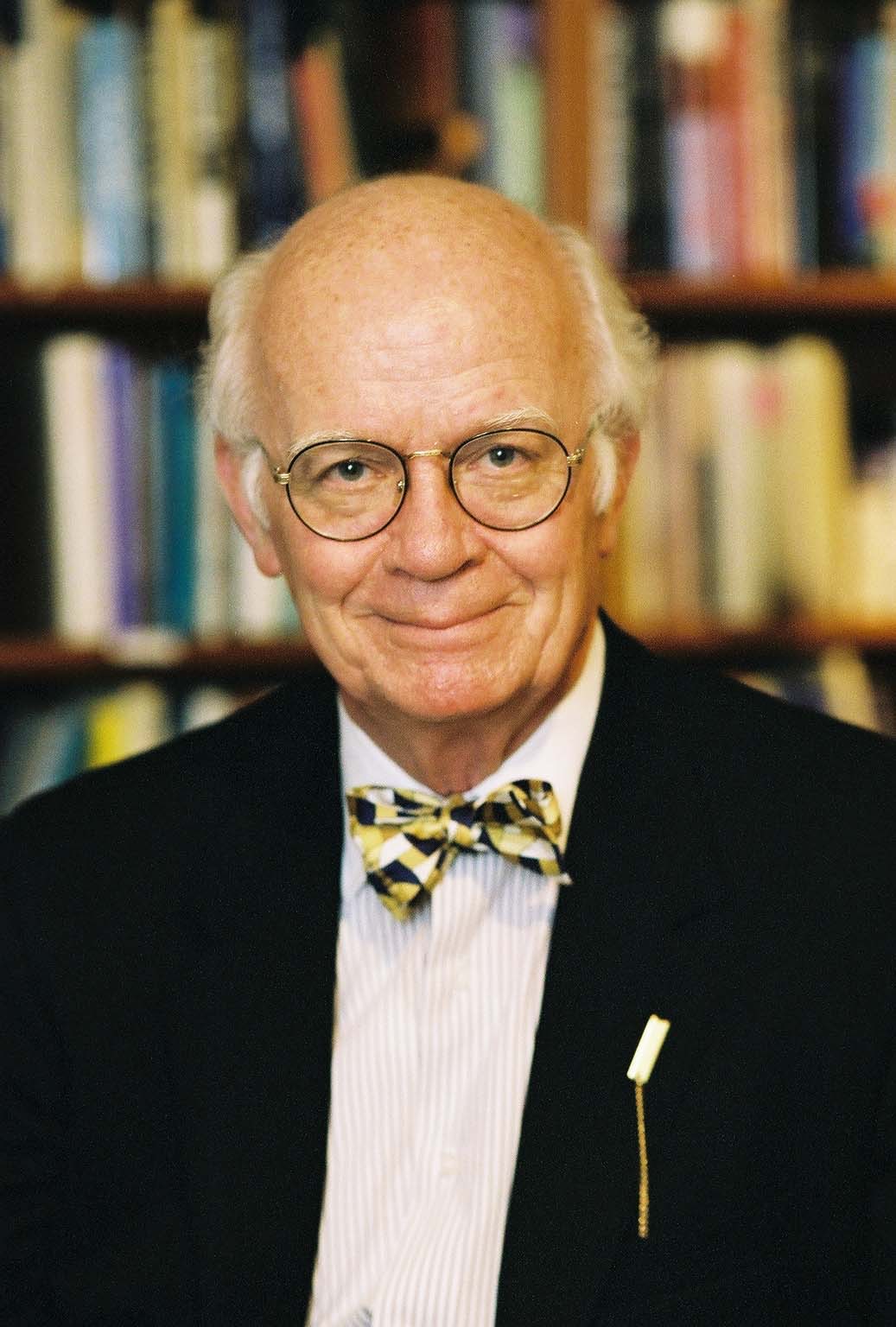


Martin E. Marty, a preeminent religious historian, prolific author, dependable exponent of mainstream Protestantism and staunch champion of pluralism, died Tuesday in Minneapolis. He was 97.
His death at a retirement home, where he had lived since 2022, was confirmed by his son Peter.
In more than 60 books, thousands of articles and as what he described as a “peregrinating lecturer,” Marty promoted what he called public theology, or the confluence of fundamental cultural and religious conventions for the common good.
He had “a knack for translating complex ideas into graspable takeaways for diverse audiences,” Peter Marty wrote in an online tribute. Time magazine said he was “generally acknowledged to be the most influential living interpreter of religion in the U.S.”
He disdained extremism and fundamentalism, both by Islamist terrorists and right-wing Protestants. And he warned, in “The One and the Many: America’s Struggle for the Common Good” (1997), that the culture wars had undermined the ideals of e pluribus unum and challenged Americans’ shared heritage.
The nation had fractured, he wrote, between “totalists,” who felt left behind and belittled, and “tribalists,” whose individual pride in race, religion, ethnicity and gender circumscribed their vision of the American mosaic.
The threat of such division to the American experiment was a theme he returned to frequently.
“Nothing is more important than to keep the richness of our pluralism alive,” Martin Marty once wrote. “To be aware of many different people and different ways, and deal with it.”
In a review of Marty’s 1991 book, “Modern American Religion, Volume Two,” Stanford historian David M. Kennedy wrote that “For all the raucous contention he chronicles, Mr. Marty remains an optimist. It is, he concludes in an eloquent peroration, with a nod to James Madison, precisely the plurality of religious voices that has insured the integrity of the social fabric by preventing the lasting dominance of any single group.”
Despite its historical ebb and flow, Marty insisted that mainstream Protestantism exerted profound influence over U.S. public policy, particularly in the 19th century, though he predicted that no single denomination would ever exert the same degree of dominance again.
“Their winning — at least through their pioneering adventures on fronts dealing with civil rights, internationalism, ecumenism, many issues of sexuality and gender, friendliness to once-warred-against science, and much more — never meant complete victory,” he wrote in The Christian Century magazine in 2013.
“But it did mean,” he added, “that through the years, at least, significant leaders risked much to express their faith beyond church walls, in the larger culture.”
Marty was one of those leaders.
He marched for civil rights in Selma, Ala., with the Rev. Dr. Martin Luther King Jr., attended the Second Vatican Council as a Protestant observer, and helped found the antiwar organization Clergy and Laymen Concerned About Vietnam. He was president of the American Academy of Religion and the American Society of Church history.
His scholarly achievements were legion. With a former student, R. Scott Appleby, he directed the six-year Fundamentalism Project of the American Academy of Arts and Sciences beginning in 1988, which explored conservative religious movements.
“Only an intellectual giant with Marty’s combination of multidisciplinary fluency and vast erudition could have foreseen the inbreaking of wave upon wave of modern anti-pluralist, anti-modernist assaults upon the liberal worldviews and institutions from the ‘benighted’ margins of Western and westernized societies,” Appleby, who teaches global affairs at the University of Notre Dame, said in a statement after Marty’s death.
“Marty stayed true to his instincts to come ‘not to condemn, not to praise, but to understand,’ ” Appleby added.
Martin Emil Marty was born Feb. 5, 1928, in West Point, Neb. His father, Emil, was a parochial school teacher and organist at Lutheran churches in Nebraska and Iowa. His mother was Anne Louise (Wuerdemann) Marty.
A graduate of a Lutheran preparatory school, he attended Concordia College in Wisconsin, Washington University and Concordia Seminary in St. Louis, where he earned a bachelor’s in divinity in 1949 and a master’s in 1952. He received a Master of Sacred Theology degree from the Lutheran School of Theology at Chicago in 1954 and a doctorate from the University of Chicago in 1956.
As an ordained minister in the Evangelical Lutheran Church in America, he served as a pastor in Washington, D.C., Maryland and Chicago’s suburbs. In 1963, he was hired as an associate professor of religious history at the University of Chicago Divinity School, where he taught until 1998.
In 1952, he married Elsa L. Schumacher; she died in 1981. In 1982, he married Harriet J. Meyer, a voice coach and the widow of a seminary classmate.
In addition to his wife and his son Peter, the publisher of The Christian Century magazine, he is survived by three other sons from his first marriage, Joel, Micah and John, who is a Minnesota state senator from Roseville; a foster daughter, Fran Garcia Carlson; a foster son, Jeff Garcia; a stepdaughter, Ursula Meyer; nine grandchildren; and 18 great-grandchildren.
 PREVIOUS ARTICLE
